Importance of field-specific knowledge in machine learning applications in biology
Keywords
Summary
144 words
Critical Evaluation
Value of the Information & Strength of the Argument
The talk provides valuable insights into the practical challenges of applying machine learning to biological problems. The speaker’s argumentation is based on his own research experiences, which adds authenticity but also limits generalizability. He effectively demonstrates how domain knowledge can guide feature selection, model interpretation, and experimental design. However, the talk lacks a systematic comparison of different approaches or quantitative evidence, relying more on anecdotal examples. The argumentation is coherent and persuasive, emphasizing the necessity of biological expertise to avoid pitfalls and improve model performance.
Scientific Rigor, Source Quality, Title Accuracy
The speaker does not cite specific sources during the talk, but the description mentions the conference and his affiliation. The title accurately reflects the content. The talk is based on the speaker’s own research and general knowledge in the field, which is appropriate for an expert opinion. However, the lack of explicit citations reduces the scientific rigor. The content is presented in a clear and logical manner, but the transcription quality is poor, which may affect the accuracy of the information conveyed.
182 words
Title / Content Match
The title accurately reflects the content, which focuses on the importance of domain-specific knowledge in ML applications in biology.
Quality & Reliability
7/10
The speaker is a domain expert (Dr. Jean Fred Fontaine) presenting his own research and experiences in applying machine learning to biology. The talk is a plenary speech at a conference, indicating a certain level of credibility. However, the content is largely anecdotal and based on personal experience rather than a systematic review or original study with rigorous methodology. The transcription is noisy and may contain errors, but the core message is clear.
Key Moments
Markers derived by PSI from the transcript: the creator did not define chapters.
- Introduction: importance of interdisciplinary field in biology and ML
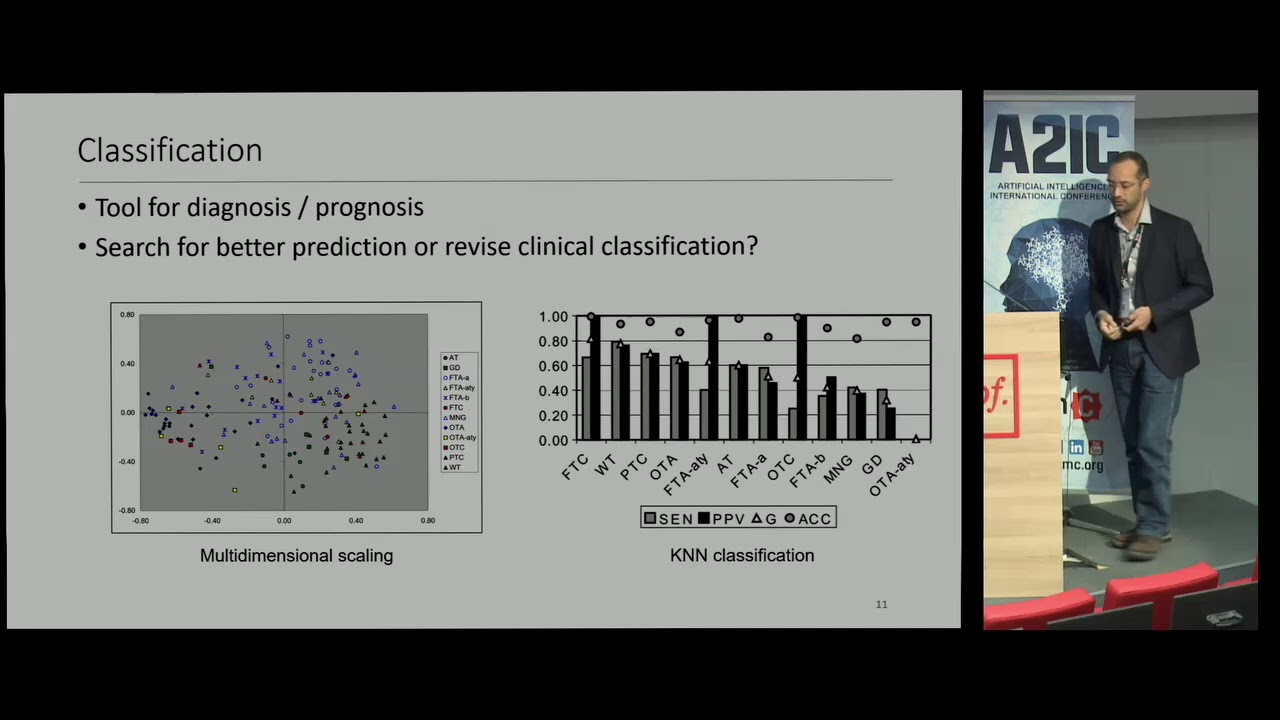
- Example: classifying tumor types using gene expression data
- Discussion on high-throughput data and challenges
- Predicting protein phosphorylation sites with domain knowledge
- Protein-protein interaction prediction and feature engineering
- Handling large-scale genomics data and assembly challenges
- Importance of experimental validation and data quality
- Conclusion: need for collaboration and domain expertise
Contribution & Novelties
The talk offers a practitioner’s perspective on the importance of domain knowledge in ML for biology, illustrated with concrete examples from the speaker’s research. It highlights the need for biological expertise in feature engineering and model interpretation, which is often overlooked in generic ML discussions.
Pour aller plus loin :
- Machine learning in bioinformatics — Overview of ML applications in biology.
- Protein phosphorylation — Background on the biological process discussed.
- Gene expression profiling — Context for the tumor classification example.
80 words
Radar Profile
The radar profile shows balanced scores across information quantity, quality, technical level, and reliability, indicating a well-rounded but not exceptional presentation. The talk is informative and technically sound, but lacks deep rigor and citations, resulting in moderate scores.