The potential of building integrated photovoltaics in Jaffna, Sri Lanka
Keywords
Summary
172 words
Critical Evaluation
Value of the Information & Strength of the Argument
The presentation provides valuable quantitative data on solar potential and economic feasibility of BIPV in a specific tropical urban context. The argumentation is structured logically: it establishes the need for renewable energy, explains the benefits of BIPV, describes the methodology, and presents results with clear implications. The use of Radiance, a validated simulation tool, adds credibility. However, the argumentation could be strengthened by discussing potential barriers to implementation, such as policy support, grid integration, and social acceptance. The economic analysis is simplified, assuming constant electricity prices and ignoring maintenance costs, which may affect the robustness of the conclusions.
Scientific Rigor, Source Quality, Title Accuracy
The study demonstrates scientific rigor by using a well-established simulation engine (Radiance) and following a systematic methodology. However, the sources cited are not explicitly listed in the presentation, and the reliance on Google Earth for building footprints introduces potential inaccuracies. The title accurately reflects the content, focusing on the potential of BIPV in Jaffna. The presentation is part of an international conference, suggesting some level of peer review, but the lack of detailed references limits the ability to verify claims. The limitations are acknowledged, which is a positive aspect of scientific transparency.
205 words
Title / Content Match
The title accurately reflects the content, which focuses on the potential of BIPV in Jaffna.
Quality & Reliability
6/10
The study uses a validated simulation engine (Radiance) and provides quantitative results, but lacks peer review and has limitations in data accuracy (Google Earth mapping, shading).
Key Moments
Markers derived by PSI from the transcript: the creator did not define chapters.
- Introduction and presenter introduction
- Overview of presentation structure
- Reasons for BIPV: climate change, construction sector, urban expansion
- Benefits of BIPV: on-site production, no land footprint, durability, flexibility
- Existing studies on solar potential in built environment
- Background on Sri Lanka: energy situation, hydropower, imports
- Sri Lanka's green objectives and need for renewable energy
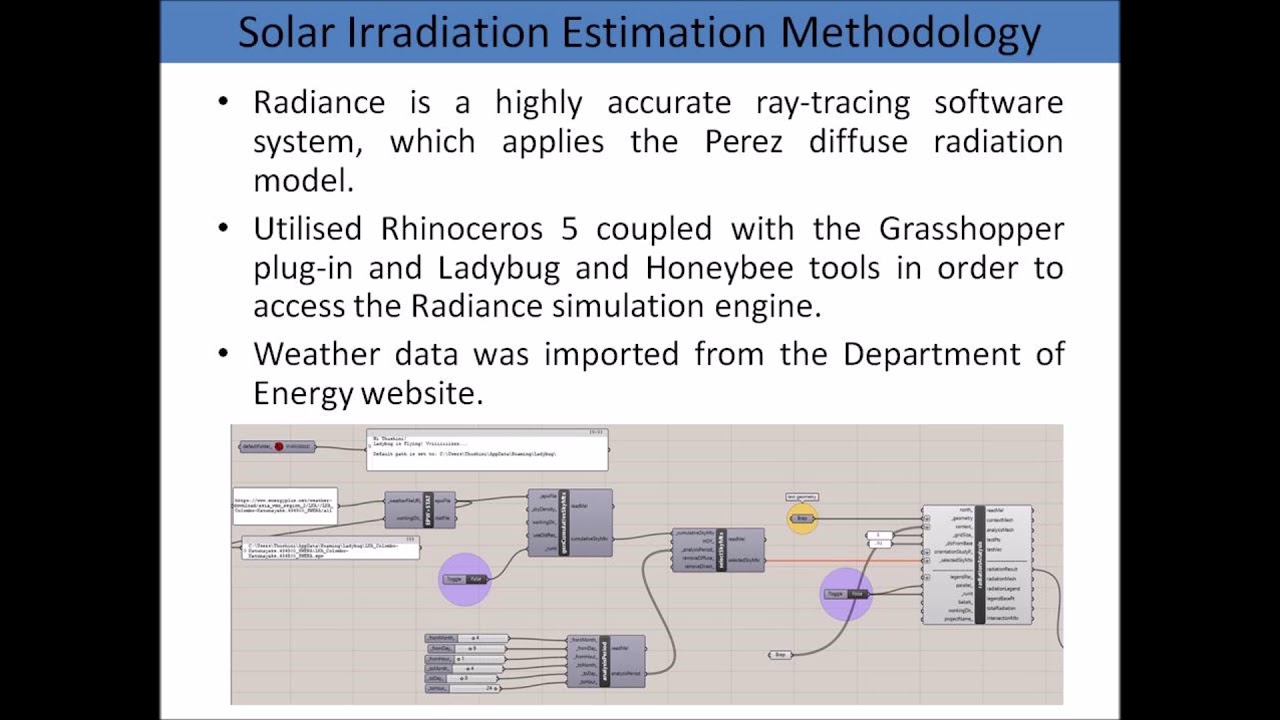
- Methodology: Radiance simulation, Google Earth, SketchUp, Grasshopper
- Results: solar radiation on roofs, electricity production, CO2 savings
- Economic analysis: payback period, profit by year 10
- Conclusion and limitations: mapping inaccuracies, shading from trees
Cited Sources
- Radiance simulation engine — Used for solar radiation estimation in the study.
- Ladybug and Honeybee tools — Plugins for Grasshopper used for environmental analysis.
Concurring Sources
- International Energy Agency - Sri Lanka — Provides context on Sri Lanka's energy mix and renewable energy targets.
Contribution & Novelties
The study provides a localized assessment of BIPV potential in Jaffna, Sri Lanka, using a validated simulation approach. It offers quantitative data on solar irradiation and economic feasibility, which can inform policy and urban planning. The research is among the few focusing on BIPV in Sri Lanka, contributing to the country’s renewable energy targets.
Pour aller plus loin :
- Building-integrated photovoltaics — Overview of BIPV technologies and applications.
- Radiance lighting simulation — Official site of the Radiance simulation engine.
- Sri Lanka energy profile — IEA country profile with energy statistics and policies.
92 words
Radar Profile
The radar profile shows a balanced distribution across scores, with slightly higher scores in quantity of information and technical level, indicating a well-structured presentation with solid technical content. However, the lower scores in quality and reliability suggest limitations in data accuracy and source transparency.