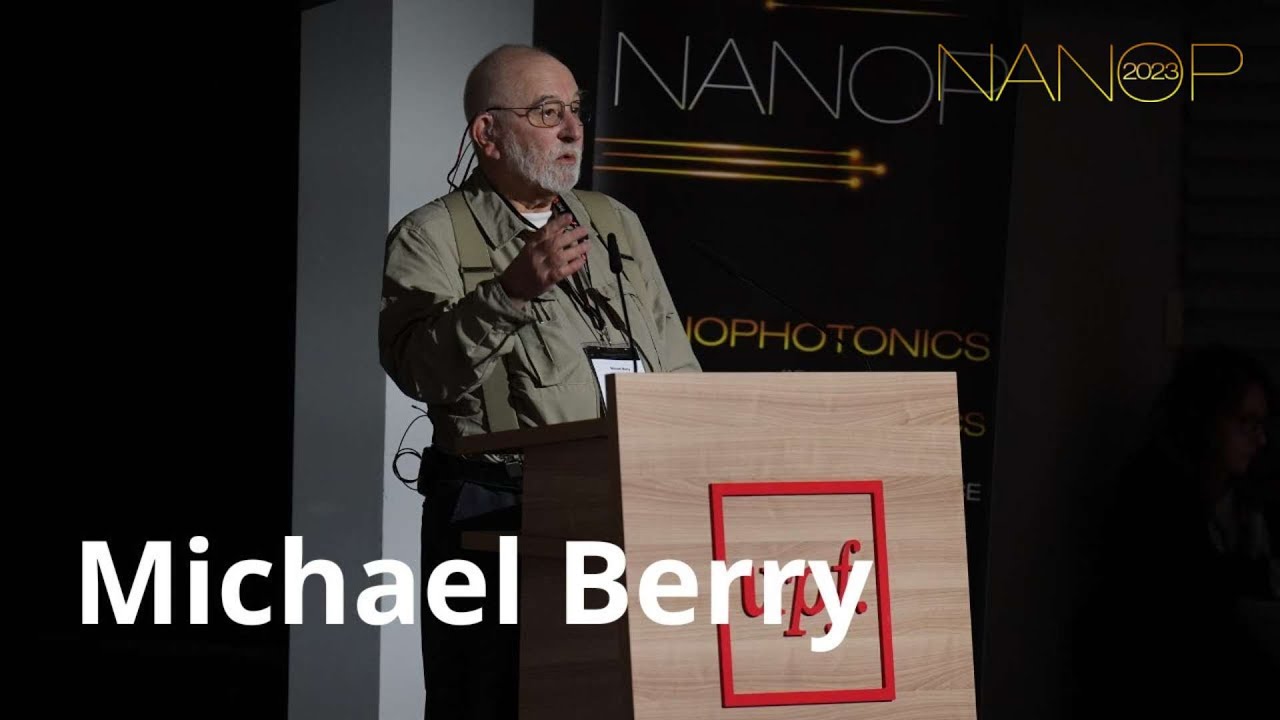
Wave trajectories, quantum potential, superoscillations: de Broglie, Madelung, Bohm, Newton
Keywords
Summary
182 words
Critical Evaluation
Value of the Information & Strength of the Argument
The talk provides valuable insights by connecting historical ideas with modern concepts, offering a unified perspective on wave phenomena. Berry’s argumentation is solid, grounded in mathematical derivations and physical reasoning. He clearly explains the significance of Madelung trajectories and the quantum potential, and demonstrates their utility in understanding interference and superoscillations. The historical narrative, especially Newton’s anticipation, adds depth and illustrates the continuity of scientific ideas. Berry also addresses potential objections, such as the singular limit of geometrical optics, and provides quantitative examples (e.g., probability of superoscillations). The presentation is rigorous and thought-provoking, though some speculative aspects (e.g., quantum vacuum effects) are acknowledged as such.
Scientific Rigor, Source Quality, Title Accuracy
The scientific rigor is high, as expected from a leading expert. Berry references key historical and modern works, including de Broglie, Madelung, Bohm, and his own contributions. He correctly attributes ideas and notes where interpretations differ (e.g., Whig history). The sources are not explicitly cited with URLs, but the talk is based on established literature. The title accurately reflects the content, covering all major topics. The talk is well-structured, with clear explanations and visual aids. The only minor issue is that some references are mentioned without full citations, but this is typical for a conference presentation.
216 words
Title / Content Match
The title accurately reflects the content, which covers wave trajectories, quantum potential, and superoscillations in the context of historical contributions.
Quality & Reliability
9/10
Presentation by a leading physicist (Michael Berry) at a scientific conference, based on established theoretical work and historical analysis. High reliability, though some speculative elements (e.g., quantum vacuum effects) are clearly identified as such.
Key Moments
Markers derived by PSI from the transcript: the creator did not define chapters.
- Introduction to Madelung trajectories and the quantum potential.
- Example of two plane waves: interference and non-crossing of trajectories.
- Phase singularities as vortices and their role in wave phenomena.
- Historical anticipation: Newton's speculation on ray bending near edges.
- Connection between quantum potential and superoscillations.
- Generalized superoscillations in non-bandlimited waves, example of Airy beams.
- Statistics of superoscillations in random waves.
- Paraxial waves: trajectories spiral instead of closing.
- Quantum vacuum effects near vortices and superkicks in radiation pressure.
- Conclusion: ubiquity of phase singularities and interconnectedness of physics.
Cited Sources
- de Broglie's 1923 papers on matter waves — Mentioned as the centenary inspiration for the talk.
- Madelung's 1926 paper on quantum hydrodynamics — Introduced the trajectories and quantum potential.
- Bohm's 1952 papers on hidden variables — Rediscovered Madelung's work.
- Whewell's 1833 work on tidal singularities — First known phase singularities.
- Sommerfeld's exact solution for edge diffraction — Used to confirm Newton's speculation.
- Braunbek and Lieneweg's 1952 paper on ray trajectories — Plotted Madelung trajectories in edge diffraction.
- Berry and Dennis's work on superoscillations — Showed that a third of random wave patterns are superoscillatory.
- Berry and Shukla's recent work on generalized superoscillations — Extended superoscillations to non-bandlimited waves.
- Berry and Barnett's work on superkicks — Discussed momentum kicks near vortices.
Concurring Sources
- Madelung, E. (1926). Quantentheorie in hydrodynamischer Form — Original paper introducing the trajectories and quantum potential.
- Bohm, D. (1952). A Suggested Interpretation of the Quantum Theory in Terms of "Hidden" Variables — Rediscovered and extended Madelung's ideas.
- Berry, M. V. (2009). Quantum backflow, negative kinetic energy, and optical retro-propagation — Discusses related phenomena.
Dissenting Sources
- Criticism of Whig history in physics — Berry acknowledges that historians may object to interpreting Newton's work as anticipating modern concepts, but he defends the value of such connections.
Contribution & Novelties
The talk provides a comprehensive overview of wave trajectories and their connections to quantum potential and superoscillations, with historical insights. It emphasizes the relevance of Madelung’s work and Newton’s anticipation, offering a fresh perspective on familiar concepts. The generalization of superoscillations to non-bandlimited waves is a notable contribution.
Pour aller plus loin :
- Madelung equations — Foundational equations for quantum hydrodynamics.
- Quantum potential — Concept central to Bohmian mechanics.
- Superoscillation — Phenomenon where bandlimited functions oscillate faster than their fastest Fourier component.
- Phase singularity — Also known as optical vortex, a zero of intensity with phase circulation.
- Bohmian mechanics — Interpretation of quantum mechanics using trajectories.
106 words
Radar Profile
The radar profile shows high scores across all dimensions, with particularly strong quality of information and reliability. The talk is technically advanced but accessible, and the quantity of information is substantial, covering multiple interconnected topics.
💬 No comments were provided for analysis.