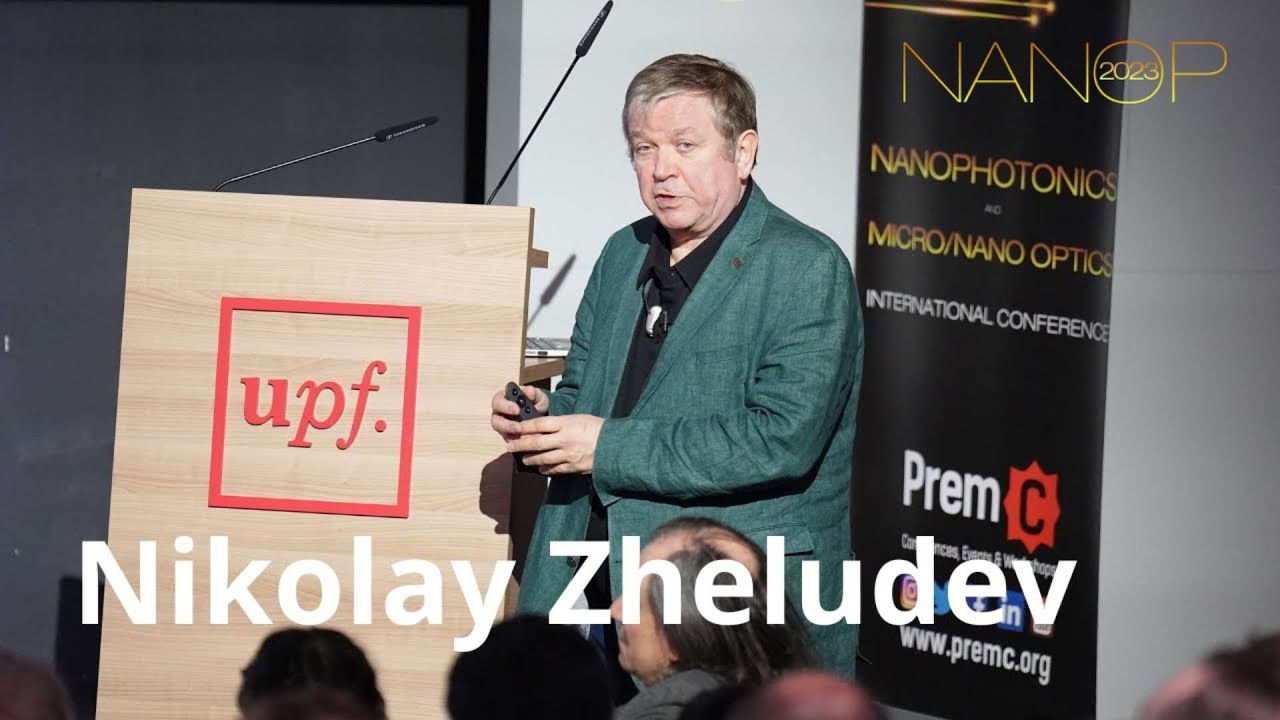
Optical Topological Metrology with Sub-atomic Resolution
Keywords
Summary
171 words
Critical Evaluation
Value of the Information & Strength of the Argument
The talk presents a compelling case for a new paradigm in optical metrology, combining superoscillatory light and deep learning. The argumentation is strong, built on a logical progression from fundamental concepts to experimental demonstrations. The speaker provides mathematical justifications and cites key papers, including work by Michael Berry. The value of the information is high, as it offers a practical route to sub-atomic resolution with visible light, which could have significant implications for nanotechnology and biology. The speaker also addresses potential limitations, such as noise and drift, and proposes solutions.
Scientific Rigor, Source Quality, Title Accuracy
The scientific rigor is high, with the speaker referencing his own published work and that of others, including Michael Berry’s seminal paper on superoscillations. The sources are credible and relevant. The title accurately reflects the content, which focuses on optical metrology using topological features to achieve sub-atomic resolution. The talk is well-structured and the claims are supported by experimental data, though some results are computational or preliminary.
172 words
Title / Content Match
The title accurately reflects the content, focusing on optical metrology using topological features to achieve sub-atomic resolution.
Quality & Reliability
8/10
Presentation by a leading expert in nanophotonics, with peer-reviewed publications and experimental demonstrations. Claims are supported by mathematical derivations and experimental data, though some results are computational or preliminary.
Key Moments
Markers derived by PSI from the transcript: the creator did not define chapters.
- Introduction of speaker by host
- Introduction to optical resolution and diffraction limit
- Superoscillations and their role in sub-wavelength focusing
- Using superoscillatory light for microscopy
- Deep learning for object recognition from diffraction patterns
- Experimental demonstration on nanoscale slits
- Imaging with super-pixels and confocal scanning
- Topological features: phase singularities and energy backflow
- Optical ruler using topological markers
- Metrology of nanoscale objects with structured light
- In-situ training and drift compensation
- High-speed metrology with millions of measurements per second
- Observing ballistic Brownian motion
- Conclusion and future directions
Cited Sources
- Superoscillations and the diffraction limit — Referenced as the basis for superoscillatory imaging
- Optical superoscillations: sub-wavelength light focusing and super-resolution imaging — Referenced for the concept of superoscillations
- Deep learning for nanophotonics — Referenced for the use of neural networks in nanophotonics
Concurring Sources
- Superoscillations and the diffraction limit — Supports the existence and properties of superoscillations.
- Optical superoscillations: sub-wavelength light focusing and super-resolution imaging — Reviews superoscillatory phenomena and their applications.
Dissenting Sources
- Superoscillations: a critical review — Raises questions about the practical limitations of superoscillations, such as energy efficiency and noise.
Contribution & Novelties
The talk presents a novel combination of superoscillatory light and deep learning for metrology, achieving sub-atomic resolution with visible light. This approach is original and could lead to new tools for nanoscale measurement and imaging. The speaker also demonstrates the importance of in-situ training to overcome drift, which is a practical challenge in high-precision measurements.
Pour aller plus loin :
- Superoscillation — Wikipedia article on the mathematical concept.
- Phase singularity — Wikipedia article on optical vortices, related to phase singularities.
- Deep learning in microscopy — Nature Methods review on deep learning in microscopy.
93 words
Radar Profile
The radar profile shows high scores in all dimensions, indicating a technically deep and reliable presentation. The lowest score is in quantity of information, but it is still high, reflecting the focused scope of the talk.