Unsaturated Maingroup Species: Beyond the Carbon Copy
Keywords
Summary
178 words
Critical Evaluation
Value of the Information & Strength of the Argument
The lecture provides valuable insights into the synthesis and reactivity of unsaturated main group species, particularly silicon. The argumentation is solid, based on experimental results and theoretical explanations. The speaker effectively demonstrates how silicon chemistry diverges from carbon chemistry, using both experimental observations and simple theoretical rationales. The value lies in the presentation of novel compounds and their potential applications, supported by clear evidence and references to prior work.
Scientific Rigor, Source Quality, Title Accuracy
The scientific rigor is high, as the speaker is a recognized expert and the work is published in peer-reviewed journals. The sources cited include landmark studies by West, Ziegler, and others, and the presentation includes references to specific publications. The title accurately reflects the content, focusing on unsaturated main group species and their differences from carbon analogues. The lecture is well-structured and provides a comprehensive overview of the field.
153 words
Title / Content Match
The title accurately reflects the content, focusing on unsaturated main group species and their divergence from carbon analogues.
Quality & Reliability
8/10
Presentation by a leading expert in main group chemistry, based on peer-reviewed research, with clear experimental evidence and references to known literature.
Key Moments
Markers derived by PSI from the transcript: the creator did not define chapters.
- Introduction to the lecture and acknowledgment of collaborators.
- Historical context: parallels between phosphorus and carbon chemistry.
- Synthesis and reactivity of disilenes (Si=Si double bonds).
- Reaction of cyclotrisilane with NHCs and equilibrium behavior.
- Differences between silicon and carbon: bond strength and hybridization.
- Synthesis of unsaturated silicon clusters and their functionalization.
- Potential applications in silicon nanoparticles and concluding remarks.
Cited Sources
- West, R., Fink, M. J., & Michl, J. (1981). Tetramesityldisilene, a stable compound containing a silicon-silicon double bond. — Landmark synthesis of the first stable disilene.
- Scheschkewitz, D. et al. (2004). A stable silicon analogue of a cyclopropenylidene. — Synthesis of a cyclotrisilene, a three-membered ring with a Si=Si bond.
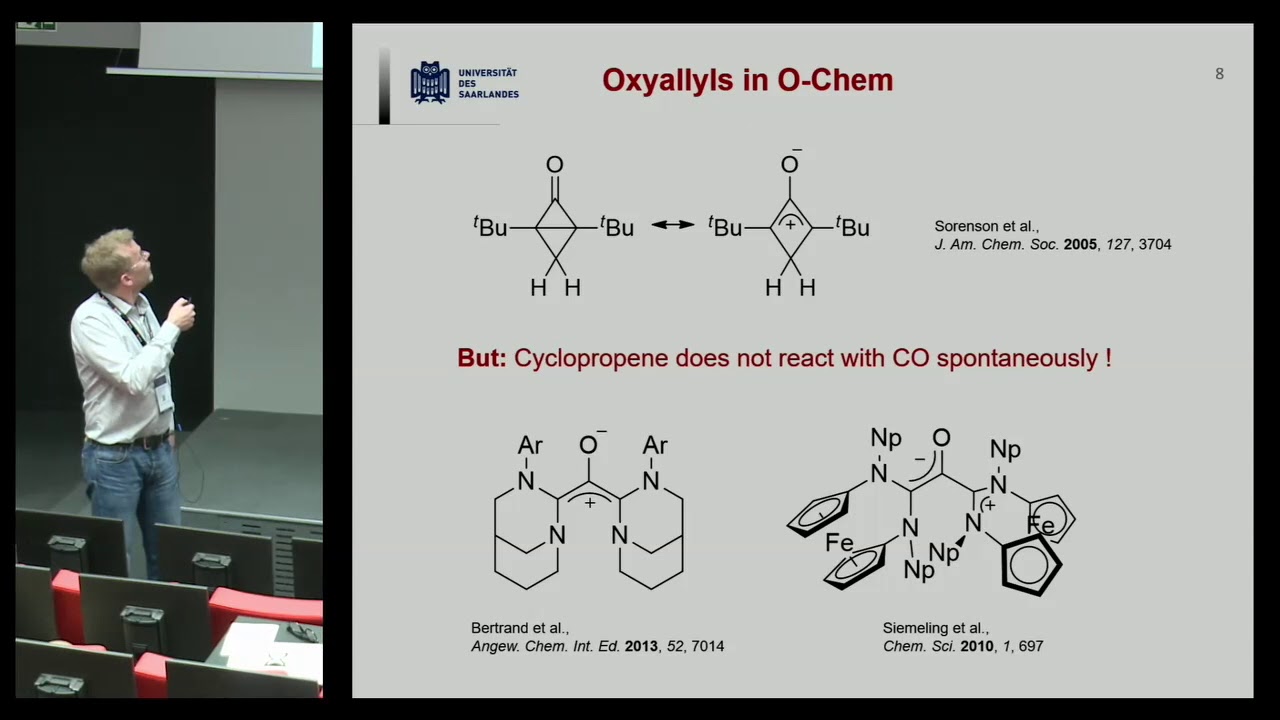
- Scheschkewitz, D. et al. (2010). Reactivity of a cyclotrisilene towards carbon monoxide. — CO activation by a Si=Si bond.
Concurring Sources
- West, R., Fink, M. J., & Michl, J. (1981). Tetramesityldisilene, a stable compound containing a silicon-silicon double bond. — Supports the existence and stability of disilenes.
- Scheschkewitz, D. et al. (2004). A stable silicon analogue of a cyclopropenylidene. — Supports the synthesis of cyclotrisilenes.
Contribution & Novelties
The lecture presents novel unsaturated silicon compounds, including Si6R6 clusters that are global minima on the potential energy surface, and demonstrates their functionalization. This goes beyond simply mimicking carbon chemistry, highlighting unique properties of silicon. The concept of ’living nanoparticle synthesis’ is introduced as a future direction.
Pour aller plus loin :
- Disilenes: The Silicon Analogues of Alkenes — Background on Si=Si double bonds.
- Silicon cluster chemistry — Overview of silicon clusters.
- Main group chemistry — General context of main group elements.
82 words
Radar Profile
The radar profile shows high scores across all dimensions, indicating a well-balanced and reliable scientific presentation. The high technical level and information quality are consistent with an expert lecture.