Human Authentication Using Facial Cues
Keywords
Summary
186 words
Critical Evaluation
Value of the Information & Strength of the Argument
The talk provides a comprehensive overview of the state of the art in periocular biometrics, highlighting its potential as a complementary or alternative modality to face and iris recognition. The speaker supports his arguments with experimental results from his own research and references to existing literature. He effectively demonstrates the advantages of the periocular region, such as its availability at various distances and its tolerance to occlusion. The argumentation is solid, though the presentation is more of a survey than a deep dive into any single study. The speaker also addresses practical challenges like cross-sensor performance degradation, which is a valuable contribution to the field.
Scientific Rigor, Source Quality, Title Accuracy
The speaker is an established researcher in the field, and the content is based on published research, as indicated by references to journal articles and book chapters. The talk is well-structured and the title accurately reflects the content. However, as a conference presentation, it lacks the rigor of a peer-reviewed paper, and some claims are presented without detailed evidence. The speaker mentions that the content is available in two published articles, which adds credibility. The title is appropriate and not misleading.
201 words
Title / Content Match
The title accurately reflects the content, which focuses on facial cues for authentication, particularly the periocular region.
Quality & Reliability
7/10
The talk is given by an academic expert in biometrics, presenting research findings and referencing published work. However, it is a conference presentation with limited depth and no formal peer review in this format.
Key Moments
Markers derived by PSI from the transcript: the creator did not define chapters.
- Introduction and speaker introduction
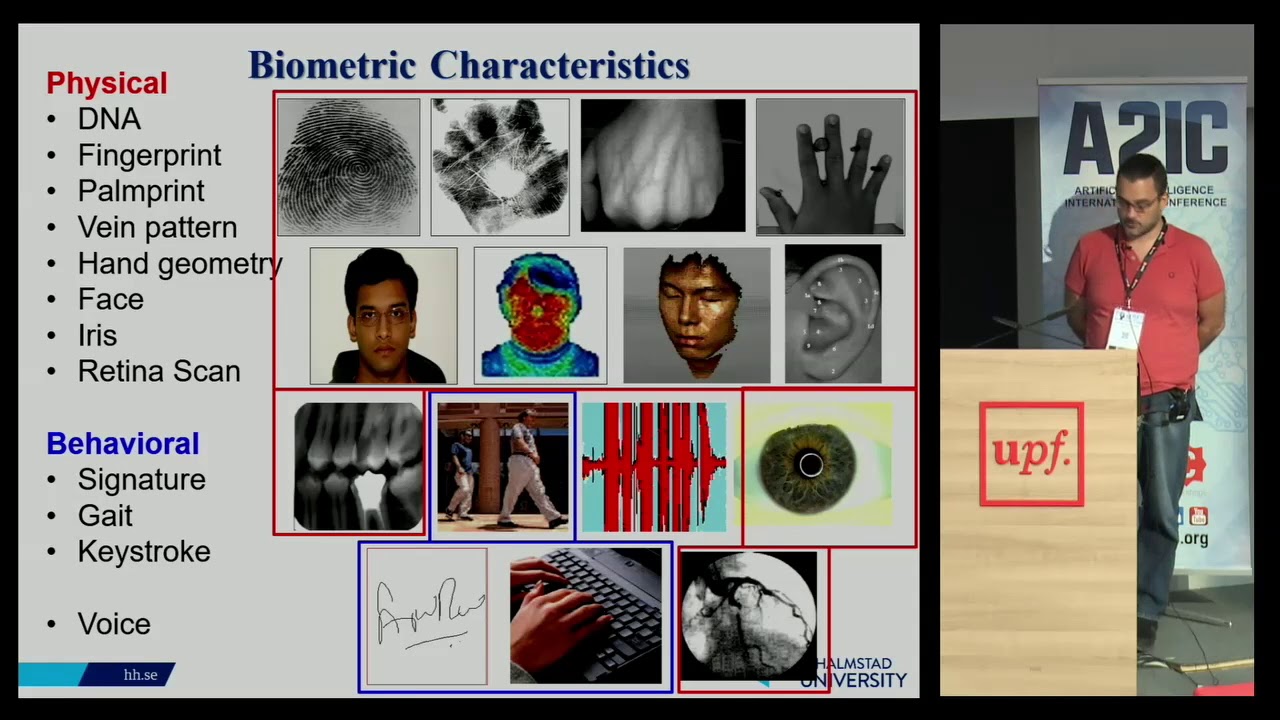
- Overview of biometrics and human-aware systems
- Traditional identity tokens and their limitations
- Introduction to biometric systems and error types
- Why face and periocular region are useful
- Feature extraction for periocular recognition
- Comparison of periocular and iris recognition
- Expression estimation from periocular region
- Cross-sensor recognition challenges
- Soft biometrics and conclusion
Cited Sources
- Periocular biometrics: a survey — Mentioned as a published article containing the content of the presentation.
- Book chapter on periocular biometrics — Mentioned as a published book chapter containing the content of the presentation.
Concurring Sources
- Periocular biometrics: a survey — The speaker's own publication, which supports the content.
Contribution & Novelties
The talk provides an overview of the speaker’s research on periocular biometrics, highlighting its potential as a robust biometric modality. It contributes to the field by summarizing recent advances and presenting new results on expression estimation and cross-sensor recognition. The speaker also discusses the integration of soft biometrics to improve recognition accuracy.
Pour aller plus loin :
- Periocular biometrics — Overview of the modality.
- Biometrics — General introduction to biometric recognition.
- Face recognition — Related technology.
76 words
Radar Profile
The radar profile shows a balanced performance across all dimensions, with slightly higher scores in information quantity and quality, indicating a well-rounded presentation. The technical level is moderate, making it accessible to a broad audience while still providing depth.