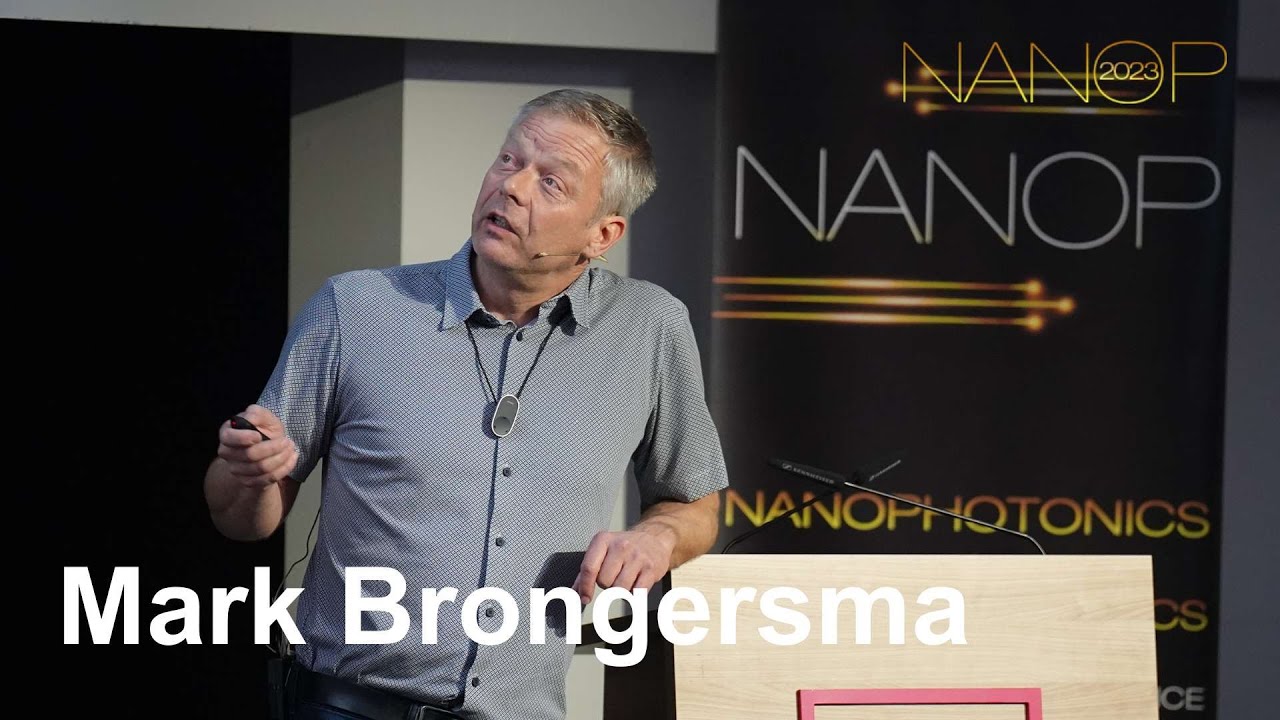
Flat Optics for Dynamic Wavefront Manipulation
Keywords
Summary
156 words
Critical Evaluation
Value of the Information & Strength of the Argument
The talk provides valuable insights into the emerging field of flat optics using 2D materials. Brongersma presents a clear argument for the use of exciton resonances in TMDs as a tunable alternative to geometric resonances. He supports his claims with experimental results, including the demonstration of electrically tunable zone plate lenses and the observation of strong modulation of reflectance. The argumentation is solid, though it relies on the speaker’s own research and selected examples, which may not fully represent the broader field. The talk also highlights important challenges, such as low diffraction efficiency and the need for improved material quality, providing a balanced perspective.
Scientific Rigor, Source Quality, Title Accuracy
The talk is scientifically rigorous, with references to published work from his group and others, including studies on strain engineering and plasmonic coupling. The sources cited are credible, though the talk does not provide a comprehensive literature review. The title accurately reflects the content, focusing on dynamic wavefront manipulation using flat optics. The talk is well-structured and the technical depth is appropriate for an expert audience.
185 words
Title / Content Match
The title accurately reflects the content, which focuses on using flat optics (metasurfaces) for dynamic wavefront manipulation.
Quality & Reliability
8/10
The speaker is a leading expert in nanophotonics, and the talk presents original research results from his group, with references to published work. However, as a plenary talk, it lacks detailed methodological descriptions and peer-review context.
Key Moments
Markers derived by PSI from the transcript: the creator did not define chapters.
- Introduction to nanophotonics and the need for dynamic wavefront manipulation.
- Overview of 2D materials and their potential for tunable optical resonances.
- Discussion of exciton resonances and their advantages over plasmonic and Mie resonances.
- Presentation of strain engineering to improve exciton linewidths.
- Demonstration of a zone plate lens made from WS2 and its electrical gating.
- Analysis of reflectance line shapes and the importance of substrate interference.
- Introduction of a quantum model to extract decay rates.
- Proposal to use plasmonic gratings to enhance exciton-plasmon coupling and recover coherence.
Cited Sources
- Nanophotonics and Micro/Nano Optics International Conference 2023 — This video is the plenary talk delivered by Prof. Mark Brongersma at the conference.
Concurring Sources
- Metasurfaces for flat optics — Provides general background on metasurfaces, which are the basis of flat optics.
- Exciton resonance in 2D materials — Explains exciton physics relevant to the talk.
Contribution & Novelties
The talk presents original research on using 2D materials for dynamic flat optics, particularly the demonstration of electrically tunable zone plate lenses and the use of strain to improve exciton linewidths. It also introduces a quantum model to understand the optical response of these materials. The talk provides a new perspective on overcoming the limitations of non-radiative decay and dephasing at room temperature.
Pour aller plus loin :
- Metasurface — Background on metasurfaces and their applications.
- Exciton — Overview of excitons in semiconductors.
- Transition metal dichalcogenide monolayers — Properties and applications of TMDs.
- Plasmonics — Introduction to plasmonics and surface plasmons.
101 words
Radar Profile
The radar profile shows high scores in all dimensions, indicating a well-rounded and reliable presentation. The talk is technically deep, provides substantial information, and is based on credible research. The only slight weakness is the lack of detailed methodological descriptions, but this is typical for a plenary talk.
💬 No comments were provided for analysis.