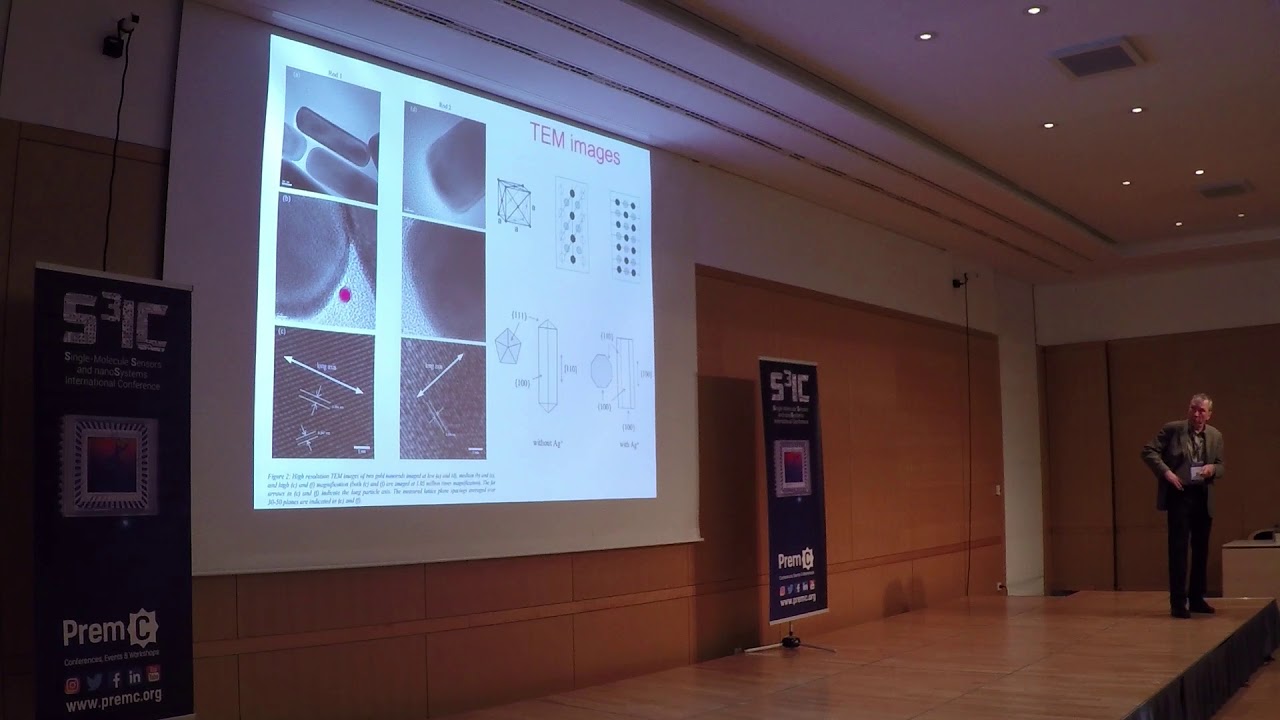
Fluorescence Excitation and Heating by Single Gold Nanoparticles
Keywords
Summary
144 words
Critical Evaluation
Value of the Information & Strength of the Argument
The talk provides valuable insights into the capabilities and limitations of gold nanoparticles for single-molecule fluorescence and sensing. Orrit’s argumentation is solid, grounded in experimental results from his group, and he clearly explains the physical principles behind each phenomenon. He also addresses practical challenges, such as the difficulty of achieving two-photon enhancement with molecules, and offers potential solutions. The presentation is well-structured, moving from basic properties to applications, and includes a live demonstration of methylene blue redox chemistry, which effectively illustrates the concept.
Scientific Rigor, Source Quality, Title Accuracy
The scientific rigor is high, as Orrit is a renowned expert and the work is based on peer-reviewed publications. He references specific experiments and collaborators, lending credibility. The title accurately reflects the content, focusing on fluorescence excitation and heating, though the talk also covers sensing and two-photon excitation. The sources cited are primarily his own group’s work, which is appropriate for a research overview. No external sources are mentioned, but the description provides context for the conference.
175 words
Title / Content Match
The title accurately reflects the main topics: fluorescence excitation and heating effects of single gold nanoparticles, though the talk covers a broader range of plasmonic applications.
Quality & Reliability
8/10
The talk is delivered by a leading expert in single-molecule spectroscopy, based on peer-reviewed research from his group. The content is technically accurate and well-supported by published work, though presented as a conference overview rather than a formal review.
Key Moments
Markers derived by PSI from the transcript: the creator did not define chapters.
- Introduction to gold nanorods and their plasmonic properties.
- Discussion of photoluminescence from gold nanorods and its similarity to scattering.
- Explanation of anti-Stokes luminescence for temperature sensing.
- Single-molecule sensing using plasmon shifts upon molecular binding.
- Live demonstration of methylene blue redox reaction.
- Single-molecule redox switching of methylene blue enhanced by gold nanorods.
- Introduction to two-photon excitation and its potential for high enhancement.
- Experiment with quantum dots to demonstrate two-photon excitation enhancement.
Cited Sources
- Single-Molecule Sensors and NanoSystems International Conference — This plenary speech was delivered at the conference in Munich, 2019.
Concurring Sources
- Gold nanorods: Synthesis, characterization and applications — General review on gold nanorods, supporting the properties discussed.
Contribution & Novelties
The talk provides a comprehensive overview of recent advances in using single gold nanoparticles for fluorescence enhancement and heating, with a focus on single-molecule sensitivity. It highlights novel approaches such as anti-Stokes luminescence for temperature sensing and two-photon excitation enhancement. The live demonstration of methylene blue redox chemistry adds a practical element.
Pour aller plus loin :
- Plasmonic nanoparticles — Overview of plasmonic properties and applications.
- Surface-enhanced Raman scattering — Related technique that benefits from similar enhancement mechanisms.
- Photothermal therapy — Application of heating nanoparticles for cancer treatment.
88 words
Radar Profile
The radar profile shows high scores across all dimensions, indicating a technically rich and reliable presentation. The balance between information quantity, quality, and technical depth is strong, with a slight emphasis on technical level, reflecting the expert audience.
💬 Sur les 0 commentaires analysés, aucune tendance n'est disponible.