IQIS Lecture 8.15 — Fault-tolerant computation and threshold theorems
Keywords
Summary
186 words
Critical Evaluation
Value of the Information & Strength of the Argument
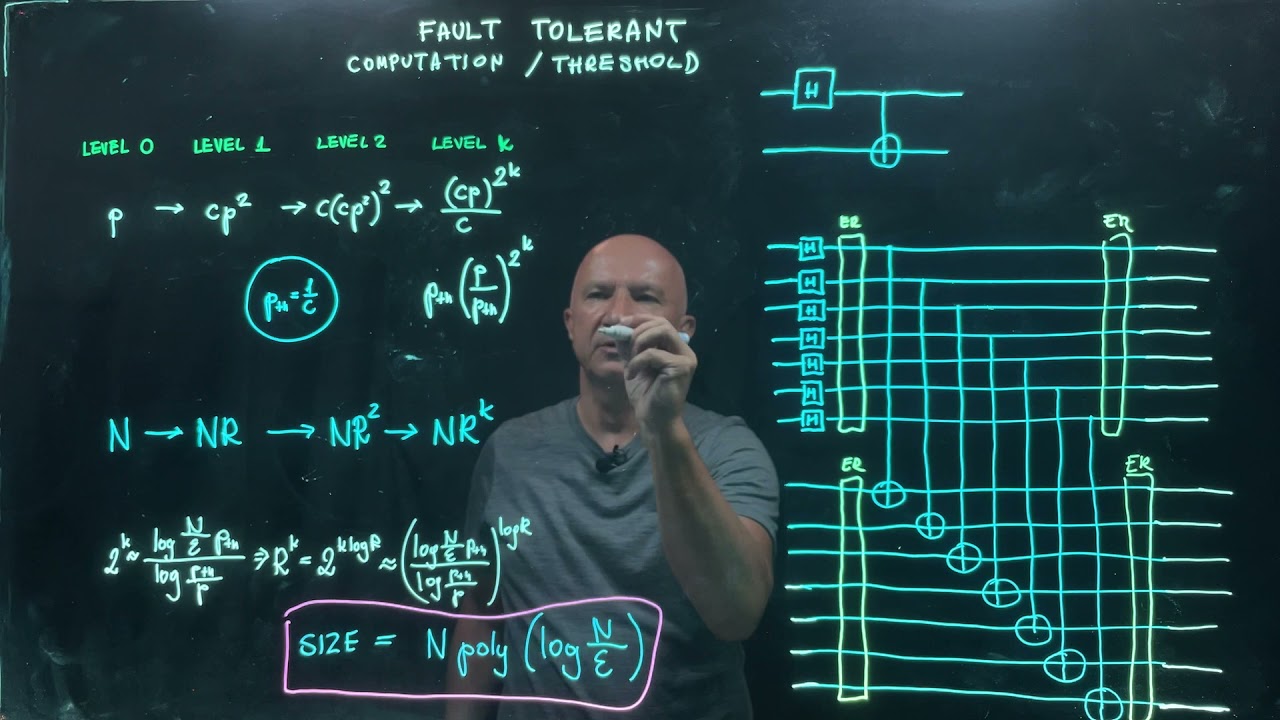
The lecture provides a clear and rigorous explanation of the threshold theorem, a cornerstone of fault-tolerant quantum computation. The argumentation is logically structured, starting from the problem of faulty components, then presenting the solution via error correction and concatenation, and culminating in the derivation of the threshold theorem. The mathematical derivations are presented in a step-by-step manner, making the reasoning accessible. The value of the information is high, as it covers both fundamental concepts and practical implications, including the overhead cost and the challenges with non-Clifford gates. The lecturer also provides intuition behind the results, such as the role of the constant C and the threshold probability. Overall, the content is scientifically sound and well-argued.
Scientific Rigor, Source Quality, Title Accuracy
The lecture demonstrates high scientific rigor, with precise definitions and logical deductions. However, it does not explicitly cite external sources, relying instead on established knowledge in the field. The title accurately reflects the content, which focuses on fault-tolerant computation and threshold theorems. The lecture is part of a series on quantum information science, and the lecturer is a recognized expert, adding to its credibility. The content is presented in a clear and organized manner, with no apparent errors or misleading statements. The lack of explicit citations is a minor weakness, but the material is standard and well-known in the quantum computing community.
232 words
Title / Content Match
The title accurately reflects the content, which focuses on fault-tolerant quantum computation and threshold theorems.
Quality & Reliability
9/10
Lecture by a renowned quantum physicist, presenting established theoretical results (threshold theorem) with clear logical structure and mathematical derivations. The content is accurate and well-explained, though it lacks explicit citations to external sources.
Key Moments
Markers derived by PSI from the transcript: the creator did not define chapters.
- Introduction to fault-tolerant quantum computation with faulty components.
- Idea of using quantum error-correcting codes and fault-tolerant design.
- Example with 7-qubit code and transversal gates.
- Explanation of error recovery units interspersed with gates.
- Introduction to code concatenation to reduce error probability.
- Derivation of effective error rate and threshold probability.
- Analysis of overhead cost and polylogarithmic scaling.
- Statement of the threshold theorem and its implications.
- Challenges with non-Clifford gates and magic states.
- Typical threshold values and concluding remarks.
Contribution & Novelties
This lecture provides a clear and concise explanation of the threshold theorem, a fundamental result in quantum computing. It stands out for its pedagogical approach, breaking down complex concepts into understandable steps. The lecturer’s emphasis on the practical implications, such as the overhead cost and the challenges with T-gates, adds depth. The lecture is part of a series, so it builds on previous material, but it is self-contained enough for a general audience with some background in quantum computing.
Pour aller plus loin :
- Quantum error correction — Overview of quantum error correction codes.
- Threshold theorem — Detailed explanation of the threshold theorem.
- Steane code — The 7-qubit code used in the example.
- Magic state distillation — Technique for implementing non-Clifford gates.
122 words
Radar Profile
The radar profile shows high scores across all dimensions, indicating a well-rounded and reliable lecture. The strong scores in information quantity and quality reflect the comprehensive coverage of the topic, while the high technical level and global reliability underscore the scientific rigor. The only slight weakness is the lack of explicit citations, but this does not detract significantly from the overall quality.