IQIS Lecture 1.3 — Ramsey interferometry
Keywords
Summary
166 words
Critical Evaluation
Value of the Information & Strength of the Argument
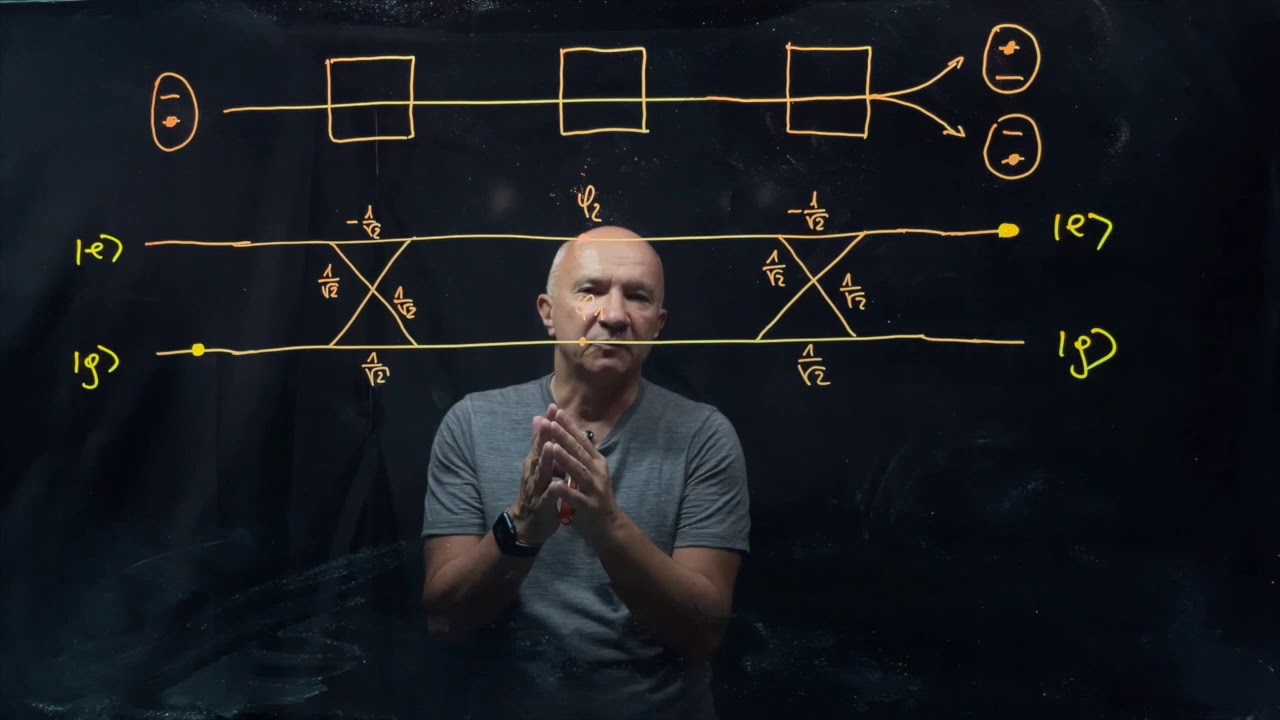
The lecture provides a clear and rigorous derivation of the probability amplitude for Ramsey interferometry, illustrating the principles of quantum interference. The argumentation is solid, with step-by-step calculations that are easy to follow. The value lies in its pedagogical clarity and the connection to quantum computing, as the setup is analogous to single-qubit operations. The explanation of the roles of the three cavities enhances understanding of how interference can be controlled.
Scientific Rigor, Source Quality, Title Accuracy
The scientific rigor is high, with a mathematically sound derivation and physically accurate descriptions. The lecture does not cite external sources, but the content is based on well-established quantum mechanics principles. The title accurately reflects the content. No comments were provided for analysis.
129 words
Title / Content Match
The title accurately reflects the content, which focuses on Ramsey interferometry as a fundamental example of quantum interference.
Quality & Reliability
9/10
The lecture is delivered by a renowned physicist (Artur Ekert), a pioneer in quantum cryptography and quantum information. The content is mathematically rigorous, with clear derivations and physical explanations. The presentation is well-structured and pedagogically effective, though it lacks explicit citations to external sources within the video.
Key Moments
Markers derived by PSI from the transcript: the creator did not define chapters.
- Introduction to Ramsey interferometry as an example of quantum interference.
- Description of the experimental setup with three cavities.
- Explanation of the resonant and dispersive interactions.
- Derivation of the probability amplitude for the two paths.
- Calculation of the probability and the interference term.
- Discussion of the roles of the three cavities and connection to quantum computing.
Cited Sources
- Quantum Information Book - Chapter 1 — Referenced in the video description as a supplementary resource for the topic of interferometers.
Concurring Sources
- Quantum Information Book - Chapter 1 — The linked resource likely covers similar material on interferometers and quantum interference.
Contribution & Novelties
The lecture provides a clear and accessible explanation of Ramsey interferometry, emphasizing its relevance to quantum information processing. It bridges fundamental quantum mechanics with practical applications in quantum computing.
Pour aller plus loin :
- Ramsey interferometry — Overview of the technique and its applications.
- Quantum superposition — Fundamental principle underlying the creation of superposition in the first cavity.
- Quantum phase estimation — Related concept where phase shifts are used in quantum algorithms.
72 words
Radar Profile
The radar profile shows high scores across all dimensions, indicating a well-balanced and reliable educational resource. The lecture excels in quality and reliability, with strong technical depth and adequate information quantity.