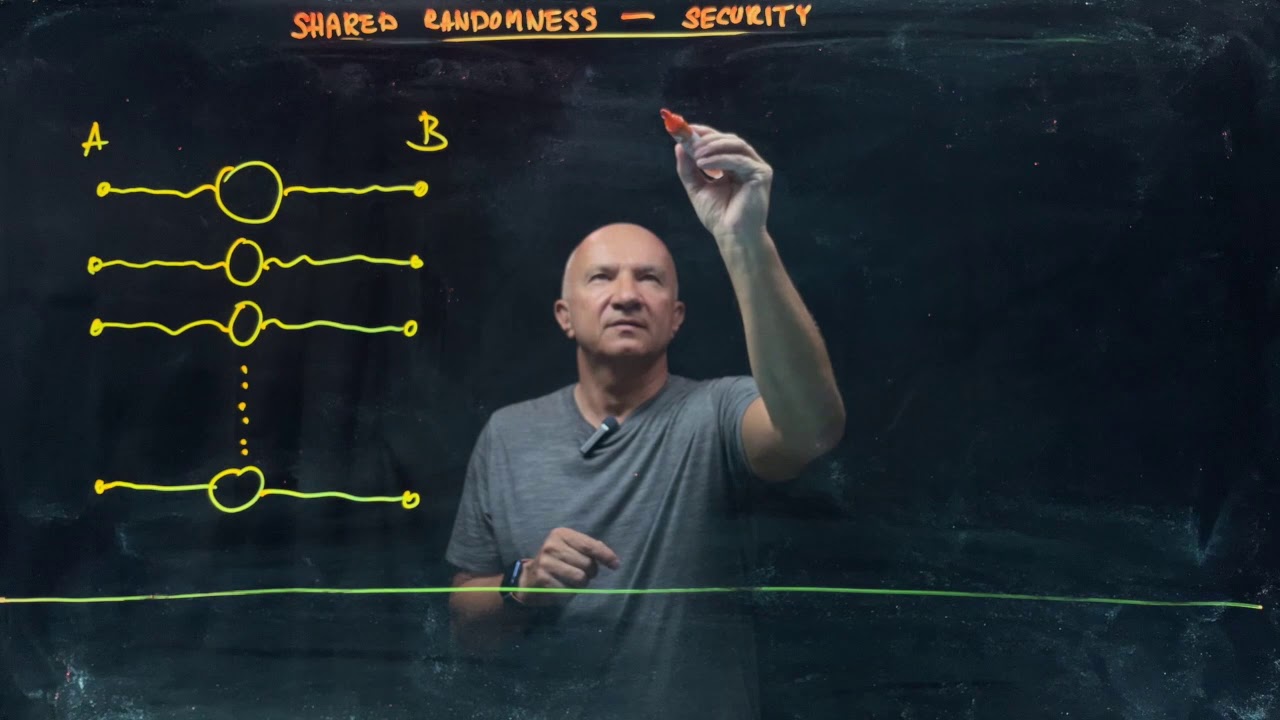
IQIS Lecture 5.5 — Security of shared randomness
Keywords
Summary
156 words
Critical Evaluation
Value of the Information & Strength of the Argument
The lecture provides valuable insights into the fundamental principles of quantum key distribution, particularly the role of entanglement and the necessity of testing for eavesdropping. The argumentation is rigorous, using mathematical formalism to illustrate the indistinguishability of certain preparations under Z measurements and the potential for distinguishing them with other measurements. The presentation is logical and builds on previous lectures, making it suitable for an audience with a background in quantum mechanics.
Scientific Rigor, Source Quality, Title Accuracy
The scientific rigor is high, as the lecture is based on well-established quantum mechanics principles. However, no external sources are cited, and the content is presented as a lecture without references. The title accurately describes the content, focusing on the security of shared randomness. The lecture is part of a series, so it assumes prior knowledge from earlier lectures.
146 words
Title / Content Match
The title accurately reflects the content: a lecture on the security of shared randomness in quantum key distribution.
Quality & Reliability
8/10
The lecture is given by a renowned physicist (Artur Ekert), a pioneer in quantum cryptography. The content is mathematically rigorous, presenting formal derivations of density matrices and measurement scenarios. The presentation is clear and logically structured, though it is a lecture without citations to external sources.
Key Moments
Markers derived by PSI from the transcript: the creator did not define chapters.
- Introduction to the topic: security of shared randomness in quantum key distribution.
- Introduction of the scenario: Alice and Bob communicate over a public channel, and Eve is an eavesdropper.
- Description of two extreme scenarios: genuine entangled source vs. Eve preparing qubits.
- Mathematical representation of the two scenarios using density matrices.
- Demonstration that Z measurements cannot distinguish between the two scenarios.
- Observation that the density operators are different, implying a test can distinguish them.
- Conclusion: the need for a good test to ensure security.
Contribution & Novelties
This lecture provides a clear pedagogical explanation of why simple Z-basis measurements are insufficient for secure quantum key distribution, and it sets the stage for more advanced tests such as Bell inequalities. The original contribution is the didactic presentation of the density matrix formalism to illustrate the indistinguishability of certain quantum states under specific measurements.
Pour aller plus loin :
- Quantum key distribution — Overview of QKD protocols and security.
- Bell’s theorem — Relevant to tests that can distinguish entangled states.
- Density matrix — Mathematical tool used in the lecture.
90 words
Radar Profile
The radar profile shows high scores in quality of information, technical level, and reliability, indicating a technically rigorous and reliable lecture. The quantity of information is moderate, as the lecture focuses on a specific aspect of QKD.