IQIS Lecture 3.8 — Entanglement, interference, and visibility
Keywords
Summary
140 words
Critical Evaluation
Value of the Information & Strength of the Argument
The lecture provides valuable insights into the fundamental trade-off between entanglement and interference, a key concept in quantum mechanics. The argumentation is rigorous and well-structured, starting with a concrete example and then generalizing to a broader framework. The mathematical derivations are clear and step-by-step, making the logic easy to follow. The use of a simple circuit to illustrate the concept is effective, and the extension to a controlled-U operation highlights the role of visibility in quantifying the loss of interference. The argument is compelling and well-supported by the calculations presented.
Scientific Rigor, Source Quality, Title Accuracy
The scientific rigor is high, as the lecture is based on well-established quantum mechanics principles and the derivations are mathematically sound. The quality of sources is excellent, given the author’s expertise and the academic nature of the content. The title accurately reflects the content, focusing on entanglement, interference, and visibility. The lecture is self-contained and does not rely on external sources, but the concepts are standard in quantum information science.
175 words
Title / Content Match
The title accurately reflects the content, which focuses on the trade-off between entanglement and interference, quantified by visibility.
Quality & Reliability
9/10
Lecture by a renowned quantum physicist, rigorous mathematical derivations, clear explanations, and no unsubstantiated claims.
Key Moments
Markers derived by PSI from the transcript: the creator did not define chapters.
- Introduction to the trade-off between entanglement and interference.
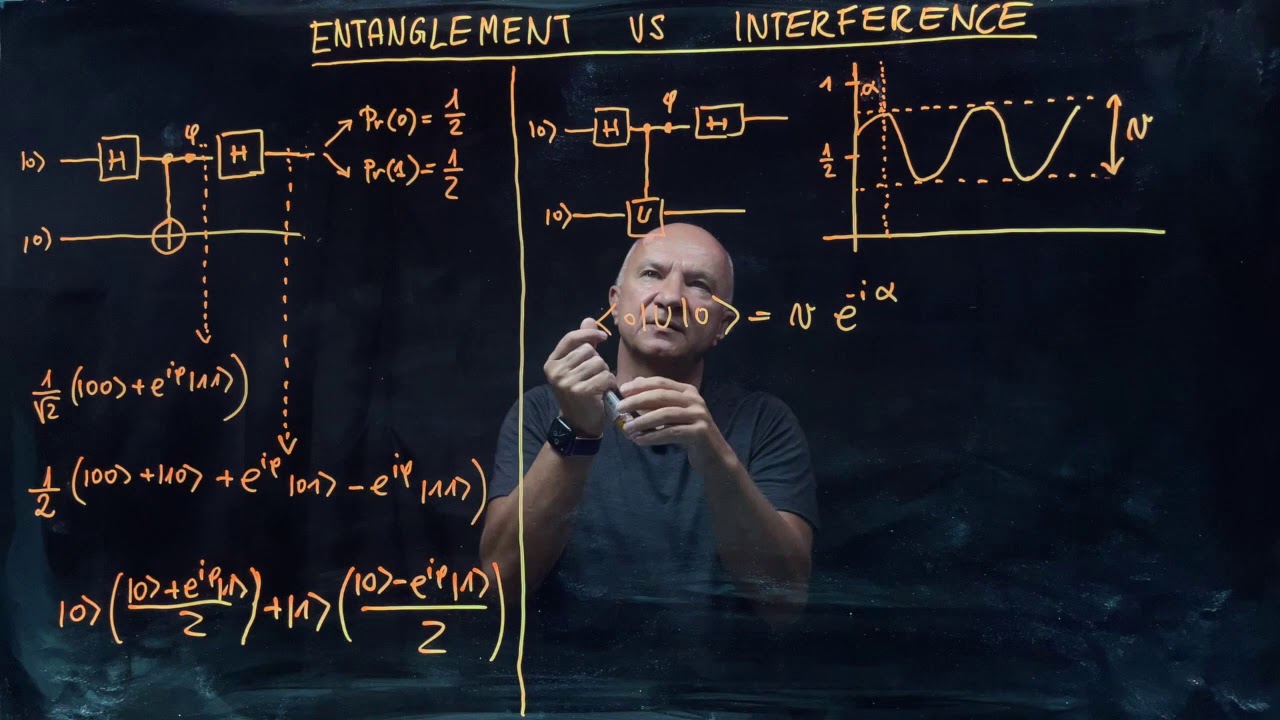
- Presentation of a two-qubit circuit with Hadamard, phase, and controlled-NOT gates.
- Derivation of the state after the first Hadamard and controlled-NOT, showing entanglement.
- Application of the second Hadamard and calculation of output probabilities, showing no interference.
- Interpretation of the controlled-NOT as a measurement that destroys interference.
- Generalization to a controlled-U operation and introduction of visibility and phase shift.
- Explanation of how visibility and phase shift modify the interference pattern.
- Connection to decoherence in quantum computers and the loss of computational power.
Contribution & Novelties
The lecture provides a clear and pedagogical explanation of the trade-off between entanglement and interference, introducing the concept of visibility as a quantitative measure. It bridges fundamental quantum mechanics with practical implications for quantum computing. The approach of using a simple circuit to illustrate the concept is effective and accessible.
Pour aller plus loin :
- Quantum entanglement — Provides background on entanglement, a key concept in the lecture.
- Quantum decoherence — Explains the process by which entanglement with the environment destroys interference, directly related to the lecture’s conclusion.
- Mach–Zehnder interferometer — A physical example of interference and visibility, illustrating the concepts discussed.
102 words
Radar Profile
The radar profile shows high scores in quality, technical level, and reliability, with a slightly lower score in quantity due to the focused scope. This indicates a lecture that is dense, accurate, and technically deep, but not overly broad in coverage.