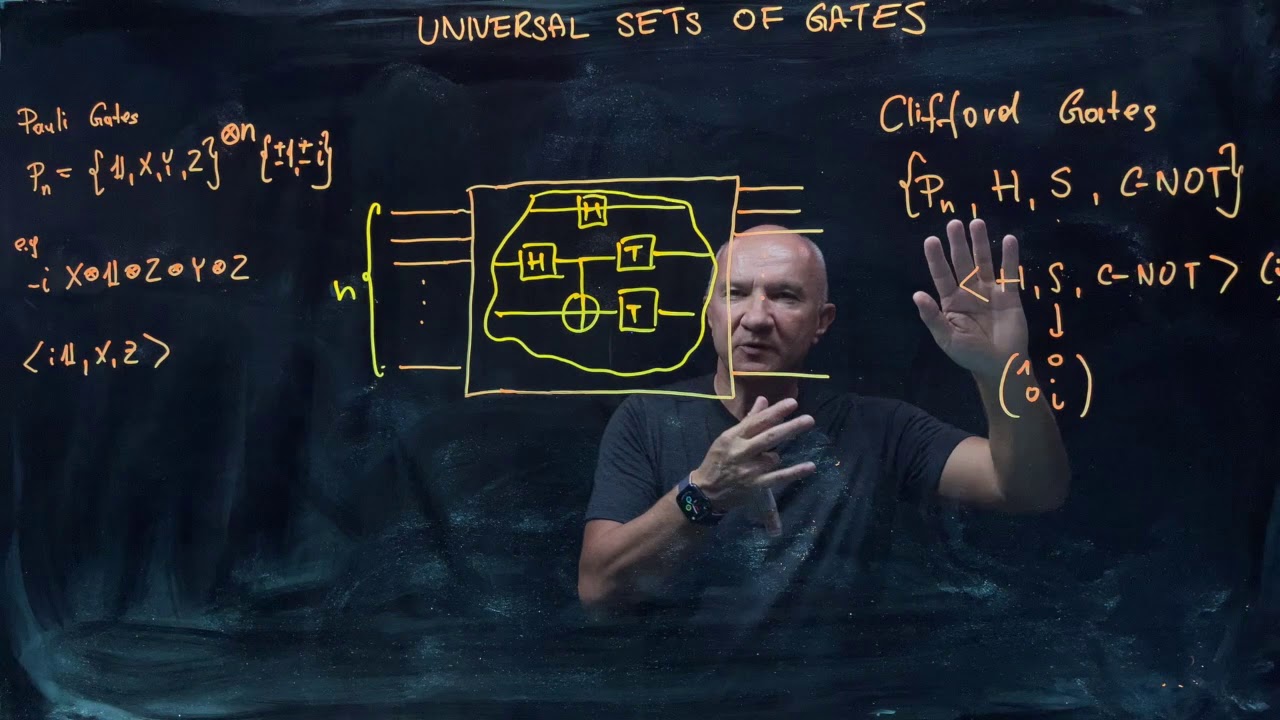
IQIS Lecture 3.9 — Universal sets of gates (for multiple qubits)
Keywords
Summary
162 words
Critical Evaluation
Value of the Information & Strength of the Argument
The lecture provides a clear and rigorous explanation of universal gate sets, building on previous lectures. It systematically compares the Pauli and Clifford groups, highlighting their limitations, and then introduces the Clifford+T set as a universal alternative. The argumentation is solid, with mathematical justifications and references to known results like the Solovay-Kitaev theorem. The lecture also offers intuitive insights, such as the Bloch sphere visualization of T rotations, making the content accessible while maintaining technical depth.
Scientific Rigor, Source Quality, Title Accuracy
The lecture is scientifically rigorous, with precise definitions and logical progression. The sources are not explicitly cited in the video, but the content aligns with standard quantum computing literature. The title accurately reflects the content, focusing on universal sets of gates for multiple qubits. No comments were provided for analysis.
141 words
Title / Content Match
The title accurately reflects the content, focusing on universal sets of gates for multiple qubits.
Quality & Reliability
9/10
Lecture by a renowned quantum physicist, mathematically rigorous, clear explanations, no unsubstantiated claims.
Key Moments
Markers derived by PSI from the transcript: the creator did not define chapters.
- Introduction to universal sets of gates for multiple qubits.
- Definition of the Pauli group for n qubits.
- Introduction of the Clifford group and its generators.
- Explanation of why Clifford gates are not universal.
- Introduction of the T gate and the Clifford+T set.
- Discussion of the Matsumoto-Amano construction for single-qubit approximation.
- Efficiency of approximation: poly-logarithmic in precision, exponential in qubits.
- Conclusion: Hadamard, CNOT, and T gates are sufficient for universal quantum computation.
Contribution & Novelties
This lecture provides a concise and clear exposition of universal gate sets, emphasizing the Clifford+T construction. It offers a pedagogical perspective that is valuable for students and researchers. The discussion of the Matsumoto-Amano construction and the efficiency scaling is particularly insightful.
Pour aller plus loin :
- Solovay-Kitaev theorem — Provides the theoretical foundation for efficient approximation of unitary gates.
- Clifford gates — Overview of the Clifford group and its properties.
- Quantum logic gate — General introduction to quantum gates and universality.
81 words
Radar Profile
The radar profile shows high scores in quality, technical level, and reliability, with slightly lower quantity due to the concise nature of the lecture. This indicates a highly informative and trustworthy content, though not exhaustive.