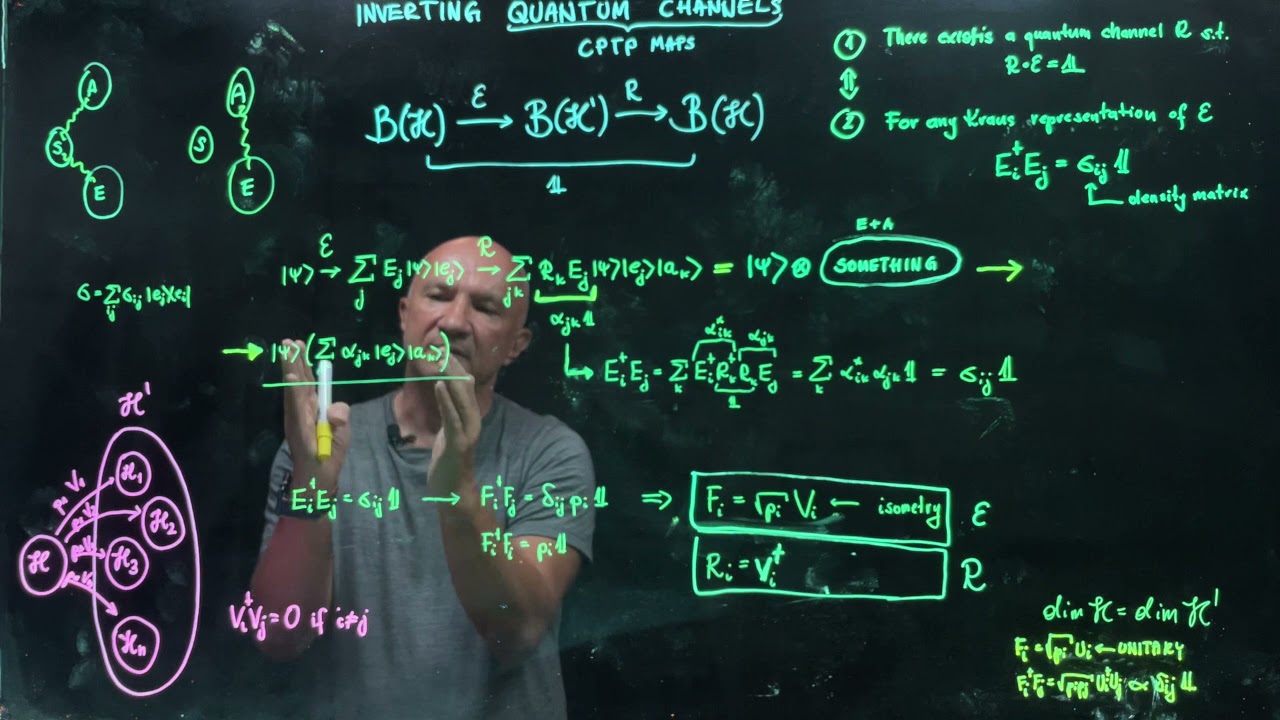
IQIS Lecture 8.6 — Inverting quantum channels
Keywords
Summary
170 words
Critical Evaluation
Value of the Information & Strength of the Argument
The lecture provides a clear and rigorous mathematical treatment of a fundamental question in quantum information theory. The argumentation is solid: the equivalence is proven both ways, with careful attention to mathematical details and physical interpretation. The use of Kraus operators and the environment/ancilla formalism gives deep insight into the structure of quantum channels. The value lies in its direct relevance to quantum error correction, as it formalizes when errors can be corrected. The presentation is well-structured, building from abstract definitions to concrete examples, and the logical flow is easy to follow.
Scientific Rigor, Source Quality, Title Accuracy
The lecture is scientifically rigorous, with precise definitions and proofs. The presenter is a leading expert, and the content aligns with standard textbooks on quantum information. The title accurately reflects the content, as the lecture indeed focuses on the inversion of quantum channels. No external sources are cited in the video, but the mathematical foundations are well-established. The lecture is part of a series on quantum information, which adds credibility.
177 words
Title / Content Match
The title accurately reflects the content: the lecture focuses on the mathematical conditions for inverting quantum channels.
Quality & Reliability
9/10
The lecture is given by a renowned physicist (Artur Ekert), a pioneer in quantum cryptography. The mathematical derivations are rigorous and clearly presented, with proper definitions and logical steps. The content aligns with established quantum information theory.
Key Moments
Markers derived by PSI from the transcript: the creator did not define chapters.
- Introduction: motivation for inverting quantum channels in quantum error correction.
- Statement of the problem: when can a quantum channel be reversed by another channel?
- Definition of quantum channel and statement of the equivalence theorem.
- Proof of 1 implies 2: using environment and ancilla to derive the condition on Kraus operators.
- Derivation of the density matrix condition from the entanglement structure.
- Proof of 2 implies 1: diagonalizing the density matrix and constructing the inverse channel.
- Interpretation: channel as probabilistic mixture of isometries.
- Special case: equal input and output dimensions imply unitary channel.
- Conclusion and connection to quantum error correction.
Contribution & Novelties
The lecture provides a clear and rigorous exposition of the conditions for invertibility of quantum channels, which is a fundamental concept in quantum information theory. The proof is self-contained and offers physical intuition through the use of environment and ancilla. This is a standard result, but the presentation is particularly pedagogical.
Pour aller plus loin :
- Quantum channel — Wikipedia article on quantum channels, providing background and context.
- Kraus operator — Wikipedia article on Kraus operators, essential for understanding the representation used.
- Quantum error correction — Wikipedia article on quantum error correction, which is the main application of the result.
100 words
Radar Profile
The radar profile shows high scores across all dimensions, indicating a well-balanced and high-quality lecture. The quantity of information is substantial, the quality is excellent, the technical level is advanced, and the reliability is high, reflecting the expertise of the presenter.