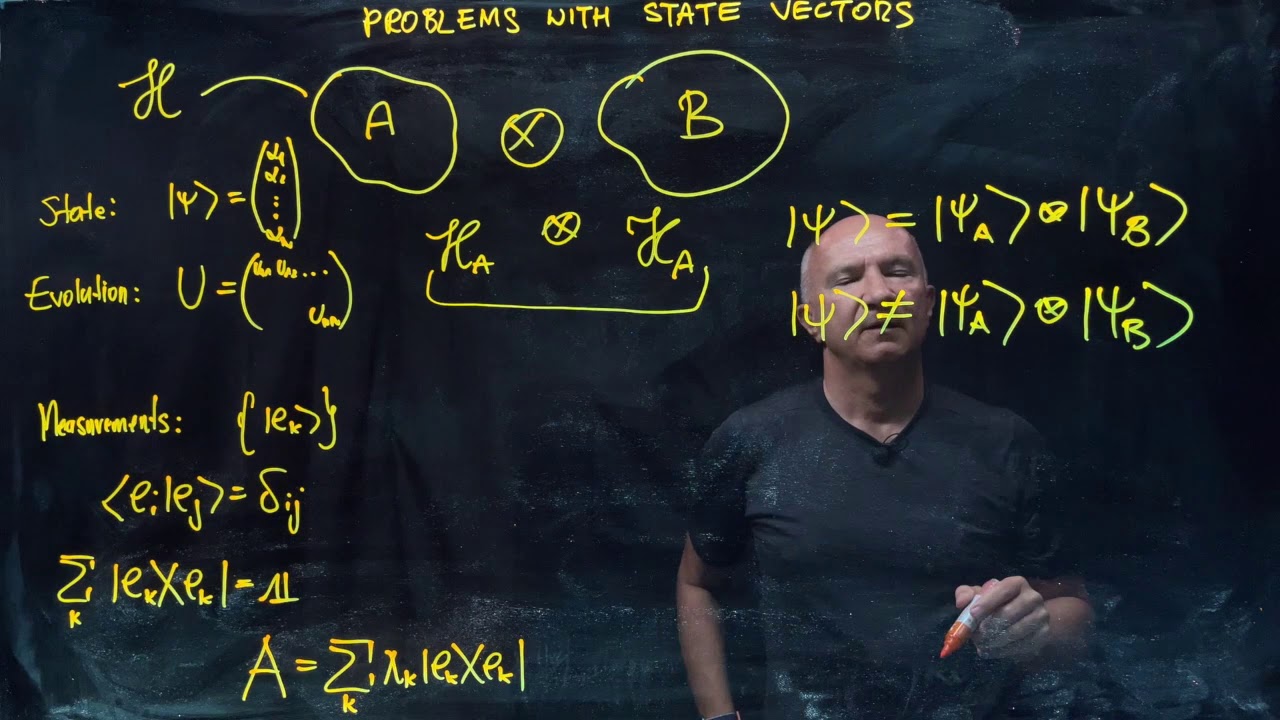
IQIS Lecture 3.10 — Problems with state vectors
Keywords
Summary
176 words
Critical Evaluation
Value of the Information & Strength of the Argument
The lecture provides a clear and rigorous explanation of the limitations of state vectors for subsystems in quantum mechanics. The argumentation is solid, building from the basic postulates to the necessity of density operators. The use of the Schmidt decomposition as a bridge is pedagogically effective. The value lies in its conceptual clarity and the motivation for the mathematical tools that follow.
Scientific Rigor, Source Quality, Title Accuracy
The scientific rigor is high, as the content is standard and presented by an expert. No external sources are cited, but the material is foundational and consistent with established quantum theory. The title accurately reflects the content, focusing on the problems with state vectors for subsystems. No comments were provided for analysis.
129 words
Title / Content Match
The title accurately reflects the content: the lecture discusses the limitations of state vectors for subsystems and motivates the need for density operators.
Quality & Reliability
8/10
Lecture by a recognized expert in quantum information, presenting standard formalism (state vectors, unitary evolution, measurements, Schmidt decomposition) with mathematical rigor. No external sources cited, but the content is foundational and consistent with established quantum theory.
Key Moments
Markers derived by PSI from the transcript: the creator did not define chapters.
- Introduction: revisiting quantum formalism (states, evolution, measurements).
- Measurement as choosing a basis; labeling outcomes with symbols.
- Tensor product for composite systems; separable vs entangled states.
- Problem: no state vector for subsystems; need for new tools.
- Schmidt decomposition via singular value decomposition; implications.
- Preview of density operators and generalized evolution/measurements.
Contribution & Novelties
This lecture provides a clear pedagogical explanation of why state vectors are insufficient for subsystems in quantum mechanics, motivating the introduction of density operators. It emphasizes the Schmidt decomposition as a key tool. For further exploration, consider the following:
- Density matrix - Wikipedia — Provides a comprehensive overview of density operators and their properties.
- Schmidt decomposition - Wikipedia — Detailed explanation of the Schmidt decomposition and its applications.
- Quantum entanglement - Wikipedia — Background on entanglement and its implications.
- Positive operator-valued measure - Wikipedia — Introduction to POVMs, which generalize measurements.
91 words
Radar Profile
The radar profile shows high scores in information quantity, quality, technical level, and reliability, indicating a well-rounded and authoritative lecture. The balance suggests a solid educational resource.