IQIS Lecture 4.1 — Overview of Lecture 4
Keywords
Summary
136 words
Critical Evaluation
Value of the Information & Strength of the Argument
The lecture provides a clear and coherent overview of the course structure, effectively connecting previous topics to upcoming ones. The argumentation is logical, explaining why the density operator formalism is necessary for describing subsystems of entangled systems. The value lies in its pedagogical clarity, helping students see the big picture and understand the motivation behind the mathematical tools. However, it is not a self-contained technical exposition; it relies on prior knowledge and does not delve into derivations.
Scientific Rigor, Source Quality, Title Accuracy
The lecture is scientifically rigorous, presented by an expert in the field. It does not cite specific sources, but the content is standard quantum information theory. The title accurately reflects the content. No comments were provided for analysis.
130 words
Title / Content Match
The title accurately reflects the content: a recap of previous lectures and a preview of the upcoming topics in Lecture 4.
Quality & Reliability
8/10
Lecture by a renowned quantum physicist, part of a structured course. Content is accurate and well-presented, but limited to a high-level overview without detailed derivations.
Key Moments
Markers derived by PSI from the transcript: the creator did not define chapters.
- Introduction and purpose of the lecture: to provide a bird's-eye view of the course.
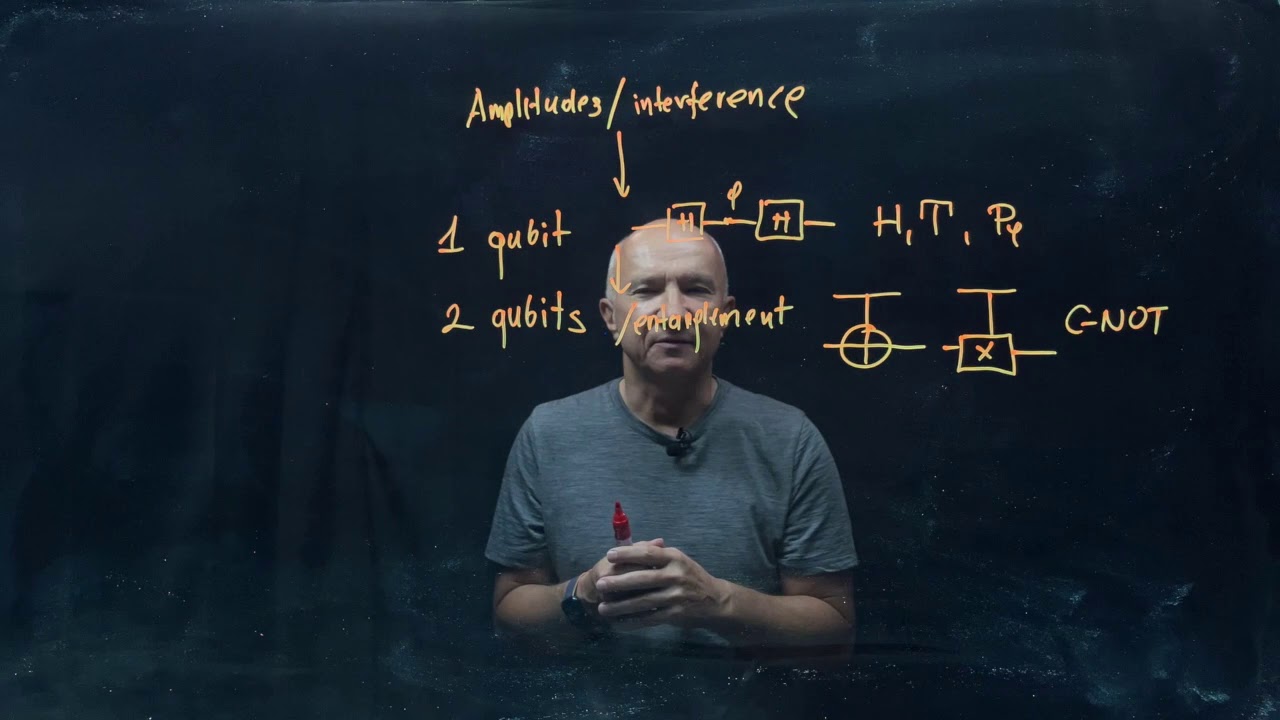
- Recap of Lecture 1: quantum interference and probability amplitudes.
- Recap of Lecture 2: single qubit operations, Hadamard and phase gates.
- Recap of Lecture 3: two qubits, entanglement, CNOT gate, and Bell states.
- Discussion of universal gates: Hadamard, CNOT, and T gate.
- Introduction to the problem of describing subsystems of entangled systems.
- Preview of Lecture 4: density operators as the solution.
- Roadmap for the rest of the course: Bell inequalities, quantum crypto, quantum algorithms, open systems, error correction.
Contribution & Novelties
This lecture provides a valuable pedagogical overview, synthesizing the course’s progression and motivating the density operator formalism. It is not a novel contribution to research but serves as an effective educational resource.
Pour aller plus loin :
- Density matrix — Standard reference for the density operator formalism.
- Bell’s theorem — Relevant to the discussion of correlations and Bell inequalities.
- Quantum error correction — Relevant to the course’s later topics.
69 words
Radar Profile
The radar profile shows high scores in quality and reliability, reflecting the expert presentation and accurate content. The quantity of information is moderate, as it is an overview, and the technical level is intermediate, suitable for a university course.