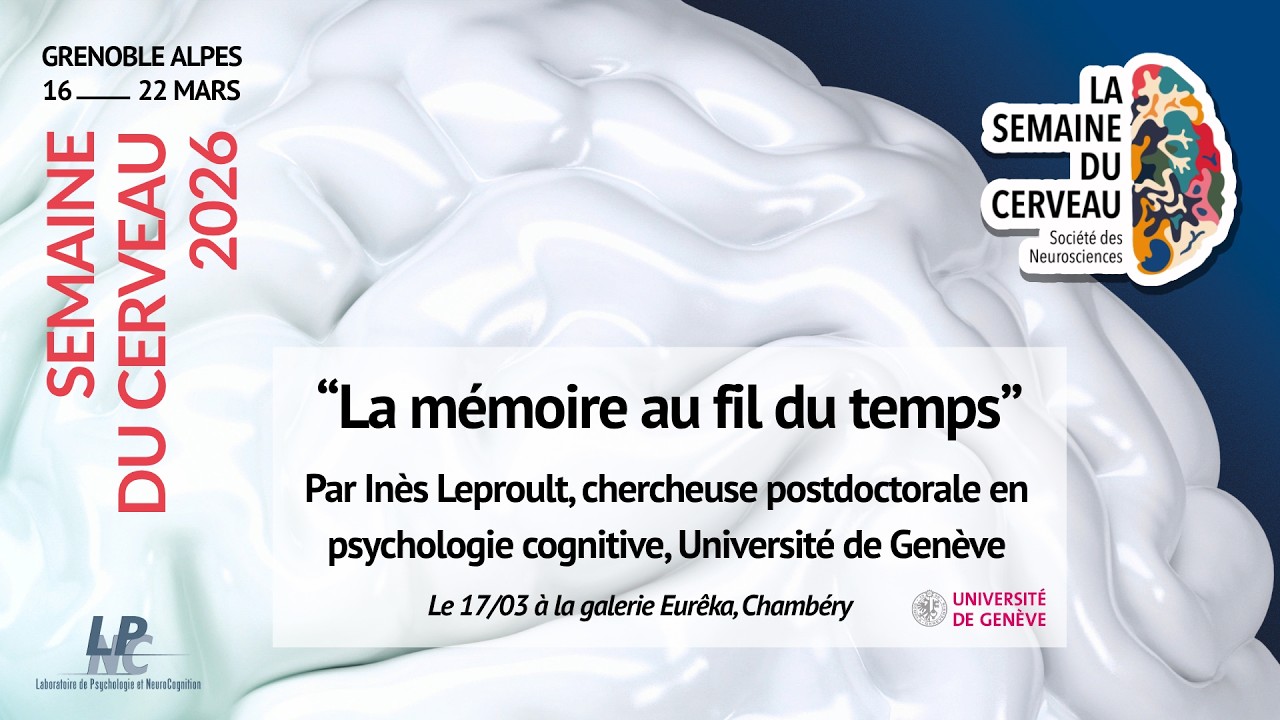
La mémoire au fil du temps : que nous apprend la psychologie cognitive - Dr Inès Leproult
Keywords
Summary
151 words
Critical Evaluation
Value of the Information & Strength of the Argument
The talk provides valuable insights into the complexity of memory, effectively debunking common misconceptions (e.g., memory is not a single entity, memories are not stored in one place, forgetting is not always a memory failure). The argumentation is solid, based on established psychological and neuroscientific research, and is supported by interactive demonstrations that engage the audience. The speaker clearly explains the shift from localizationist to connectionist models, using accessible analogies. However, the talk is introductory and does not delve into specific studies or data, which limits its depth for a more specialized audience.
Scientific Rigor, Source Quality, Title Accuracy
The scientific rigor is good: the speaker is a qualified researcher, and the content aligns with current knowledge in cognitive psychology and neuroscience. However, no specific sources are cited within the talk, and the description only provides links to the speaker’s LinkedIn and the event page. The title accurately reflects the content, covering memory from a cognitive psychology perspective and its evolution over time. The talk is well-structured and clear, with a logical progression from basic concepts to more complex ideas.
189 words
Title / Content Match
The title accurately reflects the content, which covers memory from a cognitive psychology perspective, including its evolution across the lifespan.
Quality & Reliability
8/10
The talk is given by a postdoctoral researcher in cognitive psychology, presenting established concepts and recent neuroscientific findings. The content is well-structured, based on scientific evidence, and includes interactive demonstrations. However, it is a general audience lecture without detailed citations or peer-reviewed references.
Key Moments
Markers derived by PSI from the transcript: the creator did not define chapters.
- Introduction and presentation of the speaker and the topic.
- Key principles of memory: distinction between short-term and long-term memory, and subtypes.
- Section 'Je me souviens, donc je me trompe' on memory errors and the role of attention.
- Memory across the lifespan: changes from childhood to aging.
- Conclusion and final remarks.
Cited Sources
- LinkedIn profile of Dr Inès Leproult — Speaker's professional profile, providing background and credentials.
- Semaine du Cerveau 2026 event page — Event page for the conference, providing context and related activities.
Concurring Sources
- Semaine du Cerveau 2026 event page — The event page confirms the talk's context and aligns with the content presented.
Contribution & Novelties
The talk offers a clear and engaging synthesis of current knowledge on memory, emphasizing the distributed nature of memory traces and the role of the hippocampus as a coordinator. It effectively uses interactive demonstrations to illustrate key concepts, making the content accessible to a general audience. The section on memory across the lifespan provides practical insights into age-related changes and potential strategies for maintaining memory function.
Pour aller plus loin :
- Hippocampus - Wikipedia — Provides detailed anatomical and functional information about the hippocampus, relevant to the discussion of its role in memory.
- Memory - Wikipedia — Overview of memory types and processes, complementing the talk’s classification.
- Cognitive psychology - Wikipedia — Background on the discipline and its methods, supporting the talk’s framework.
- Inattentional blindness - Wikipedia — Explains the phenomenon demonstrated with the ‘invisible gorilla’ video, relevant to the discussion of attention and encoding.
145 words
Radar Profile
The radar profile shows high scores in information quantity, quality, and reliability, with a moderate technical level. This indicates a well-balanced presentation that is informative and scientifically sound, but not overly technical, making it suitable for a general audience.