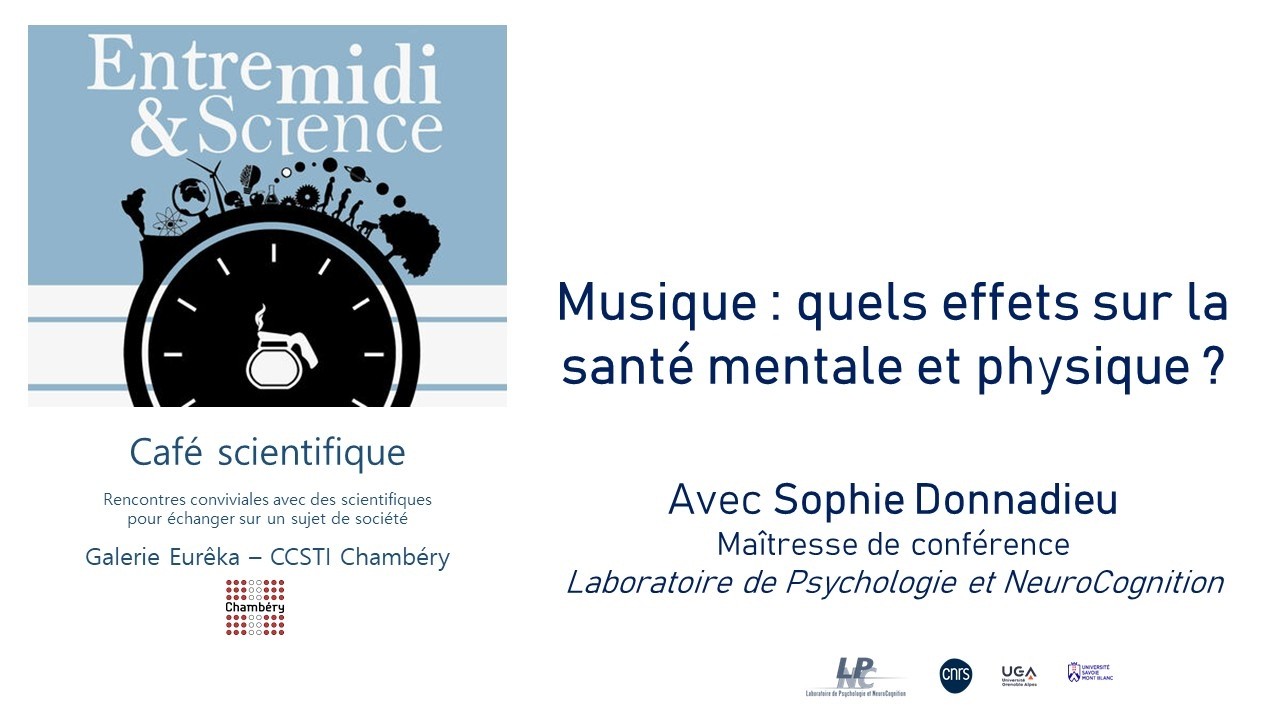
Musique : quels effets sur la santé mentale et physique ?
Keywords
Summary
149 words
Critical Evaluation
Value of the Information & Strength of the Argument
The talk provides valuable insights into the neuroscientific basis of music’s effects on health, supported by specific studies and clinical examples. The argumentation is coherent, moving from basic mechanisms (plasticity) to applications (therapy). However, it lacks critical discussion of limitations and conflicting evidence, and some claims are presented without detailed citations.
Scientific Rigor, Source Quality, Title Accuracy
The speaker is a credible researcher, and the content is scientifically grounded. However, specific sources are not systematically cited in the talk; the description provides links to the speaker’s profile and the event page. The title accurately reflects the content. No comments were provided for analysis.
112 words
Title / Content Match
The title accurately reflects the content, which explores the effects of music on mental and physical health through neuroscientific mechanisms.
Quality & Reliability
8/10
The speaker is a researcher in psychology and neurocognition, and the talk is grounded in established scientific concepts (brain plasticity, auditory-motor coupling) and specific studies (e.g., Elbert et al., Fauvel et al., Schlaug et al.). However, the presentation is a general overview without detailed citations or critical discussion of conflicting evidence.
Key Moments
Markers derived by PSI from the transcript: the creator did not define chapters.
- Introduction and audience interaction about music listening habits.
- Explanation of brain plasticity and structural changes in musicians.
- Functional connectivity differences between musicians and non-musicians.
- Auditory-motor coupling and its role in music practice.
- Clinical example: melodic intonation therapy for aphasia.
- Clinical example: rhythmic auditory stimulation for Parkinson's disease.
- Discussion of the Mozart effect and transfer of skills.
- Music and well-being, aging, and conclusion.
Cited Sources
- Sophie Donnadieu - LPNC — Speaker's profile page at the laboratory.
- Entre midi et sciences - Chambéry — Event page for the conference series.
Concurring Sources
- Elbert et al. (1995) - Increased cortical representation of the fingers of the left hand in string players — Study cited in the talk on structural changes in musicians.
- Fauvel et al. (2014) - Morphological brain plasticity induced by musical expertise — Study on functional connectivity in musicians.
- Schlaug et al. (2010) - Training-induced neuroplasticity in young children — Study on arcuate fasciculus development in children with music training.
Dissenting Sources
- Pietschnig et al. (2010) - Meta-analysis on the Mozart effect — The talk mentions the Mozart effect but does not discuss the replication failures and meta-analyses that question its validity.
Contribution & Novelties
The talk provides a clear synthesis of current neuroscientific knowledge on music’s effects on the brain and health, with concrete clinical applications. It emphasizes the importance of brain plasticity and auditory-motor coupling.
Pour aller plus loin :
- Melodic Intonation Therapy — A therapy for aphasia mentioned in the talk.
- Rhythmic auditory stimulation — A technique used for gait rehabilitation in Parkinson’s disease.
- Brain plasticity — The underlying mechanism discussed throughout the talk.
72 words
Radar Profile
The radar profile shows high scores in information quality and reliability, moderate in quantity and technical level, indicating a well-structured but not overly technical presentation.