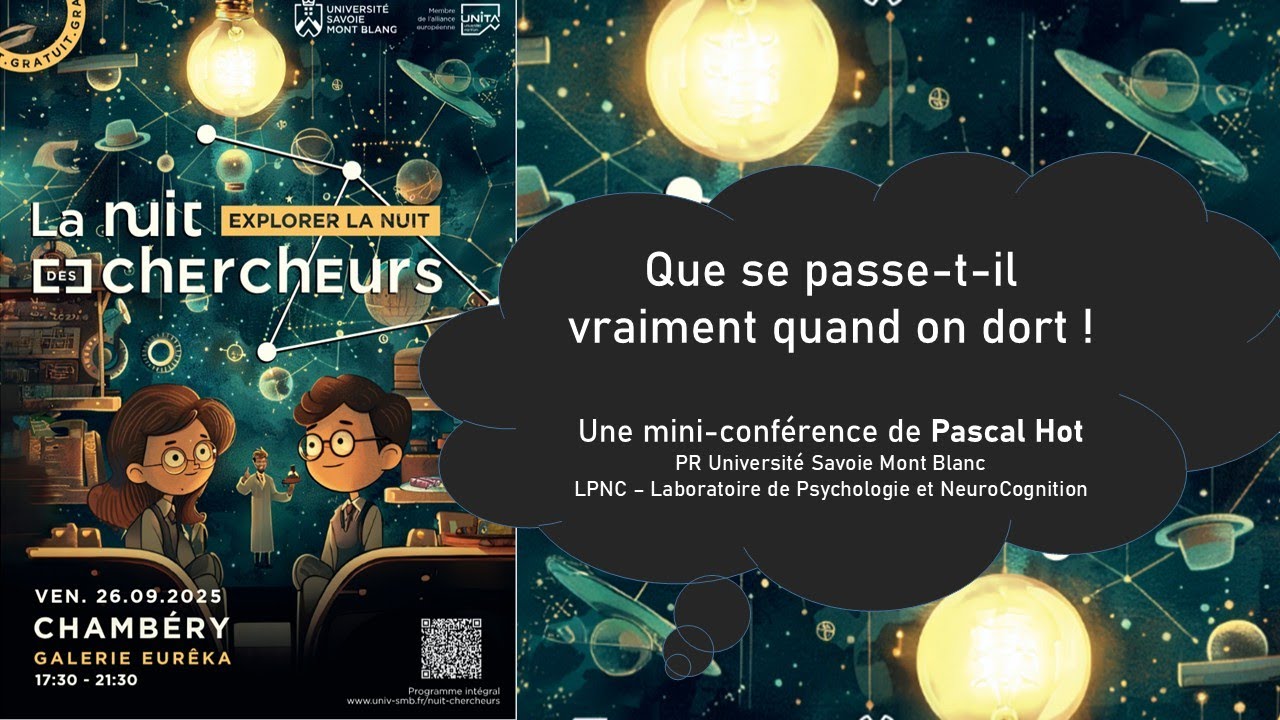
Rêves et réalités : que se passe-t-il quand on dort
Keywords
Summary
185 words
Critical Evaluation
Value of the Information & Strength of the Argument
The presentation provides a comprehensive overview of current scientific understanding of sleep and dreams, supported by key studies and hypotheses. The speaker effectively argues for the importance of sleep for physical and mental health, using examples from animal research and human studies. The argumentation is solid, though it is a general audience talk, so some details are simplified. The speaker acknowledges the complexity of establishing causal relationships in sleep research, which adds to the credibility of the presentation.
Scientific Rigor, Source Quality, Title Accuracy
The speaker is a professor in cognitive neuroscience, and the content is based on established research, including the glymphatic hypothesis, memory consolidation studies, and emotional regulation theories. The presentation is clear and scientifically grounded, though it is a general audience talk without detailed citations. The title accurately reflects the content, which explores the functions of sleep and dreams, including their physiological and psychological aspects.
157 words
Title / Content Match
The title accurately reflects the content, which explores the functions of sleep and dreams, including their physiological and psychological aspects.
Quality & Reliability
8/10
The speaker is a professor in cognitive neuroscience, and the content is based on established research, including the glymphatic hypothesis, memory consolidation studies, and emotional regulation theories. The presentation is clear and scientifically grounded, though it is a general audience talk without detailed citations.
Key Moments
Markers derived by PSI from the transcript: the creator did not define chapters.
- Introduction: 25 years spent sleeping, 10 years dreaming.
- Evolutionary perspective: sleep in different species, including jellyfish and flies.
- Glymphatic hypothesis: brain clears waste during deep sleep.
- Stages of sleep: slow-wave sleep and REM sleep.
- REM sleep and brain maturation in early life.
- Memory consolidation: studies in rats and humans showing replay of learned experiences.
- Emotional regulation: study on divorced individuals and dreaming about the traumatic event.
- Q&A: lucid dreaming and its implications for consciousness.
- Q&A: relationship between sleep and emotional sensitivity.
Cited Sources
- Pascal Hot - LPNC — Speaker's institutional page, providing credentials and research interests.
- Nuit européenne des chercheurs 2025 — Event page for the conference, providing context for the talk.
Concurring Sources
- Sleep and memory: a systematic review — Supports the claim that sleep consolidates memories, as discussed in the talk.
- The glymphatic system and its role in sleep — Provides evidence for the glymphatic hypothesis mentioned in the talk.
Contribution & Novelties
The talk provides a clear and accessible synthesis of current research on sleep and dreams, emphasizing the glymphatic hypothesis, memory consolidation, and emotional regulation. It offers a balanced view, acknowledging the complexity of causal relationships. For further exploration, the following concepts are relevant:
Pour aller plus loin :
- Glymphatic system — The brain’s waste clearance system, central to the talk’s discussion of sleep’s restorative function.
- Memory consolidation during sleep — The process by which memories are stabilized, a key theme of the presentation.
- Lucid dreaming — A phenomenon discussed in the Q&A, with implications for consciousness research.
97 words
Radar Profile
The radar profile shows high scores in quantity and quality of information, with a moderate technical level, indicating a well-balanced presentation suitable for a general audience. The reliability is high, reflecting the speaker's expertise.