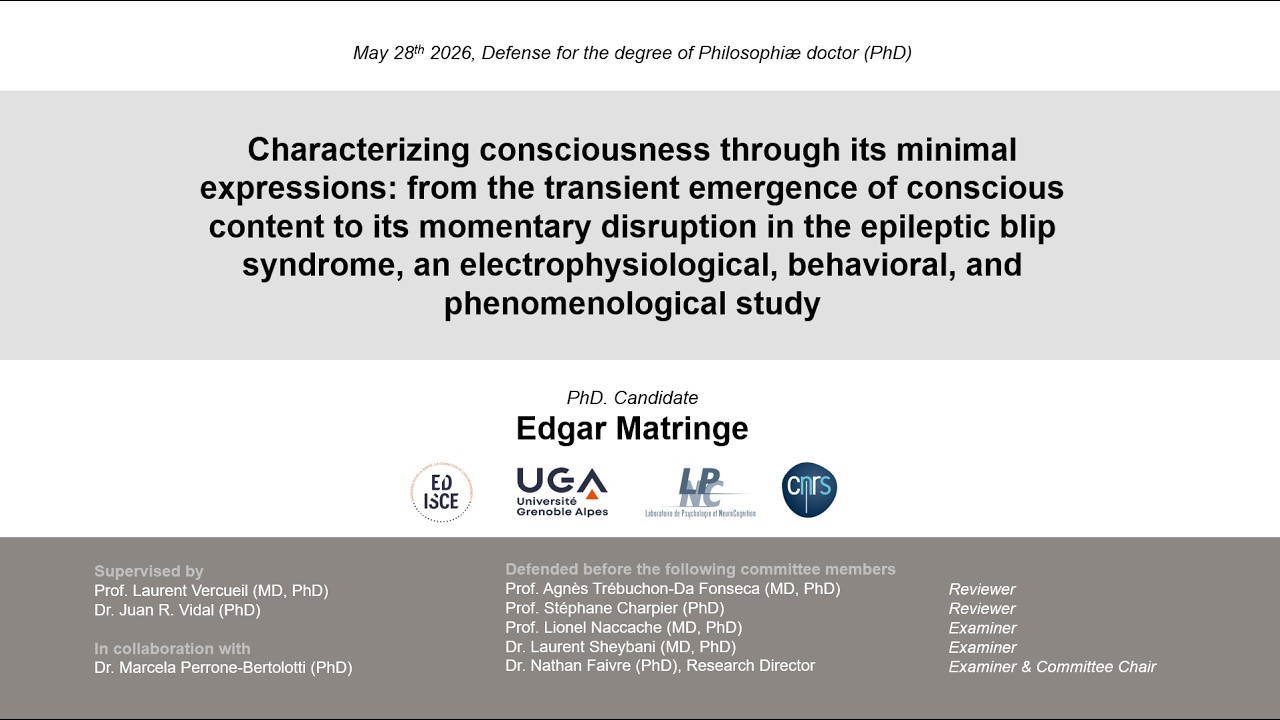
Characterizing consciousness through its minimal expressions : from the transient emergence of ...
Keywords
Summary
161 words
Critical Evaluation
Value of the Information & Strength of the Argument
The presentation provides substantial value by introducing a novel theoretical framework (NCICs) and presenting original experimental data. The argumentation is solid, grounded in established theories (NCCs, global neuronal workspace, predictive processing) and methodologically rigorous. The speaker carefully interprets results, acknowledges limitations, and connects findings to broader implications. The case report and group study are well-designed, and the conclusions are supported by the data. The work bridges two usually separate fields, offering a fresh perspective on consciousness research.
Scientific Rigor, Source Quality, Title Accuracy
The scientific rigor is high: the research uses appropriate methods (intracranial EEG, scalp EEG, behavioral measures), and the analyses are detailed. The sources cited are relevant and include seminal works (e.g., on NCCs, absence seizures). The title accurately reflects the content, and the presentation is well-structured. The description provides a link to the author’s ResearchGate profile, which serves as a source for further information. The work is original and contributes to the field.
165 words
Title / Content Match
The title accurately reflects the content, covering both normal and impaired consciousness through minimal expressions, as presented in the thesis.
Quality & Reliability
8/10
The presentation is a PhD defense, based on original research with rigorous methodology, including intracranial EEG and scalp EEG studies, and is grounded in established theoretical frameworks. The speaker is transparent about limitations and methodological challenges. The work is presented by the researcher himself, ensuring accuracy of the reported results.
Key Moments
Markers derived by PSI from the transcript: the creator did not define chapters.
Cited Sources
- ResearchGate profile of Edgar Matringe — Author's profile with publications related to the thesis.
Concurring Sources
- ResearchGate profile of Edgar Matringe — Author's profile with publications related to the thesis.
Contribution & Novelties
The thesis introduces the concept of neural correlates of impaired consciousness (NCICs) as a symmetrical counterpart to NCCs, and characterizes the epileptic blip syndrome as a minimal form of consciousness impairment. It provides original data on how expectations modulate neural markers of perceptual awareness, and demonstrates distinct EEG profiles in patients experiencing blips. This bridges normal and impaired consciousness research, offering a new model for studying consciousness.
Pour aller plus loin :
- Neural correlates of consciousness — Overview of NCC framework.
- Absence seizure — Clinical and EEG characteristics.
- Global neuronal workspace theory — Theory referenced in the thesis.
- Predictive processing — Framework for expectations in perception.
106 words
Radar Profile
The radar profile shows high scores in quality of information and technical level, indicating a rigorous and detailed presentation. The quantity of information is also high, but the global score is slightly lower due to the niche topic and limited accessibility for a general audience.