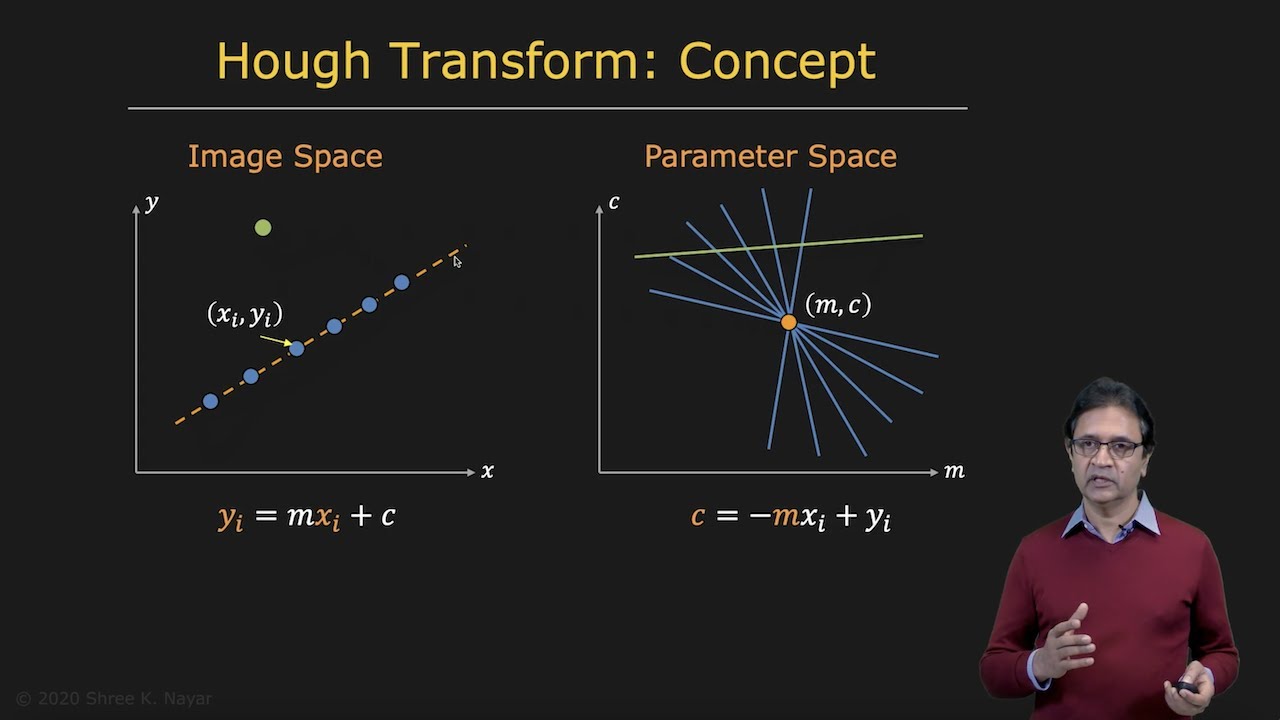
Hough Transform | Boundary Detection
Keywords
Summary
123 words
Critical Evaluation
Value of the Information & Strength of the Argument
The video provides a thorough and clear explanation of the Hough transform, building from basic concepts to more complex applications. The argumentation is solid, with mathematical derivations and visual demonstrations. The lecturer effectively uses examples to illustrate the algorithm’s operation and its advantages in handling noisy or incomplete data. The progression from lines to circles and the discussion of parameter space dimensionality are well-structured, making the content valuable for learners.
Scientific Rigor, Source Quality, Title Accuracy
The lecture is scientifically rigorous, presented by a professor from Columbia University. It is part of a well-known educational series, and the content aligns with standard computer vision curricula. The title accurately describes the content. No external sources are cited in the video, but the lecture is based on established principles in computer vision.
139 words
Title / Content Match
The title accurately reflects the content, which focuses on the Hough transform for boundary detection.
Quality & Reliability
9/10
Lecture by a renowned professor from Columbia University, clear and rigorous explanations, well-structured, with practical examples and mathematical foundations.
Key Moments
Markers derived by PSI from the transcript: the creator did not define chapters.
- Introduction to boundary detection problems and the Hough transform.
- Explanation of line detection using slope-intercept parameterization.
- Introduction of the accumulator array and voting mechanism.
- Discussion of the normal form parameterization (rho-theta) to avoid infinite slope.
- Practical considerations: accumulator cell size, peak finding, and noise resilience.
- Demonstration of line detection on real images.
- Introduction to circle detection with known radius.
- Circle detection with unknown radius and 3D parameter space.
- Use of edge orientation to reduce voting to two points.
- Conclusion on the exponential complexity with higher dimensions.
Contribution & Novelties
The video provides a clear and accessible explanation of the Hough transform, a fundamental technique in computer vision. It effectively demonstrates the mapping between image space and parameter space, and the voting mechanism. The lecture is part of a comprehensive series that builds understanding from first principles.
Pour aller plus loin :
- Hough transform - Wikipedia — Overview and history.
- Generalised Hough transform - Wikipedia — Extension to arbitrary shapes.
- Computer Vision: Algorithms and Applications by Richard Szeliski — Comprehensive textbook covering Hough transform and other techniques.
87 words
Radar Profile
The radar profile shows high scores across all dimensions, indicating a well-balanced and high-quality educational content. The video excels in information quantity and quality, with a strong technical level and high reliability.