A Brief History of Imaging | Image Sensing
Keywords
Summary
129 words
Critical Evaluation
Value of the Information & Strength of the Argument
The lecture provides valuable historical context that is essential for understanding the foundations of computer vision. The argumentation is clear and logical, tracing the evolution from simple pinhole cameras to sophisticated digital imaging systems. Nayar effectively highlights key technological breakthroughs and their impact on society, such as the democratization of photography and the rise of visual communication. The narrative is engaging and supported by concrete examples, like the Kodak Brownie and modern camera modules, which make the content relatable and memorable.
Scientific Rigor, Source Quality, Title Accuracy
The scientific rigor is high, as the lecture is based on well-documented historical facts and technological developments. The quality of sources is implicit, given the presenter’s expertise and the academic context. The title accurately reflects the content, which is a concise historical overview. The lecture does not cite specific external sources, but the information is consistent with established knowledge in the field.
158 words
Title / Content Match
The title accurately reflects the content, which provides a concise historical overview of imaging technology.
Quality & Reliability
8/10
The lecture is presented by a renowned professor in computer vision, based on established historical facts and technological developments. The content is accurate and well-structured, though it is a high-level overview without deep technical details.
Key Moments
Markers derived by PSI from the transcript: the creator did not define chapters.
- Introduction to the history of imaging, starting with the pinhole camera.
- Discussion on the addition of lenses to improve brightness and the use of mirrors for artist convenience.
- Invention of film and the Daguerreotype camera, enabling recording without an artist.
- Challenges of color photography and the development of dye couplers.
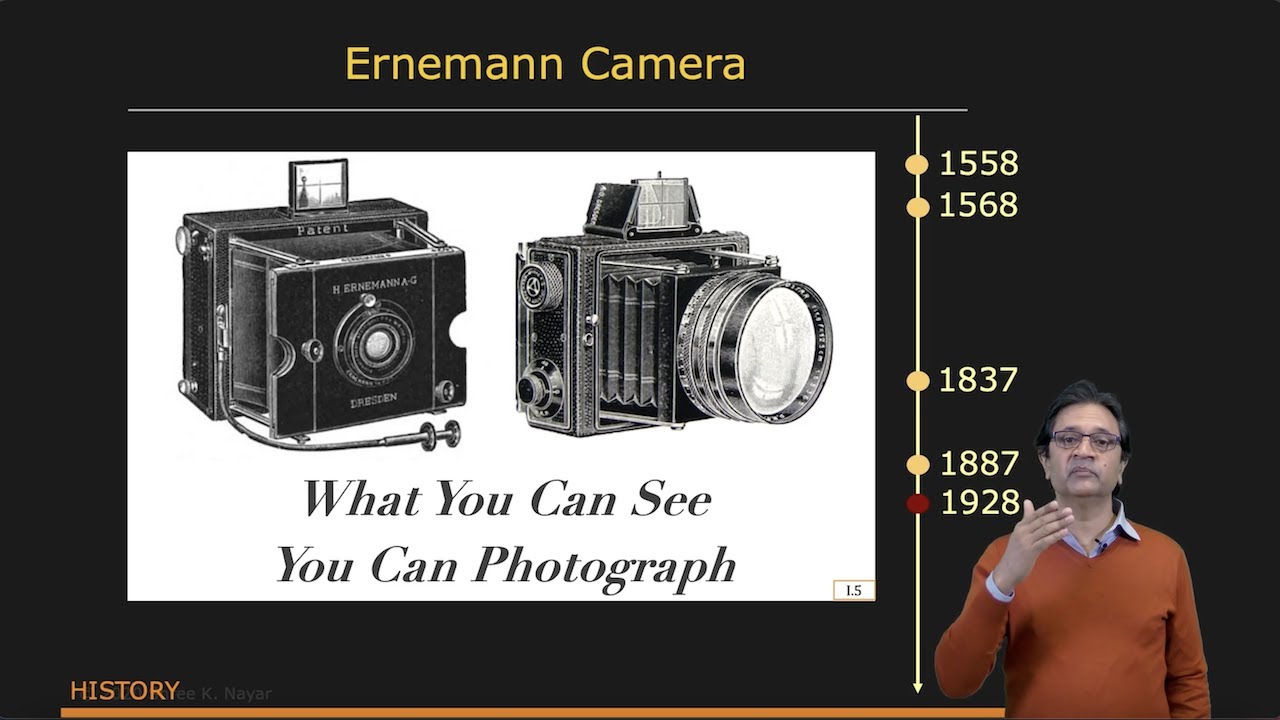
- Introduction of consumer film cameras like the Ernemann camera in the 1920s.
- The silicon image detector as the most important invention, leading to digital cameras.
- Smartphone cameras and the revolution in visual communication.
- Comparison between the Kodak Brownie and modern camera modules, and future trends like optics on wafer.
Contribution & Novelties
The lecture provides a concise and engaging historical overview of imaging, emphasizing the pivotal role of the silicon image detector. It connects technological advancements to their societal impact, such as the democratization of photography and the rise of visual communication. The future outlook on optics on wafer and 3D electronics offers a forward-looking perspective.
Pour aller plus loin :
- Pinhole camera — Provides foundational knowledge on the earliest imaging device.
- Silver halide — Explains the chemical basis of traditional film photography.
- Charge-coupled device — Details the technology behind silicon image detectors.
- Smartphone camera — Discusses the evolution and impact of cameras in mobile devices.
104 words
Radar Profile
The radar profile shows high scores in quality and reliability, with moderate scores in quantity and technical level, indicating a well-presented but not overly detailed lecture.