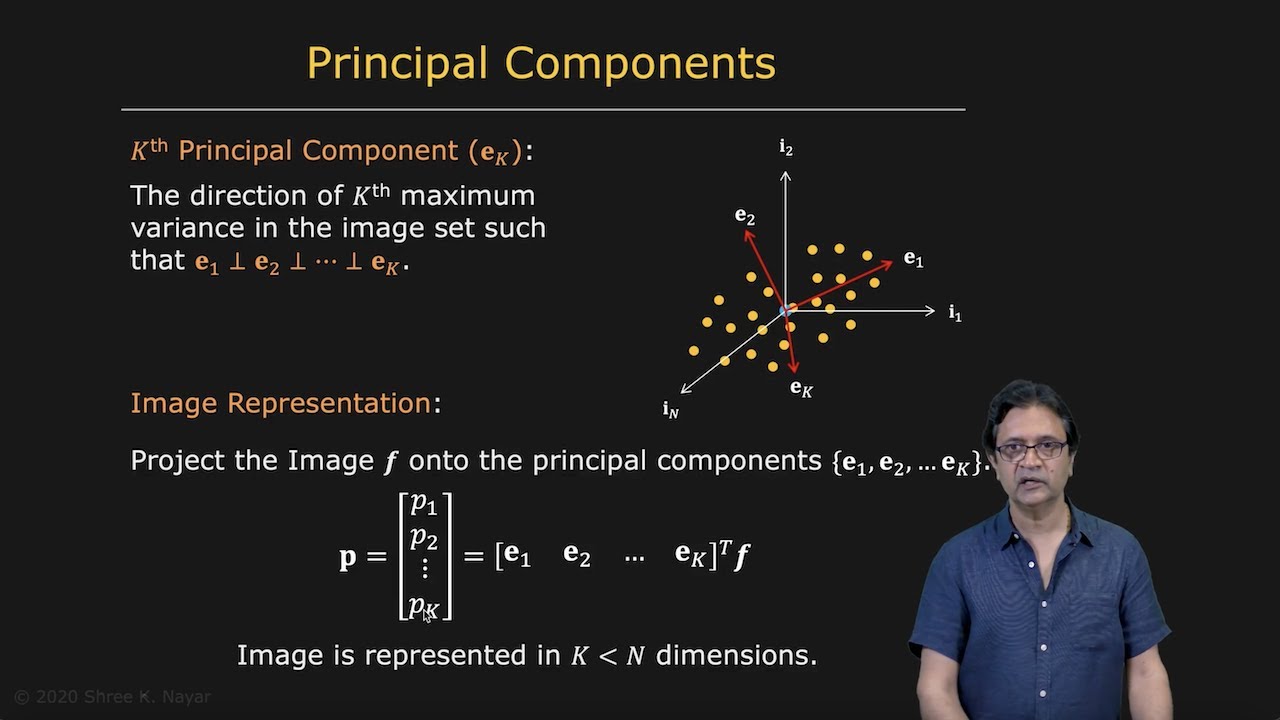
Principal Component Analysis | Appearance Matching
Keywords
Summary
196 words
Critical Evaluation
Value of the Information & Strength of the Argument
The lecture provides a clear and rigorous explanation of PCA, building from fundamental concepts. The argumentation is logical and well-paced, using intuitive examples (like the 3D plane) to illustrate abstract ideas. The value lies in its pedagogical approach, making complex mathematical concepts accessible without oversimplification. The instructor emphasizes the practical motivation (efficiency in matching) and connects PCA to the broader context of computer vision. The explanation of forward and backward projections is particularly valuable, as it clarifies the reconstruction process and the trade-off between dimensionality and information loss.
Scientific Rigor, Source Quality, Title Accuracy
The scientific rigor is high, with accurate mathematical formulations and clear derivations. However, the video does not cite specific sources or references, relying instead on the instructor’s expertise. The title accurately reflects the content, which is focused on PCA for appearance matching. The lecture is part of a well-regarded series, and the instructor’s credentials (Shree Nayar, Columbia University) lend credibility. The absence of citations is a minor weakness, but the content is self-contained and reliable.
178 words
Title / Content Match
The title accurately reflects the content, which focuses on Principal Component Analysis in the context of appearance matching.
Quality & Reliability
9/10
The lecture is delivered by a renowned expert in computer vision from Columbia University, with clear explanations grounded in mathematical principles. The content is accurate and well-structured, though it lacks explicit citations to external sources within the video.
Key Moments
Markers derived by PSI from the transcript: the creator did not define chapters.
- Introduction to the problem of appearance matching and the need for dimensionality reduction.
- Explanation of representing an image as a vector by stacking columns.
- Introduction to the concept of an N-dimensional space and orthonormal basis.
- Connection between template matching and L2 distance in N-dimensional space.
- Example of dimensionality reduction from 3D to 2D using a plane.
- Key observation that appearance distributions are structured and lie in a lower-dimensional subspace.
- Definition of the first principal component as the direction of maximum variance.
- Introduction of the second principal component and the orthonormal basis.
- Forward and backward projections, and the concept of a linear subspace.
Contribution & Novelties
This lecture provides a clear and intuitive introduction to PCA specifically tailored for computer vision applications, emphasizing the connection between image representation and dimensionality reduction. It explains the mathematical foundations without assuming prior knowledge, making it accessible to a broad audience. The lecture’s contribution lies in its pedagogical clarity and its focus on the practical problem of appearance matching.
Pour aller plus loin :
- Principal Component Analysis (Wikipedia) — Comprehensive overview of PCA, including mathematical details and applications.
- Eigenface (Wikipedia) — Application of PCA to face recognition, directly related to the lecture’s context.
- Dimensionality Reduction (Wikipedia) — General concepts and methods for reducing data dimensionality.
105 words
Radar Profile
The radar profile shows high scores in quality and reliability, with slightly lower scores in quantity and technical level. This indicates a well-explained, accurate tutorial that may not cover all possible aspects but excels in clarity and correctness.