Animal Eyes | Image Formation
Keywords
Summary
141 words
Critical Evaluation
Value of the Information & Strength of the Argument
The lecture provides valuable insights into the physical and biological principles of image formation, connecting evolutionary biology with optical engineering. The argumentation is solid, built on clear explanations and demonstrations, such as the curved sensor concept and the iris control experiment. The use of historical experiments and simulations strengthens the narrative, making complex ideas accessible without oversimplification.
66 words
Title / Content Match
The title accurately reflects the content, which focuses on image formation in animal eyes, including a detailed examination of the human eye.
Quality & Reliability
8/10
The lecture is presented by a renowned professor in computer vision, based on established physics and biology principles, and includes references to historical experiments and simulations. The content is accurate and well-structured, though it is an educational overview rather than a peer-reviewed study.
Key Moments
Markers derived by PSI from the transcript: the creator did not define chapters.
- Introduction to animal eye diversity and the trilobite's compound eye.
- Explanation of the limpet's curved image sensor and its directional sensitivity.
- Discussion of primitive eyes: nautilus pinhole, scorpion, snail, squid, and vertebrate.
- Nilsson's simulation of eye evolution from flat tissue to complex eye.
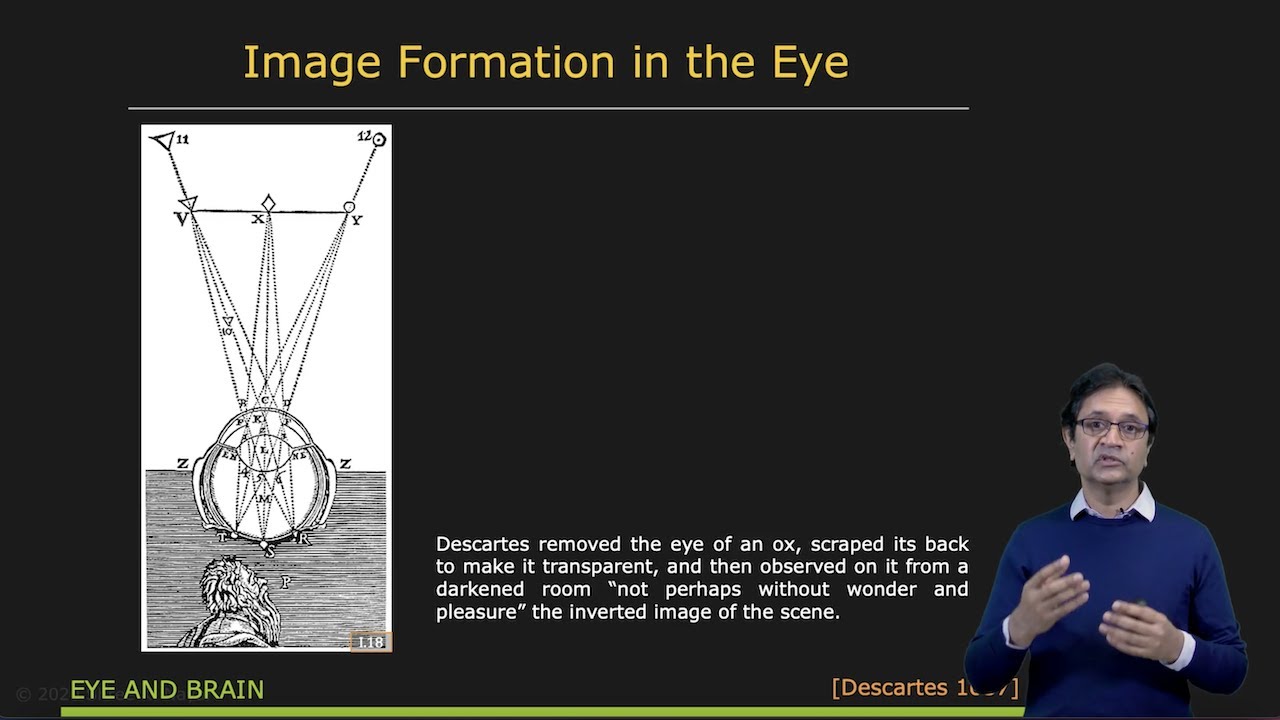
- Historical experiments by Descartes and Kepler on image formation in eyes.
- Anatomy of the human eye: cornea, iris, pupil, lens, retina, and fovea.
- Iris control system and experiment with a narrow beam of light.
- Accommodation and age-related changes in focusing ability.
- Vision defects (myopia, hyperopia) and correction with lenses.
- Liquid lenses and electrowetting technology inspired by the eye.
Contribution & Novelties
The lecture provides a comprehensive overview of image formation in animal eyes, linking evolutionary biology with optical principles. It offers a unique perspective by connecting historical experiments with modern computational imaging. The discussion of liquid lenses and electrowetting highlights how biological designs inspire technological innovations.
Pour aller plus loin :
- Nilsson & Pelger (1994) - A pessimistic estimate of the time required for an eye to evolve — Key paper on eye evolution simulation.
- Electrowetting - Wikipedia — Overview of the principle behind liquid lenses.
- Accommodation (eye) - Wikipedia — Detailed explanation of focusing mechanism.
95 words
Radar Profile
The radar profile shows high scores in information quantity, quality, and reliability, with a moderate technical level. This indicates a well-balanced educational resource that is both informative and trustworthy, suitable for learners with some background in science.