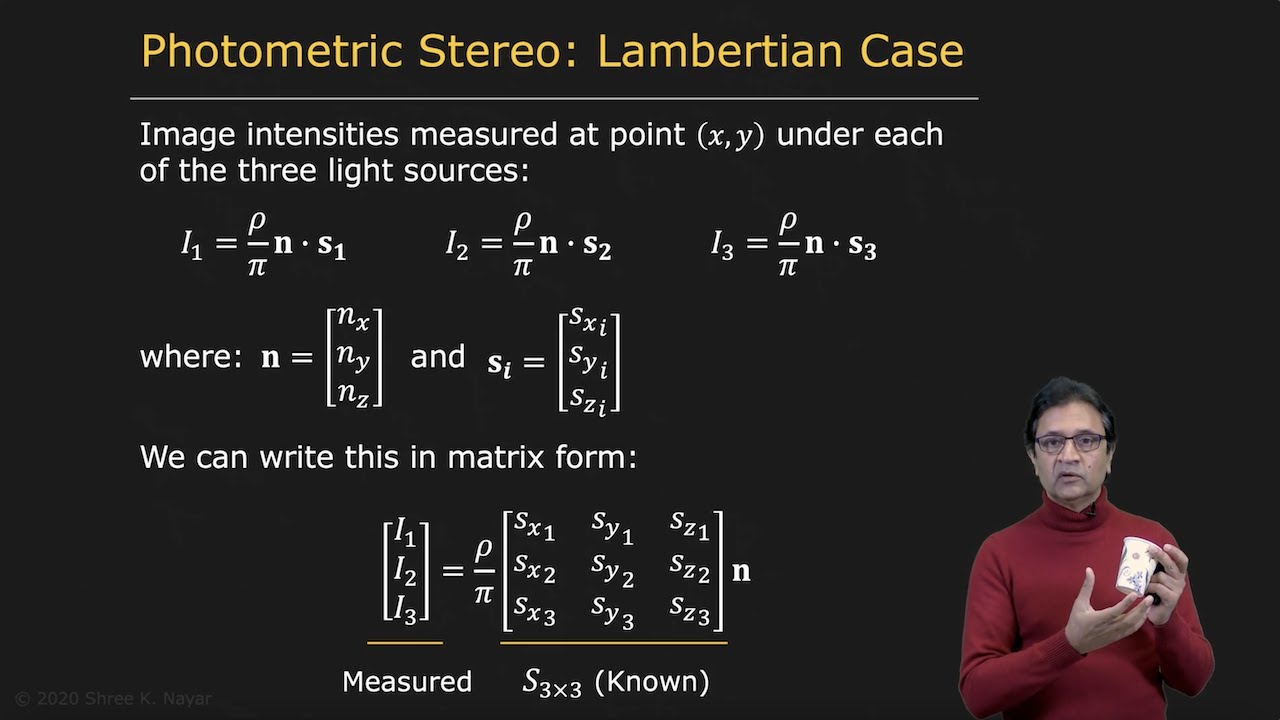
Lambertian Case | Photometric Stereo
Keywords
Summary
169 words
Critical Evaluation
Value of the Information & Strength of the Argument
The lecture provides high-value information by clearly explaining the mathematical foundations of photometric stereo for Lambertian surfaces. It systematically derives the equations, discusses the invertibility condition, and introduces the least squares method for robustness. The argumentation is solid, building from basic principles to practical applications, and includes illustrative examples and visual results. The explanation of the effective light source property is particularly insightful, offering a deeper understanding of Lambertian reflectance.
79 words
Title / Content Match
The title accurately reflects the content, which focuses on the Lambertian case in photometric stereo.
Quality & Reliability
9/10
The content is a rigorous lecture by a leading expert (Shree Nayar) from Columbia University, presenting mathematical derivations and practical considerations for photometric stereo. The explanations are clear, well-structured, and based on established principles. The video is part of a reputable educational series.
Key Moments
Markers derived by PSI from the transcript: the creator did not define chapters.
- Introduction to Lambertian case with multiple light sources
- Matrix formulation of photometric stereo
- Conditions for invertibility of source matrix
- Outdoor photometric stereo and equinox/winter solstice issues
- Least squares solution for more than three light sources
- Effective point light source property for Lambertian surfaces
- Experimental results on sphere, mask, and toy
- Discussion of limitations with non-Lambertian surfaces
Contribution & Novelties
The lecture provides a clear and comprehensive explanation of photometric stereo for Lambertian surfaces, including the mathematical derivation, practical considerations, and the effective light source property. It is valuable for students and practitioners new to computer vision.
Pour aller plus loin :
- Photometric stereo - Wikipedia — Overview and history of the technique.
- Bidirectional reflectance distribution function - Wikipedia — Background on BRDFs, relevant to the discussion of non-Lambertian surfaces.
- Least squares - Wikipedia — Mathematical method used for solving overdetermined systems.
82 words
Radar Profile
The radar profile shows high scores in quality and reliability, with slightly lower but still strong scores in quantity and technical level. This indicates a well-produced, informative lecture that is technically sound and reliable.