Stereo Vision in Nature | Uncalibrated Stereo
Keywords
Summary
207 words
Critical Evaluation
Value of the Information & Strength of the Argument
The lecture provides valuable insights into biological stereo vision, connecting it to computational concepts. The argumentation is solid, based on well-documented experiments and established anatomical knowledge. The presentation is engaging and logically structured, building from natural examples to human physiology and then to psychological experiments, culminating in implications for computer vision. The use of historical experiments adds depth and credibility.
Scientific Rigor, Source Quality, Title Accuracy
The scientific rigor is high, with accurate descriptions of anatomical structures and historical experiments. The sources are not explicitly cited in the video, but the experiments mentioned (e.g., Stratton, Held and Hein) are well-known in the literature. The title accurately reflects the content, which covers stereo vision in nature and then transitions to uncalibrated stereo in computer vision, though the latter is only briefly touched upon. The lecture is part of a reputable series by a leading expert.
153 words
Title / Content Match
The title accurately reflects the content, which discusses stereo vision in nature and then transitions to uncalibrated stereo in computer vision.
Quality & Reliability
8/10
The lecture is presented by a renowned expert in computer vision, Shree Nayar, from Columbia University. The content is well-structured, accurate, and based on established scientific knowledge. The presentation is clear and educational, with appropriate references to historical experiments.
Key Moments
Markers derived by PSI from the transcript: the creator did not define chapters.
- Introduction to stereopsis and its role in predators and prey.
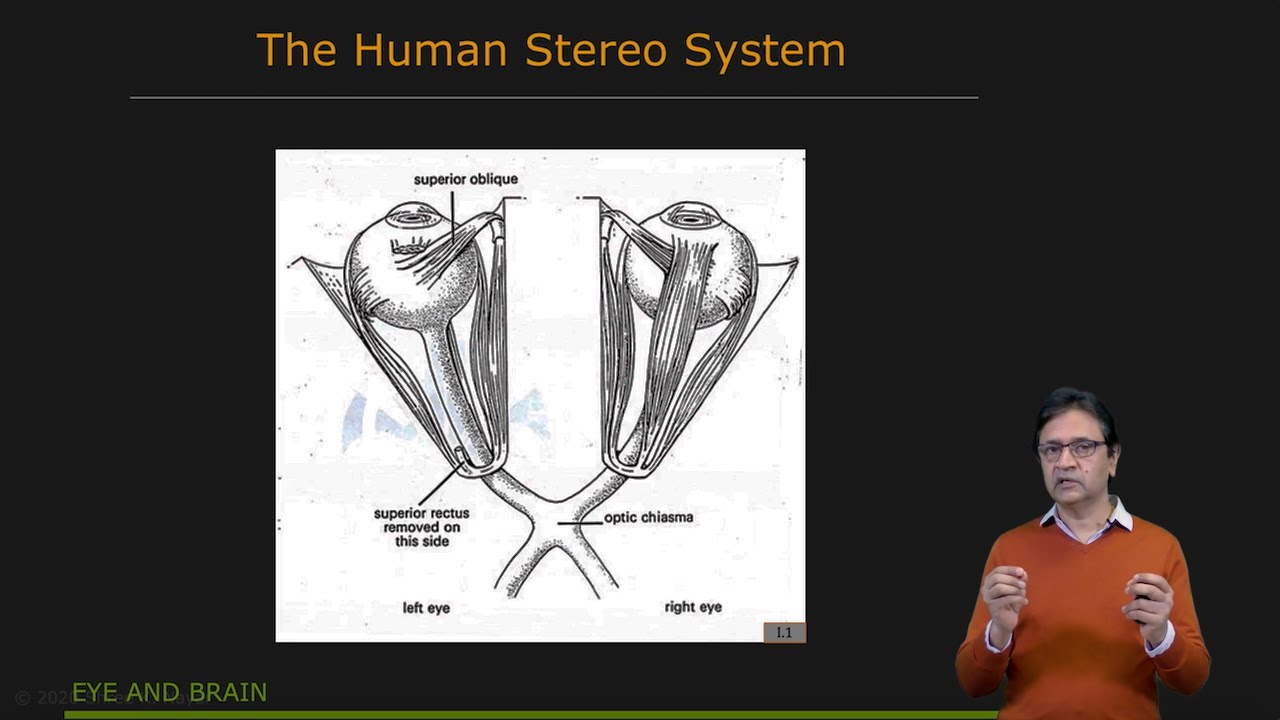
- Human stereo system: interocular distance, vergence, and ocular muscles.
- Routing of visual information through lateral geniculate nucleus for stereo matching.
- Pseudoscope experiment and depth reversal.
- Telestereoscope and its effect on perceived depth.
- Pulfrich pendulum effect and its explanation.
- Stratton's experiments with inverted images and human adaptation.
- Held and Hein kitten experiment and the importance of active learning.
Cited Sources
- First Principles of Computer Vision — This video is part of the lecture series.
Concurring Sources
- Stereopsis — General concept of depth perception from binocular vision.
- Pulfrich effect — The illusion described in the lecture.
- Visual adaptation — Phenomenon discussed with Stratton's experiments.
Contribution & Novelties
The lecture provides a comprehensive overview of stereo vision in nature, highlighting key experiments and their implications for computer vision. It bridges biology and computational approaches, emphasizing the importance of active learning and adaptation. The discussion of uncalibrated stereo is brief but sets the stage for further study.
Pour aller plus loin :
- Stereopsis — Overview of depth perception from binocular disparity.
- Pulfrich effect — Explanation of the pendulum illusion.
- Held and Hein kitten experiment — Details on the active learning experiment.
82 words
Radar Profile
The radar profile shows high scores in information quantity and quality, with moderate technical level and high reliability. This indicates a well-balanced educational content that is both informative and credible, suitable for a broad audience interested in computer vision and perception.
💬 Sur les 0 commentaires analysés, aucune tendance n'est disponible.