Camera Response and HDR Imaging | Image Sensing
Keywords
Summary
146 words
Critical Evaluation
Value of the Information & Strength of the Argument
The lecture provides a clear and rigorous explanation of fundamental concepts in computational imaging. It builds from first principles, defining the camera response function and its importance, then logically progresses to HDR imaging techniques. The argumentation is solid, supported by mathematical formulations and practical demonstrations. The value lies in its educational clarity and the connection between theoretical concepts and real-world applications, such as smartphone HDR.
Scientific Rigor, Source Quality, Title Accuracy
The content is scientifically rigorous, based on established research in computer vision. The lecturer, Shree Nayar, is a renowned expert, and the material reflects his deep knowledge. The title accurately describes the content. No external sources are cited in the video, but the techniques discussed are well-documented in the literature. The lecture is part of a series designed for educational purposes, and its quality is high.
146 words
Title / Content Match
The title accurately reflects the content, which covers camera response functions and high dynamic range imaging techniques.
Quality & Reliability
9/10
Lecture by a leading expert in computer vision, based on established principles and published research. The content is well-structured, accurate, and includes practical examples and references to commercial implementations.
Key Moments
Markers derived by PSI from the transcript: the creator did not define chapters.
- Introduction to camera response function and its nonlinearity.
- Explanation of exposure and its components (aperture and integration time).
- Why camera response functions are nonlinear and examples of gamma curves.
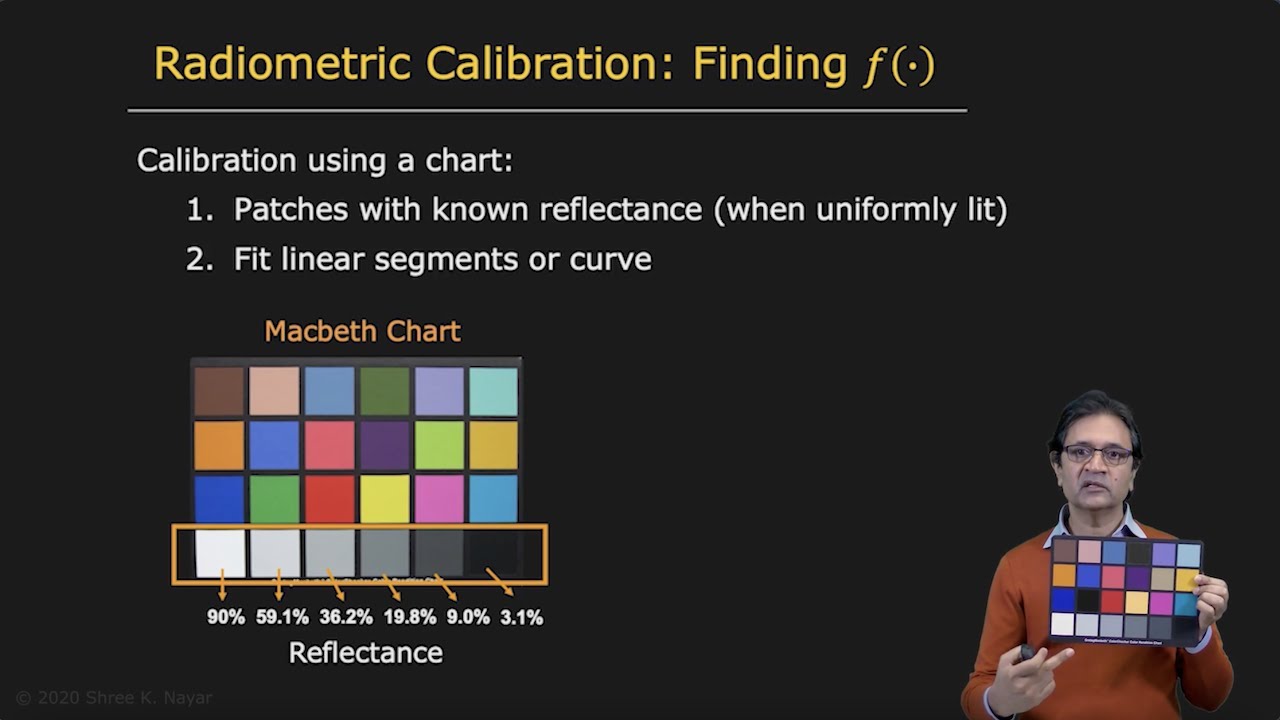
- Radiometric calibration using a calibration chart with known reflectances.
- Introduction to high dynamic range imaging and the need for it.
- Exposure bracketing technique and its limitations with moving objects.
- Single-shot HDR using assorted pixel image sensors.
- Examples of HDR images captured with assorted pixel sensors.
Contribution & Novelties
The lecture provides a comprehensive and accessible introduction to camera response functions and HDR imaging, synthesizing foundational knowledge with modern techniques. It uniquely connects the theoretical aspects with practical implementations, such as assorted pixel sensors in smartphones. The ‘Pour aller plus loin’ section offers resources for deeper exploration.
Pour aller plus loin :
- Camera response function — Overview of the concept and its role in imaging.
- High dynamic range imaging — General introduction to HDR techniques.
- Radiometric calibration — Explanation of the calibration process.
- Assorted pixels — Description of the sensor technology.
92 words
Radar Profile
The radar profile shows high scores across all dimensions, indicating a well-balanced and reliable educational resource. The strong performance in information quantity and quality, combined with high technical depth and reliability, makes it an excellent reference for learners.