Appearance Matching
Keywords
Summary
185 words
Critical Evaluation
Value of the Information & Strength of the Argument
The lecture provides a comprehensive and clear explanation of appearance matching, building on previous lectures in the series. The value lies in its pedagogical approach, breaking down the pipeline into logical steps and illustrating each with examples. The argumentation is solid, as the method is well-established and the demonstrations support the claims. The lecturer explains the rationale behind each step, such as brightness normalization to handle lighting variations, and the use of manifolds for continuous representation. The applications shown are relevant and demonstrate the versatility of the method. The presentation is convincing and effectively communicates the underlying principles.
Scientific Rigor, Source Quality, Title Accuracy
The scientific rigor is high, as the lecture is based on foundational work in computer vision, including the eigenfaces method by Turk and Pentland and the appearance matching approach by Murase and Nayar. The sources are not explicitly cited in the video, but the methods are well-known and the lecturer is a co-author of key papers. The title accurately reflects the content. The lecture is part of a series designed for a broad audience, but the technical depth is appropriate for the topic. No comments were provided for analysis.
202 words
Title / Content Match
The title accurately reflects the content, which focuses on the concept and applications of appearance matching.
Quality & Reliability
9/10
The lecture is delivered by a leading expert in computer vision, Shree Nayar, and presents a well-established method (appearance matching) with clear explanations and demonstrations. The content is consistent with the scientific literature and the presentation is rigorous.
Key Moments
Markers derived by PSI from the transcript: the creator did not define chapters.
- Introduction to appearance matching pipeline
- Offline learning phase: capturing images and normalization
- Computing mean vector and covariance matrix
- Applying PCA to find eigenspace
- Projecting images and fitting parametric manifold
- Recognition phase: input image processing and nearest neighbor search
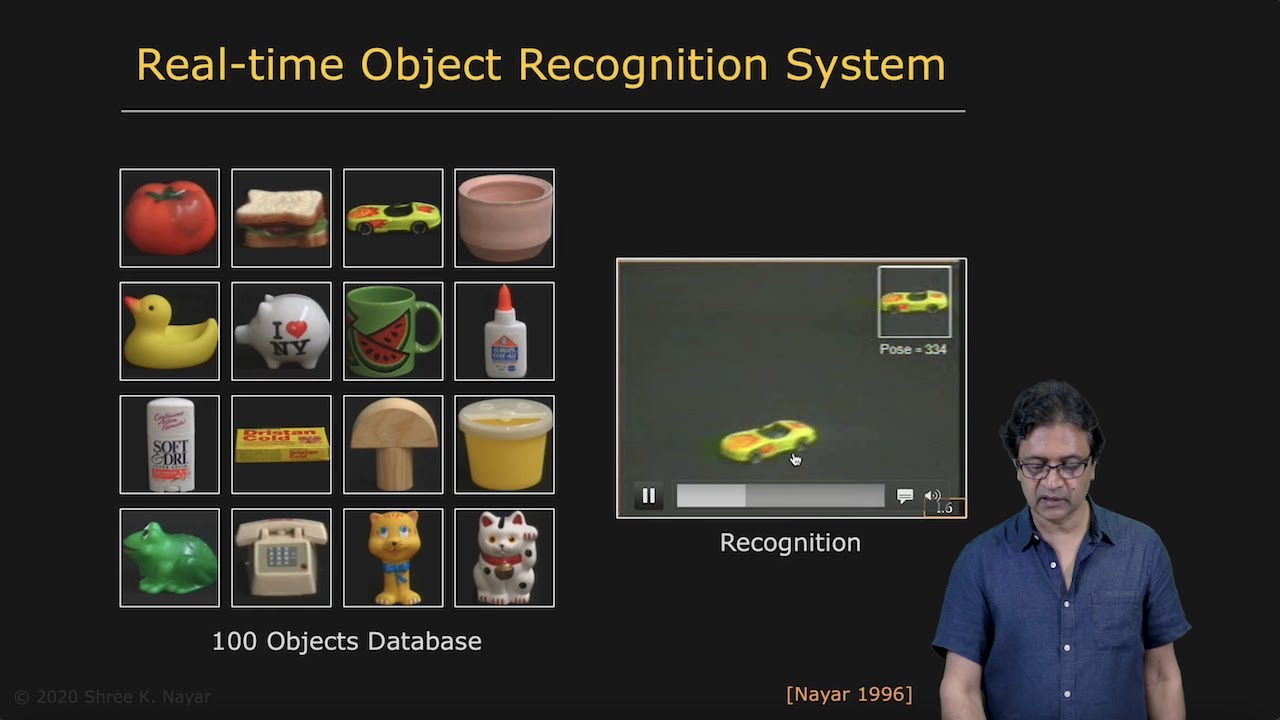
- Example: object recognition system from 1996
- Example: temporal inspection for defect detection
- Example: visual servoing for robotic tasks
- Example: face recognition using eigenfaces
Contribution & Novelties
This lecture provides a clear and structured introduction to appearance matching, a fundamental technique in computer vision. It synthesizes key concepts such as PCA, eigenspaces, and manifolds, and demonstrates their application in various domains. The lecture is valuable for learners as it builds on previous material and offers practical examples.
Pour aller plus loin :
- Eigenface - Wikipedia — Overview of eigenfaces, a key application of appearance matching.
- Principal Component Analysis - Wikipedia — Foundational technique used in the method.
- Appearance-based object recognition - Research paper — Original paper by Murase and Nayar on appearance matching.
96 words
Radar Profile
The radar profile shows high scores across all dimensions, indicating a well-balanced and reliable educational content. The lecture excels in information quality and technical depth, with a slight emphasis on quantitative information and reliability.