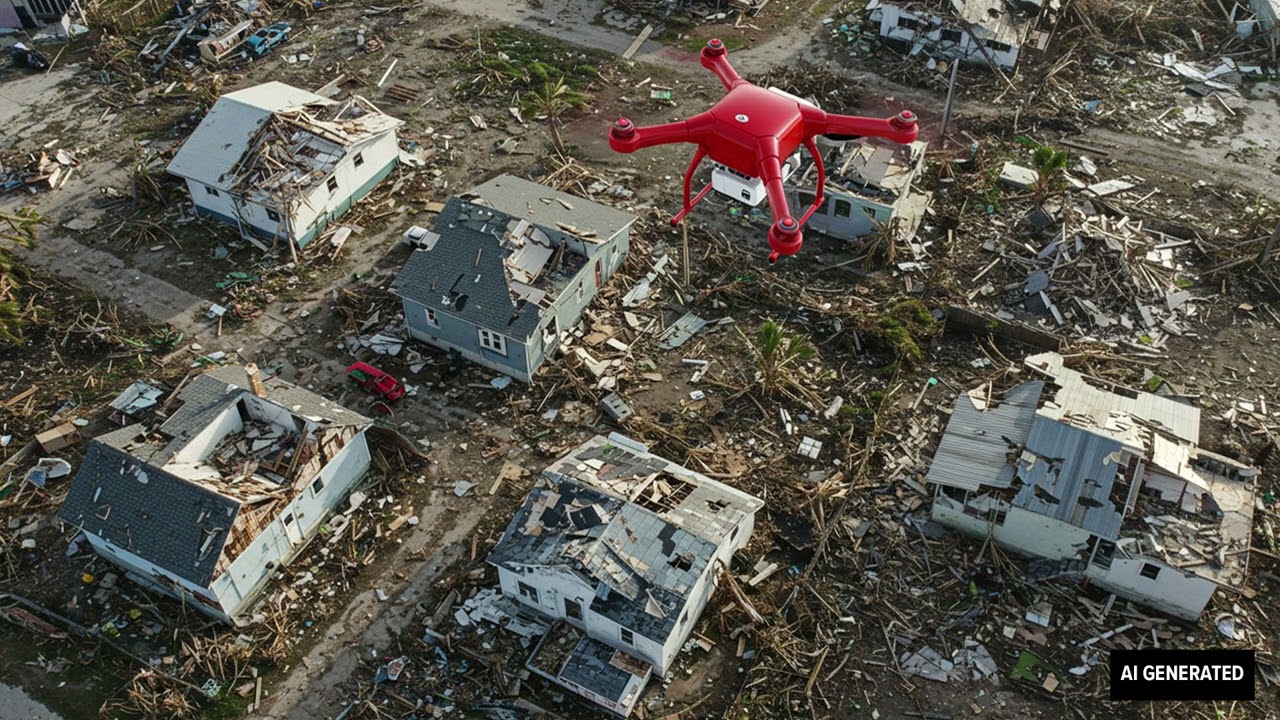
Critical Choices: AI in Disaster Management and Healthcare
Keywords
Summary
156 words
Critical Evaluation
The podcast provides a valuable overview of AI applications in high-stakes decision-making, featuring an authoritative voice in the field. Professor Singh’s expertise is evident, and the discussion is grounded in concrete projects like the CLARKE system, which adds credibility. The content is well-structured, moving from disaster management to healthcare, and highlights both the potential and the challenges of AI adoption. However, the format is conversational and lacks technical depth; for instance, the specifics of the AI algorithms and the validation methods are only briefly mentioned. The claims about the CLARKE system’s performance (e.g., 2,000 homes in seven minutes) are presented without detailed evidence, though they are plausible given the context. The discussion on maternal health is compelling but lacks statistical details beyond the 30% engagement improvement. The episode also touches on important issues like data labeling, accountability, and the need for human-AI collaboration, which are critical for real-world deployment. The title accurately reflects the content, and the episode does not overpromise, acknowledging the remaining work needed for full deployment. Overall, the content is informative and reliable, but it would benefit from more technical specifics and references to peer-reviewed studies to strengthen its scientific rigor.
194 words
Title / Content Match
The title accurately reflects the content, which focuses on AI applications in disaster management and healthcare decision-making.
Quality & Reliability
8/10
The content is presented by a recognized academic institution (Carnegie Mellon University) and features an expert in the field (Professor Aarti Singh), who is the director of an NSF-funded AI institute. The discussion is grounded in specific projects (CLARKE system) and includes references to real-world deployments and training efforts. However, the format is an interview/podcast, which limits depth and does not provide peer-reviewed evidence for all claims.
Key Moments
Markers derived by PSI from the transcript: the creator did not define chapters.
- Introduction to the episode and the topic of AI in disaster management and healthcare.
- Professor Aarti Singh introduces the AI Institute for Societal Decision Making and its mission.
- Discussion on the use of drones and robots in disaster response, including snake robots and drone imagery.
- Explanation of how AI processes drone data for damage assessment and route recommendations.
- Tabletop exercise with Florida emergency managers and identification of needs like customizing operating plans.
- Challenges of real-time AI deployment, including misinformation and the need for accountability.
- Introduction of the CLARKE system and its capability to assess 2,000 homes in seven minutes.
- The problem of unlabeled disaster data and the crowdsourcing effort to create labeled datasets.
- Training of emergency managers on CLARKE, with 60 participants from 38 agencies.
- Transition to healthcare applications, focusing on maternal mortality and patient risk profiles.
Cited Sources
- CMU Expert Aarti Singh — Profile page of Professor Aarti Singh, providing background on her work.
- Episode page on CMU website — Official page for this podcast episode, including description and related links.
Concurring Sources
- NSF AI Institute for Societal Decision Making — NSF award page confirming the existence and scope of the institute.
Contribution & Novelties
The episode provides insights into the practical application of AI in disaster management and healthcare, highlighting the CLARKE system as a concrete example of AI-assisted damage assessment. It emphasizes the importance of labeled data and human-AI collaboration, offering a realistic view of the challenges and potential of AI in high-stakes decision-making.
Pour aller plus loin :
- AI Institute for Societal Decision Making — Official NSF award page for the institute, providing details on its goals and projects.
- CLARKE system — Texas A&M University’s website, where the CLARKE system is developed; specific page not available, but the institution is the source.
- Maternal mortality in the US — CDC page on maternal mortality, providing statistics and context for the healthcare discussion.
119 words
Radar Profile
The radar profile shows high scores in quality of information and reliability, reflecting the expert guest and institutional backing. The quantity of information is moderate, and the technical level is accessible, indicating a balance between depth and accessibility.