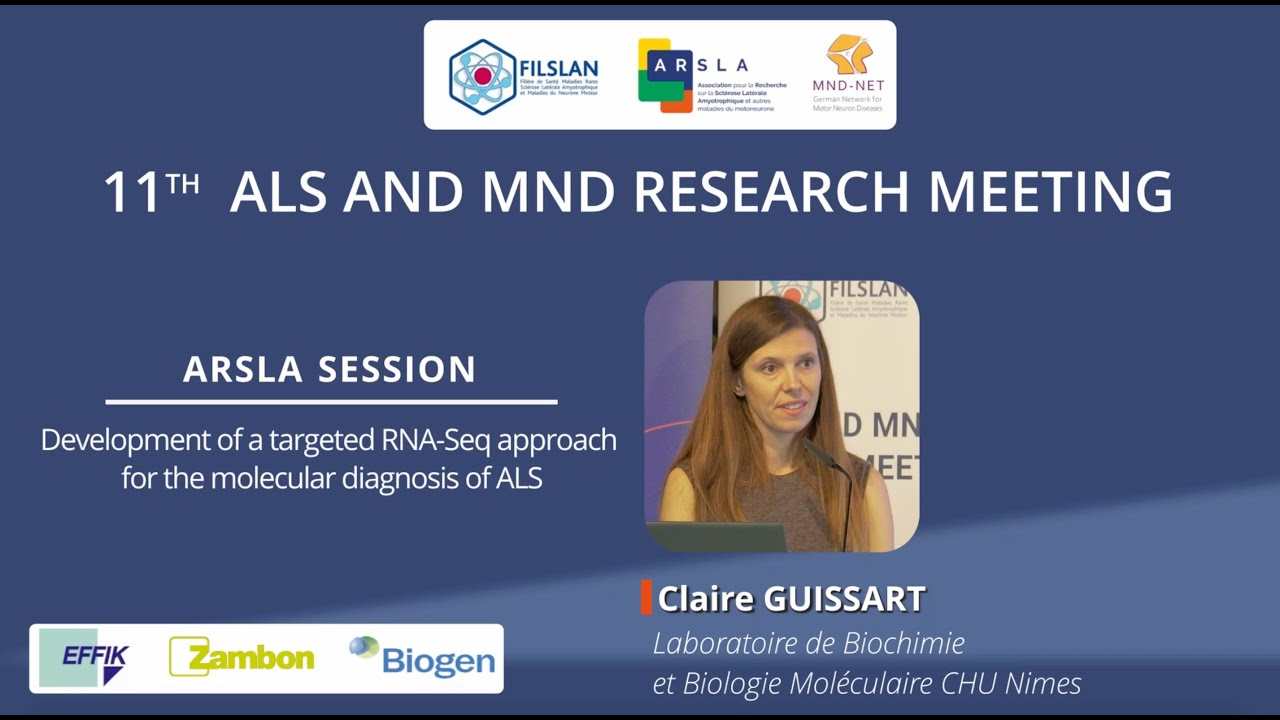
JR11 - Oral communication - Claire GUISSART
Keywords
Summary
139 words
Critical Evaluation
Value of the Information & Strength of the Argument
The presentation provides valuable data on the utility of targeted RNA-Seq in resolving uncertain splicing variants in ALS. The argumentation is solid, supported by concrete case studies and quantitative results (11 out of 37 variants reclassified). The methodology is clearly explained, and limitations are acknowledged, such as the pipeline not detecting intron retention. The speaker effectively demonstrates the clinical impact of the approach.
72 words
Title / Content Match
Title accurately reflects the content: an oral communication on targeted RNA-Seq for ALS molecular diagnosis.
Quality & Reliability
8/10
Presentation of original research with clear methodology, data from 400 patients, and functional validation of splicing variants. Limitations acknowledged (pipeline not detecting all events).
Key Moments
Markers derived by PSI from the transcript: the creator did not define chapters.
- Introduction and motivation for studying intronic variants
- Overview of project objectives and workflow
- Explanation of splicing variant interpretation and ACMG classification
- Results: 400 patients, 80 RNA analyses, 11 confirmed deleterious variants
- Bioinformatic pipeline development and feedback loop
- Case study 1: HNRNPA1 variant with multiple splicing impacts
- Case study 2: SQSTM1 deep intronic variant reclassified as likely pathogenic
- Future developments and conclusion
Contribution & Novelties
The presentation introduces a targeted RNA-Seq approach specifically for ALS molecular diagnosis, addressing the challenge of classifying intronic splicing variants. The novelty lies in the systematic integration of RNA analysis into routine diagnostics and the development of a bioinformatic pipeline with feedback optimization. The approach has led to reclassification of variants and resolution of cases, demonstrating its clinical utility.
Pour aller plus loin :
- ACMG/AMP guidelines for variant interpretation — Provides the framework for variant classification used in the study.
- Sashimi plot visualization — A tool for visualizing splicing events, central to the presented results.
- RNA-Seq in clinical diagnostics — Overview of RNA sequencing applications in medicine, relevant to the methodology.
111 words
Radar Profile
The radar profile shows high scores in information quantity, quality, and reliability, with a slightly lower technical level, indicating a well-balanced presentation accessible to a specialized audience.