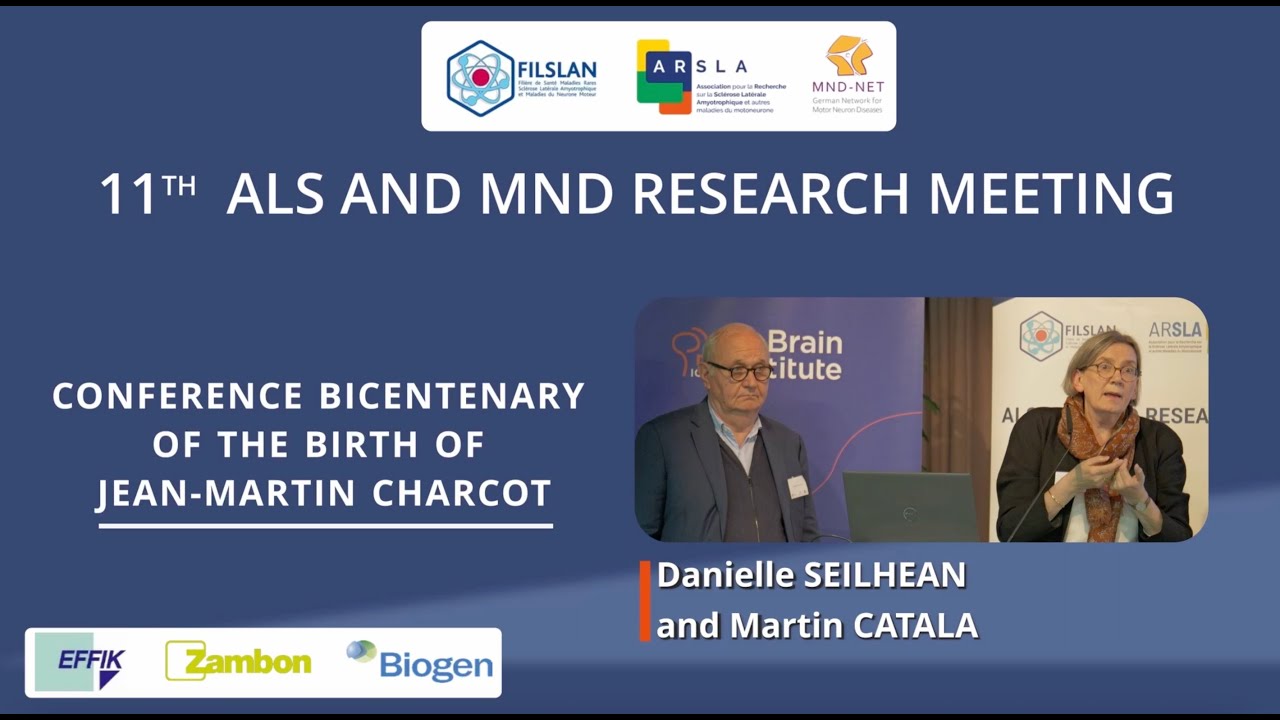
JR11 - Conference - Danielle SEILHEAN and Martin CATALA
Keywords
Summary
175 words
Critical Evaluation
Value of the Information & Strength of the Argument
The presentation offers substantial historical value by synthesizing primary sources and archival materials. The argumentation is solid, as the speakers carefully trace the evolution of ideas and evidence, from early root experiments to Charcot’s systematic observations. They critically evaluate historical claims, such as the myth that ALS sprang fully armed from Charcot’s head, and provide nuanced interpretations of Charcot’s theories. The use of original documents, including a sketchbook and patient records, strengthens their argument. However, the talk is largely descriptive and interpretive, with limited critical analysis of the limitations of historical sources.
Scientific Rigor, Source Quality, Title Accuracy
The scientific rigor is high, with references to primary historical publications and archival collections. The speakers demonstrate a thorough command of the literature of the period, citing works by Bell, Magendie, Clarke, Waller, and others. The quality of sources is excellent, as they draw on original documents and pathological specimens. The title accurately reflects the content, as the conference is indeed a presentation by the two named speakers on a historical topic. The adequacy between title and content is perfect, with no misleading elements.
191 words
Title / Content Match
The title accurately reflects the content: a conference presentation by the two named speakers at the 11th ALS and MND research meeting.
Quality & Reliability
8/10
The conference is delivered by two experts in neuropathology and anatomy, based on primary historical sources and archival documents. The content is well-documented and aligns with established historical knowledge, though it is an interpretive presentation rather than a systematic review.
Key Moments
Markers derived by PSI from the transcript: the creator did not define chapters.
- Introduction and presentation of the topic: bicentenary of Charcot's birth.
- Early discoveries on spinal roots: Bell, Magendie, Müller.
- First descriptions of progressive muscular atrophy by Cruveilhier and Duchenne.
- Clarke's histological work on the spinal cord.
- Waller's degeneration and its application to the spinal cord.
- Charcot's 1868 description of ALS based on the case of Katherine Oel.
- Charcot's lectures in the 1870s and his theory of systematic sclerosis.
- Archival findings: Charcot's sketchbook and identification of patient Victoria.
- Charcot's techniques: microscopy, chromic acid fixation, and staining.
- Charcot's interpretation of fetal myelination and vulnerability of lateral tracts.
- Conclusion: ALS as a result of a long intellectual process, not a sudden discovery.
Cited Sources
- Bell's letter on ventral roots (1811) — Mentioned as the first demonstration of motor function of ventral roots.
- Magendie's experiments on spinal roots (1822) — Confirmed the motor function of ventral roots and sensory function of dorsal roots.
- Clarke's histological sections (1850) — Provided the best histology of the spinal cord at the time.
- Cruveilhier's description of progressive muscular atrophy — First description of a case of ALS, with fasciculations.
- Duchenne's work on progressive muscular atrophy — Described atrophy of anterior horns.
- Waller's degeneration (1850) — Demonstrated Wallerian degeneration in peripheral nerves.
- Charcot's 1868 publication on ALS — First description of amyotrophic lateral sclerosis based on the case of Katherine Oel.
- Charcot's lectures (1870s) — Collected by students and published, detailing his theories.
- Charcot's sketchbook — Archival watercolors by Charcot, now at Sorbonne University.
Concurring Sources
- Charcot's original publications — Primary sources cited in the talk.
- Historical accounts of ALS — General historical narratives align with the presentation.
Dissenting Sources
- Some modern interpretations of Charcot's work — The speakers' emphasis on Charcot's theory of systematic sclerosis may differ from some modern interpretations that focus more on his clinical descriptions.
Contribution & Novelties
This conference provides a novel historical perspective by combining archival research with clinical and pathological insights. It challenges the myth that ALS was a sudden discovery by Charcot, instead showing it as the culmination of decades of observations. The identification of the patient Victoria and the analysis of Charcot’s sketchbook offer new biographical details. The presentation also highlights Charcot’s theoretical framework, which is often overlooked in modern accounts.
Pour aller plus loin :
- Jean-Martin Charcot — Overview of Charcot’s life and contributions.
- Amyotrophic lateral sclerosis — Modern understanding of ALS.
- Wallerian degeneration — Explanation of the process described by Waller.
- Spinal cord anatomy — Basic anatomy relevant to the talk.
110 words
Radar Profile
The radar profile shows high scores in quality and reliability, reflecting the expert presentation and use of primary sources. The quantity of information is also high, but the technical level is moderate, as the talk is accessible to a general medical audience. The overall balance indicates a well-rounded, informative historical lecture.
💬 No comments were provided for analysis.