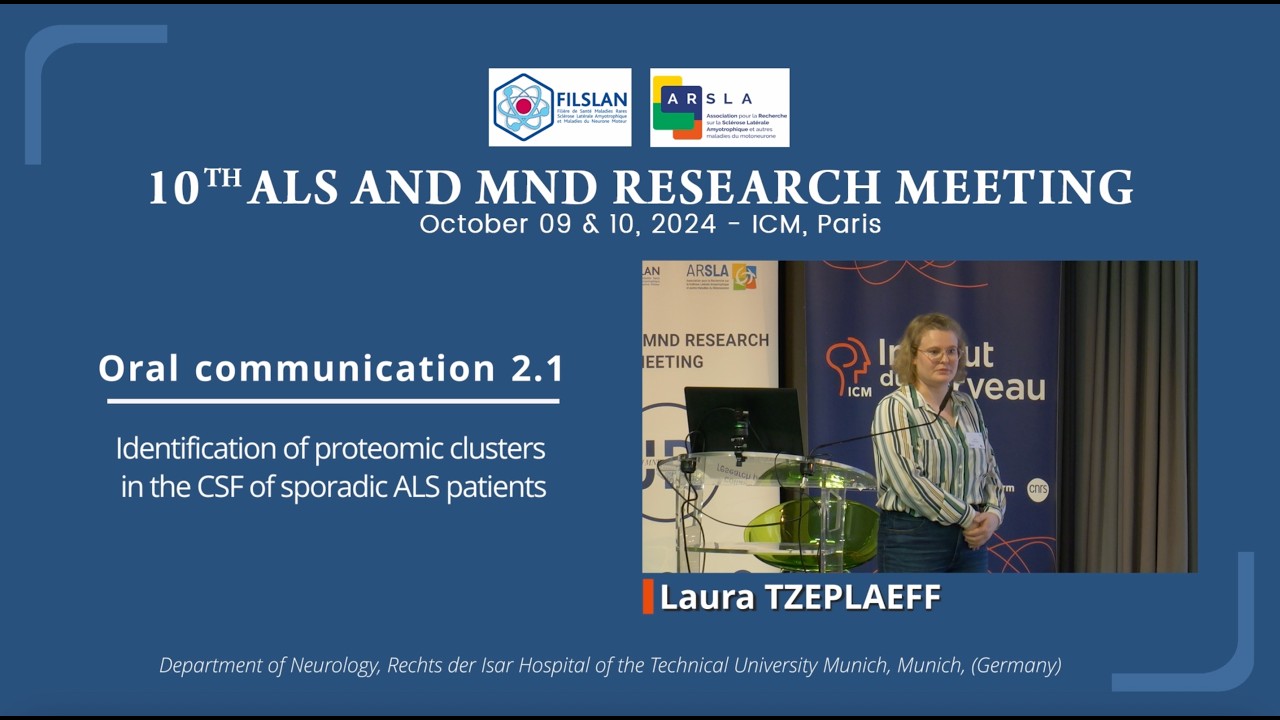
JR10 - Oral communication - Laura TZEPLAEFF
Keywords
Summary
141 words
Critical Evaluation
Value of the Information & Strength of the Argument
The presentation provides valuable insights into ALS heterogeneity, using robust proteomic methods and clustering algorithms. The argumentation is logical, progressing from brain to CSF analysis, and clearly explains the identification of distinct molecular subgroups. The correlation with clinical data (age at onset) strengthens the clinical relevance. However, the sample size is relatively small, and the lack of validation in an independent cohort limits the strength of conclusions.
76 words
Title / Content Match
The title accurately reflects the content, which is an oral communication on proteomic clusters in ALS CSF.
Quality & Reliability
7/10
Presentation of original research with clear methodology, but limited peer-review context and small sample size.
Key Moments
Markers derived by PSI from the transcript: the creator did not define chapters.
- Introduction and background on brain proteomic clusters
- CSF sample collection and mass spectrometry analysis
- Differential expression analysis between ALS and controls
- Sex-specific differences in protein expression
- Clustering analysis and identification of two/three clusters
- Characterization of alpha and beta clusters
- Correlation with clinical data and conclusions
Contribution & Novelties
This study contributes to the understanding of ALS heterogeneity by identifying distinct proteomic clusters in CSF, which could facilitate patient stratification and personalized treatment approaches. The finding of an immune response/coagulation cluster associated with younger age at onset is novel and clinically relevant.
Pour aller plus loin :
- ALS biomarkers — Overview of ALS and biomarkers.
- Proteomics — Background on proteomic techniques.
- Clustering algorithms — Explanation of clustering methods used.
70 words
Radar Profile
The radar profile shows high scores in information quality and technical level, with moderate scores in quantity and reliability, indicating a technically sound but limited-scope presentation.