JR11 - Oral communication - Raphaëlle CASSEL
Keywords
Summary
168 words
Critical Evaluation
Value of the Information & Strength of the Argument
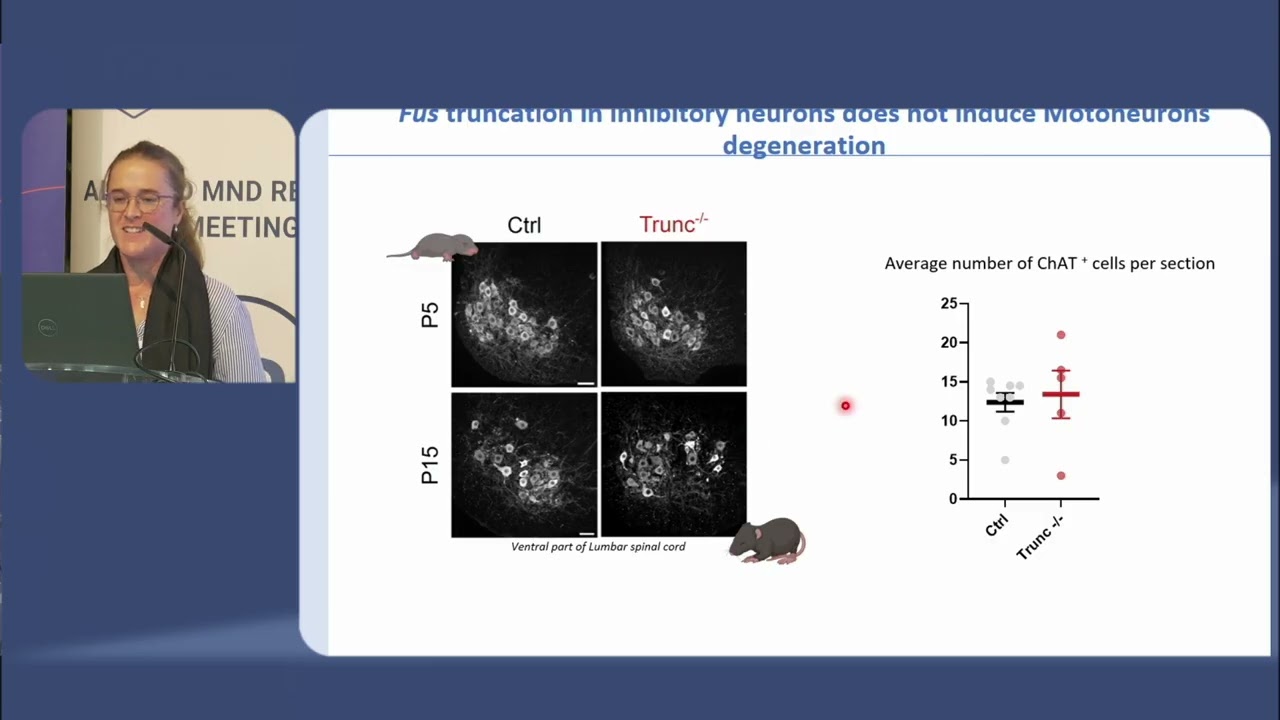
The value of the information lies in its presentation of novel findings on the role of inhibitory neurons in ALS/FTD, specifically using a conditional mouse model to isolate the effects of FUS mutation in these cells. The argumentation is logical and methodical: the speaker systematically rules out alternative explanations (e.g., lower motor neuron loss, NMJ denervation, feeding issues) and highlights the unexpected mortality phenotype. However, the presentation is limited by the lack of mechanistic insight into the cause of death, which the speaker openly acknowledges. The scientific value is moderate, as the findings are preliminary and not yet published, but they contribute to the understanding of FUS-related pathology.
Scientific Rigor, Source Quality, Title Accuracy
The scientific rigor is adequate for a conference presentation: the methodology is clearly described, and the results are presented with appropriate caution. However, no specific sources are cited in the talk, and the description provides no links to publications. The title accurately reflects the content, and the presentation adheres to the expected format of a research talk. The adequacy between title and content is high, as the talk directly addresses the involvement of inhibitory neurons in ALS/FTD linked to FUS.
203 words
Title / Content Match
The title accurately reflects the content: an oral communication on the involvement of inhibitory neurons in ALS and FTD linked to FUS protein.
Quality & Reliability
7/10
Presentation of original research at a scientific meeting, with clear methodology and results, but limited detail and no peer-reviewed publication cited.
Key Moments
Markers derived by PSI from the transcript: the creator did not define chapters.
- Introduction and acknowledgments to ARSLA
- Background on FUS protein and its role in ALS/FTD
- Description of mouse models with conditional FUS NLS truncation in inhibitory neurons
- Survival curve showing mortality around P20 in homozygous mutants
- Body weight and length measurements at P5 and P15
- Motor performance tests: surface righting, negative geotaxis, and wire hang
- Examination of lower motor neurons and neuromuscular junctions
- Cortical inhibitory neuron analysis showing FUS mislocalization
- Investigation of feeding difficulties and EEG attempts
- Conclusions and Q&A session
Contribution & Novelties
This presentation provides novel insights into the role of inhibitory neurons in FUS-related ALS/FTD by using a conditional mouse model that specifically targets FUS NLS truncation in inhibitory neurons. The unexpected mortality phenotype around P20 and the lack of lower motor neuron degeneration suggest a cortical mechanism for motor deficits. The work highlights the importance of inhibitory neuron dysfunction in ALS/FTD spectrum disorders.
Pour aller plus loin :
- FUS protein — Overview of FUS gene and protein functions.
- Amyotrophic lateral sclerosis — General information on ALS.
- Frontotemporal dementia — Overview of FTD.
- Inhibitory postsynaptic potential — Basic concept of inhibitory neurotransmission.
101 words
Radar Profile
The radar profile shows high scores in technical level and information quality, reflecting the specialized nature of the content and the presenter's expertise. The lower score in information quantity is due to the concise format of a conference talk, while the reliability score is moderate, consistent with preliminary unpublished findings.