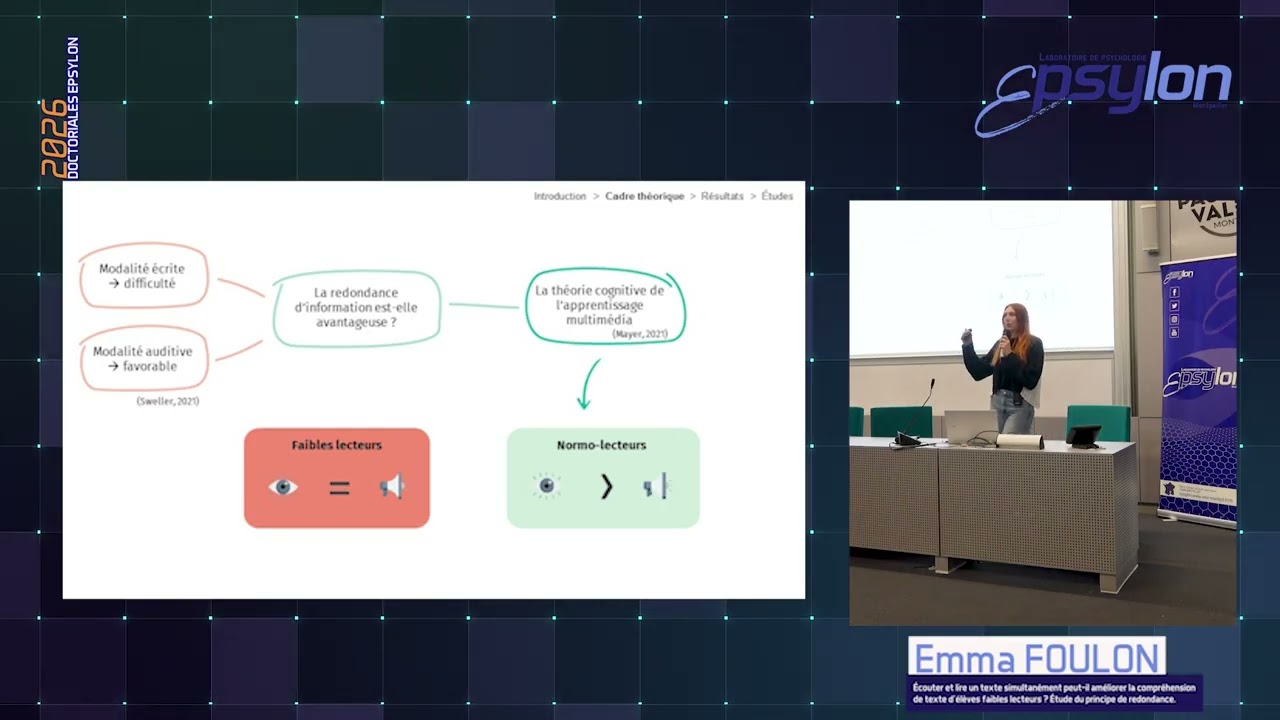
Doctoriales Epsylon 2026 Emma Foulon
Keywords
Summary
244 words
Critical Evaluation
Value of the Information & Strength of the Argument
The presentation provides valuable insights into an under-researched area: the redundancy effect for weak readers. The argumentation is grounded in established theory (CTML) and prior empirical work, including a meta-analysis. The speaker clearly explains the theoretical rationale and the potential for redundancy to compensate for the transient nature of audio and the difficulties of text for weak readers. The progression from master’s study to planned experiments shows a systematic research approach. However, the argumentation is limited by the preliminary nature of the findings and the lack of detailed statistical results in the presentation.
Scientific Rigor, Source Quality, Title Accuracy
The presentation demonstrates scientific rigor by referencing key theories and studies, such as Mayer’s CTML and the meta-analysis by Adesope and Nesbit. The speaker acknowledges the lack of consensus in the literature and the absence of effects in prior studies. The title accurately reflects the content, as it is a doctoral presentation. The sources are not explicitly cited with URLs, but the theoretical framework is well-established. The adequacy between title and content is high.
182 words
Title / Content Match
The title accurately reflects the content: a doctoral student presenting her thesis topic at the Epsylon doctoral days.
Quality & Reliability
7/10
The presentation is based on established cognitive theories (CTML) and includes references to a meta-analysis and prior studies. However, the speaker is a first-year PhD student presenting preliminary work, and the video is a short conference presentation, limiting depth and verification of claims.
Key Moments
Markers derived by PSI from the transcript: the creator did not define chapters.
- Introduction: Emma Foulon introduces herself and her thesis topic.
- Background on dyslexia and weak readers.
- Explanation of multimedia learning and CTML.
- Discussion of the redundancy principle and its potential for weak readers.
- Presentation of master's study results and moderators.
- Description of first thesis study: adaptive audio software.
- Plans for future studies and conclusion.
Cited Sources
- Mayer's Cognitive Theory of Multimedia Learning — Theoretical framework for the research.
- Adesope & Nesbit meta-analysis on redundancy effect — Identified moderators of the redundancy effect.
Concurring Sources
- Mayer's CTML — Supports the idea that multimedia combinations can enhance learning.
Dissenting Sources
- Studies showing no effect of redundancy — The speaker mentions that prior studies found no significant effects, which contrasts with her hypothesis.
Contribution & Novelties
The presentation offers a novel perspective on applying the redundancy principle to weak readers, suggesting that synchronized text and audio might create a dual trace that enhances comprehension. The proposed adaptive audio software is an innovative application. The research addresses a gap in the literature, as only one team has studied this specific population.
Pour aller plus loin :
- Cognitive Theory of Multimedia Learning — Overview of Mayer’s theory.
- Redundancy effect — Explanation of the effect.
- Dyslexia — Background on dyslexia.
81 words
Radar Profile
The radar profile shows balanced scores across information quantity, quality, technical level, and reliability, indicating a solid but not exceptional presentation. The high quality and reliability scores reflect the use of established theories and empirical evidence, while the moderate technical level suggests accessibility to a broad audience.