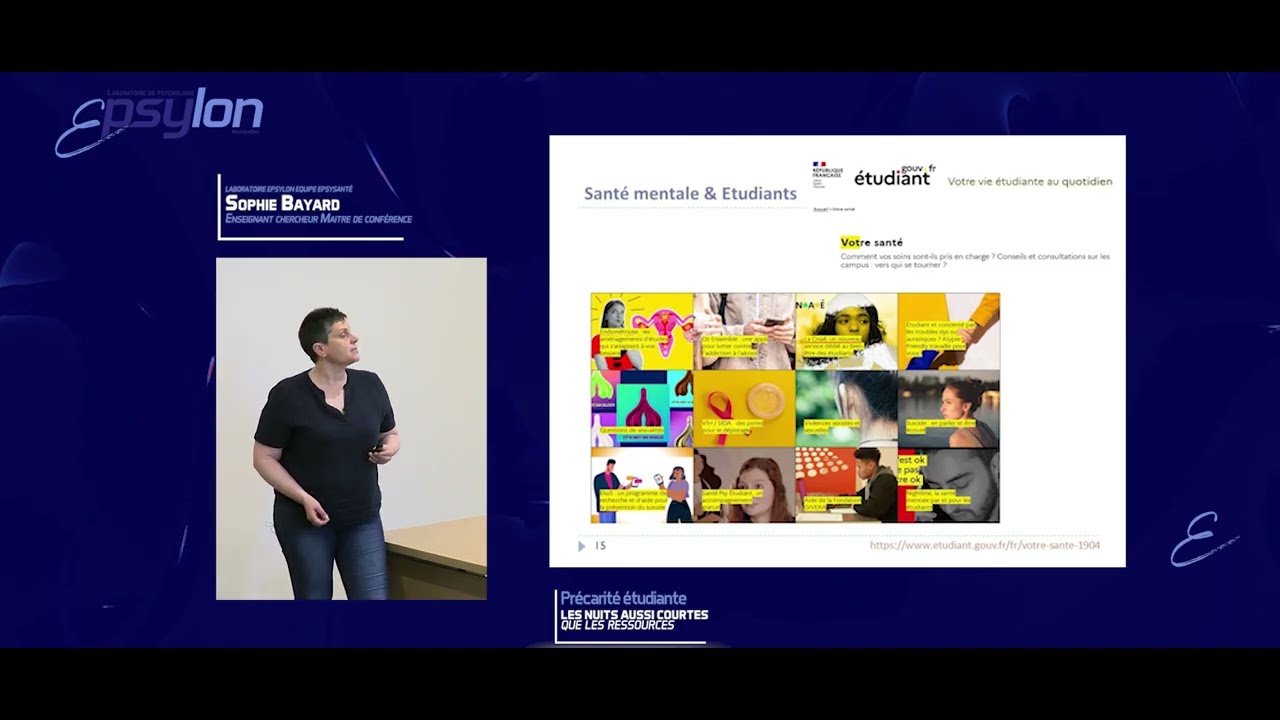
Intervention Sophie Bayard (laboratoire Epsylon) sur la Précarité étudiante
Keywords
Summary
167 words
Critical Evaluation
Value of the Information & Strength of the Argument
The presentation provides valuable insights into the complex interplay between precarity, sleep, mental health, and academic success. The speaker supports her arguments with references to recent studies and national data, such as the OMS study and the Observatoire national de la vie étudiante. She also presents preliminary data from her own research, adding original evidence. The argumentation is coherent and well-structured, building a model that links these factors. However, the talk is largely an expert opinion, and the preliminary results are not yet published, which limits the strength of the conclusions.
Scientific Rigor, Source Quality, Title Accuracy
The speaker demonstrates scientific rigor by citing multiple studies and national statistics, and she clearly distinguishes between established literature and preliminary findings. The sources are relevant and recent, though not all are explicitly named with full references. The title accurately reflects the content, which is a focused lecture on student precarity and its consequences. The presentation is well-organized and the speaker is transparent about the limitations of the data.
175 words
Title / Content Match
The title accurately reflects the content: a lecture on student precarity, focusing on sleep, mental health, and academic success.
Quality & Reliability
7/10
Presentation by a university lecturer, based on scientific literature and preliminary data from an ongoing study. The speaker cites several studies and national data, but the presentation is largely an expert opinion and preliminary results not yet published. The video is a conference recording, not a peer-reviewed source.
Key Moments
Markers derived by PSI from the transcript: the creator did not define chapters.
- Introduction and acknowledgments
- Overview of the PRISME research program
- Statistics on student precarity in France
- Definition of multidimensional precarity
- Link between precarity and mental health
- Prevalence of insomnia among students
- Sleep as a modifiable risk factor for neurodegenerative diseases
- Survey on students' information needs regarding sleep
- Role of executive functions in academic success
- Preliminary results from the study at Paul-Valéry University
Cited Sources
- Observatoire national de la vie étudiante — Cited as source of data on student precarity in France.
- OMS study on precarity and mental health — Cited as a robust study linking precarity to mental health issues.
- Sleep Medicine consortium publication — Cited as a wake-up call on the importance of sleep in mental health.
Concurring Sources
- Observatoire national de la vie étudiante — Provides national data on student living conditions, supporting the claims about precarity.
Contribution & Novelties
The presentation offers a novel perspective by integrating multidimensional precarity, insomnia, mental health, and executive functions in a unified model for student academic success. It highlights the lack of research in France on these relationships and presents preliminary data from a local study. The emphasis on sleep as a neglected factor in university health policies is a valuable contribution.
Pour aller plus loin :
- Insomnia — Overview of insomnia, its diagnosis, and prevalence.
- Executive functions — Definition and role of executive functions in cognition.
- Student mental health — WHO fact sheet on mental health, relevant to student populations.
98 words
Radar Profile
The radar profile shows high scores in quantity of information and technical level, reflecting the detailed and specialized content. The quality of information and global reliability are slightly lower, indicating that while the presentation is well-supported, it is based on expert opinion and preliminary data rather than peer-reviewed publications.
💬 No comments were provided for analysis.