Doctoriales Epsylon 2026 Méryl Donadey
Keywords
Summary
191 words
Critical Evaluation
Value of the Information & Strength of the Argument
The presentation provides valuable insights into the implementation of person-centered care in nursing homes, based on original qualitative research. The argumentation is coherent, systematically moving from the problem (crisis in nursing homes) to the solution (person-centered approaches) and then to the complexities of implementation. The speaker effectively uses a hypothetical example to illustrate the ideal application, making the concept tangible. The study’s methodology is appropriate for exploring implementation factors, and the findings are presented as a systemic model. However, the presentation lacks specific data or quotes to substantiate the claims, and the generalizability of the findings is not discussed. The argument for the value of mixed methods is well-made, but the link between research and societal change could be elaborated further.
Scientific Rigor, Source Quality, Title Accuracy
The scientific rigor is moderate. The speaker references the Montessori method and Cameron Camp but does not provide specific citations or sources. The study’s methodology is described, but details on data analysis and validity are omitted. The title accurately reflects the content, which is a doctoral presentation. The description of the video provides context about the research team’s focus on health psychology, but no additional sources are listed. Overall, the presentation appears scientifically grounded but lacks explicit references to support the claims.
218 words
Title / Content Match
The title accurately reflects the content: a presentation of doctoral research within the Epsylon laboratory.
Quality & Reliability
7/10
The presentation is based on a doctoral research project with a clear qualitative methodology (semi-structured interviews, thematic analysis). The speaker references scientific literature and the Montessori method for elderly care, but does not provide specific citations or data in the video. The content is coherent and appears scientifically grounded, though limited by the format.
Key Moments
Markers derived by PSI from the transcript: the creator did not define chapters.
- Introduction and presentation of the speaker and thesis topic.
- Discussion of the nursing home crisis and the goal of changing perceptions.
- Explanation of person-centered approaches and the Montessori method.
- Illustration of an ideal application of the Montessori method in a nursing home.
- Challenges in implementation and the need for systemic factors.
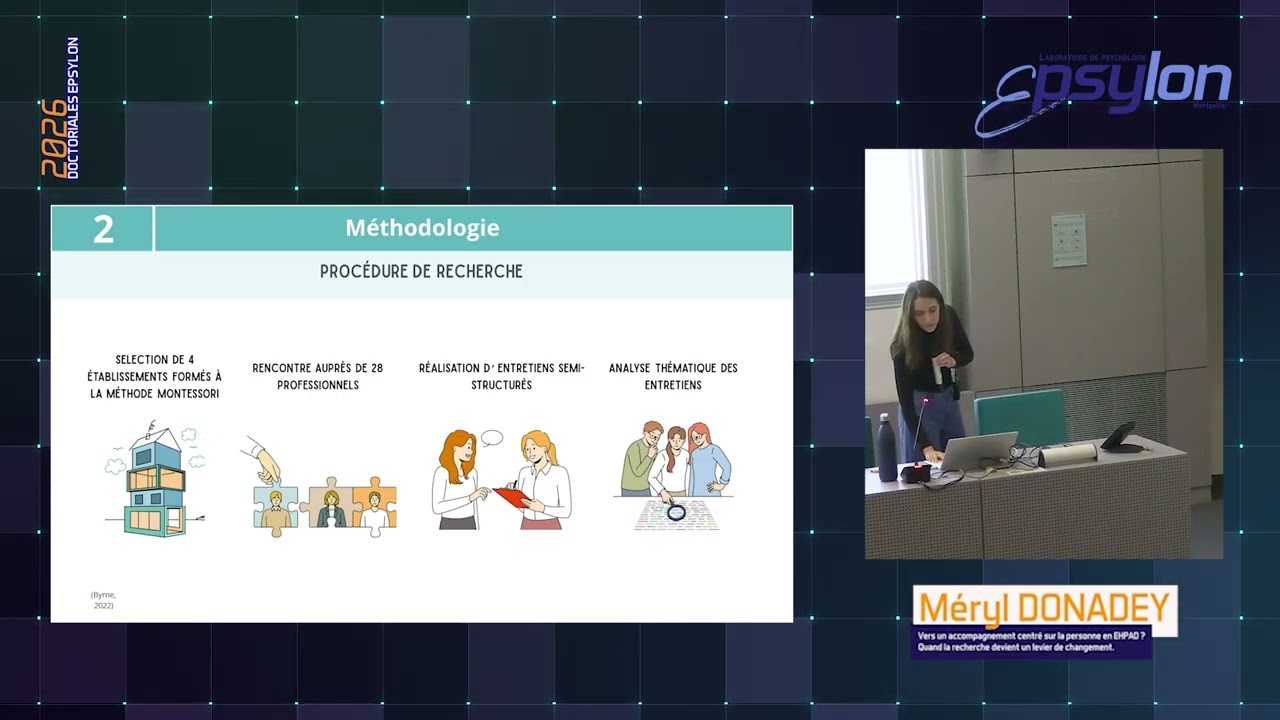
- Description of the qualitative study design and interviews with 28 professionals.
- Presentation of results: factors at societal, organizational, and individual levels.
- Chronological process of implementation and long-term outcomes.
- Conclusion: reflections on methodology and researcher's role in societal change.
Cited Sources
- Montessori method for dementia care — Referenced as the basis of the method, adapted by Cameron Camp.
Concurring Sources
- Person-centered care in nursing homes — The findings align with existing literature on person-centered care, as mentioned by the speaker.
Contribution & Novelties
The presentation offers original insights into the implementation of the Montessori method in nursing homes, identifying a systemic model of factors that influence its adoption. The qualitative approach provides rich, contextual data that complement existing quantitative studies. The speaker highlights the importance of staff engagement and organizational resources, and the potential for research to drive societal change through training modules and webinars.
Pour aller plus loin :
- Person-centered care in dementia — Overview of the concept.
- Montessori-based activities for dementia — Information on dementia care approaches.
- Implementation science — Framework for understanding factors influencing adoption of interventions.
97 words
Radar Profile
The radar profile shows moderate to high scores across all dimensions, with the highest in quality of information and fiabilité, reflecting a well-structured and scientifically grounded presentation. The lower score in technical level suggests the content is accessible to a general audience, while still providing depth. The overall balance indicates a solid, informative talk.