Nathalie Huet Journée d'étude Pasco 2026, La demande d'aides
Keywords
Summary
223 words
Critical Evaluation
Value of the Information & Strength of the Argument
The presentation provides a comprehensive overview of help-seeking in learning, grounded in established theoretical models and empirical research. The speaker effectively argues that help-seeking is a complex, self-regulated strategy that depends on metacognitive and motivational factors. She supports her points with references to key studies and models, such as Nelson-Le Gall’s model and research by Puustinen. The distinction between executive and instrumental help is clearly explained and illustrated with examples using AI. The argumentation is coherent and well-structured, moving from theoretical foundations to practical implications. The speaker also addresses common misconceptions and provides evidence-based insights into why some learners seek help effectively while others do not.
Scientific Rigor, Source Quality, Title Accuracy
The presentation demonstrates scientific rigor by referencing established models and empirical studies. The speaker cites specific researchers and studies, such as Nelson-Le Gall (1981) and Puustinen, and discusses findings from her own research. The sources are credible within the field of educational psychology. The title accurately reflects the content, which focuses on the topic of help-seeking. The presentation is well-organized and aligns with the title. No comments were provided for analysis.
192 words
Title / Content Match
The title accurately reflects the content, which focuses on the topic of help-seeking in learning contexts.
Quality & Reliability
8/10
The speaker is a professor of cognitive psychology, and the content is based on established models and research in the field. The presentation is well-structured and cites specific studies and models, though it is a conference talk rather than a peer-reviewed publication.
Key Moments
Markers derived by PSI from the transcript: the creator did not define chapters.
- Introduction and thanks to organizers
- Observation that only some students ask for help in class and digital environments
- Definition of help-seeking as a self-regulated learning strategy
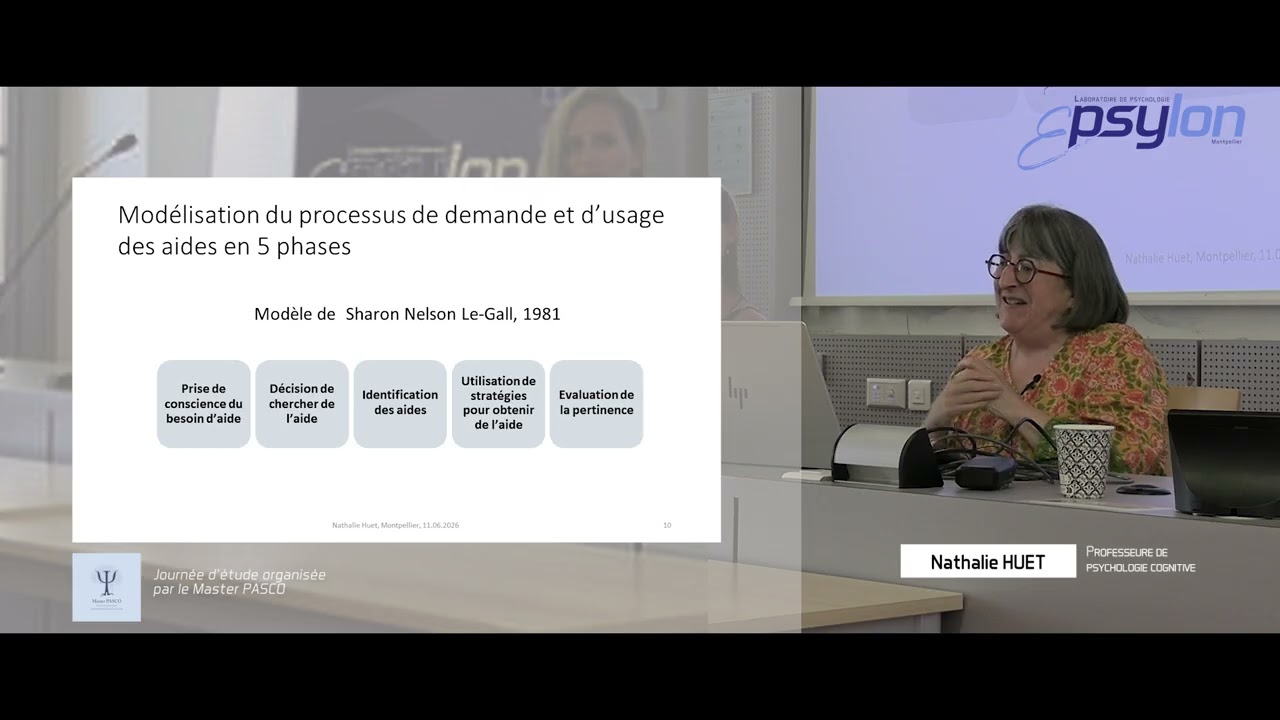
- Presentation of Nelson-Le Gall's five-step model of help-seeking
- Distinction between executive and instrumental help-seeking
- Discussion of confirmation requests and inappropriate help-seeking behaviors
- Factors affecting help-seeking: metacognitive and motivational
- Threats to competence and autonomy, and strategies to reduce them
- Self-efficacy and help-seeking: three hypotheses and research findings
- Conclusion and summary of key points
Cited Sources
- Nelson-Le Gall, S. (1981). Help-seeking: An understudied skill in children. — Mentioned as the classic model of help-seeking steps.
- Puustinen, M. (research on help-seeking in digital environments) — Referenced for research on help-seeking behavior and formulation of requests.
- Bandura, A. (self-efficacy theory) — Referenced for definition of self-efficacy.
Concurring Sources
- Nelson-Le Gall, S. (1981). Help-seeking: An understudied skill in children. — Model presented aligns with established literature.
- Puustinen, M. (research on help-seeking) — Findings on help-seeking behavior are consistent with the presentation.
Contribution & Novelties
The presentation offers a synthesis of existing research on help-seeking, with a focus on the role of self-efficacy and the distinction between executive and instrumental help. It provides practical insights for educators, such as using prompts to reduce perceived threats. The speaker also shares findings from her own study, contributing original data on the relationship between self-efficacy and effective help-seeking.
Pour aller plus loin :
- Self-regulated learning — Overview of the concept central to the presentation.
- Metacognition — Key factor in help-seeking behavior.
- Self-efficacy — Bandura’s theory discussed in the talk.
- Help-seeking — General overview of the topic.
98 words
Radar Profile
The radar profile shows high scores in information quantity, quality, and technical level, with a slightly lower but still strong score in global reliability. This indicates a well-informed and technically detailed presentation that is generally reliable, though it is based on expert opinion rather than a systematic review.