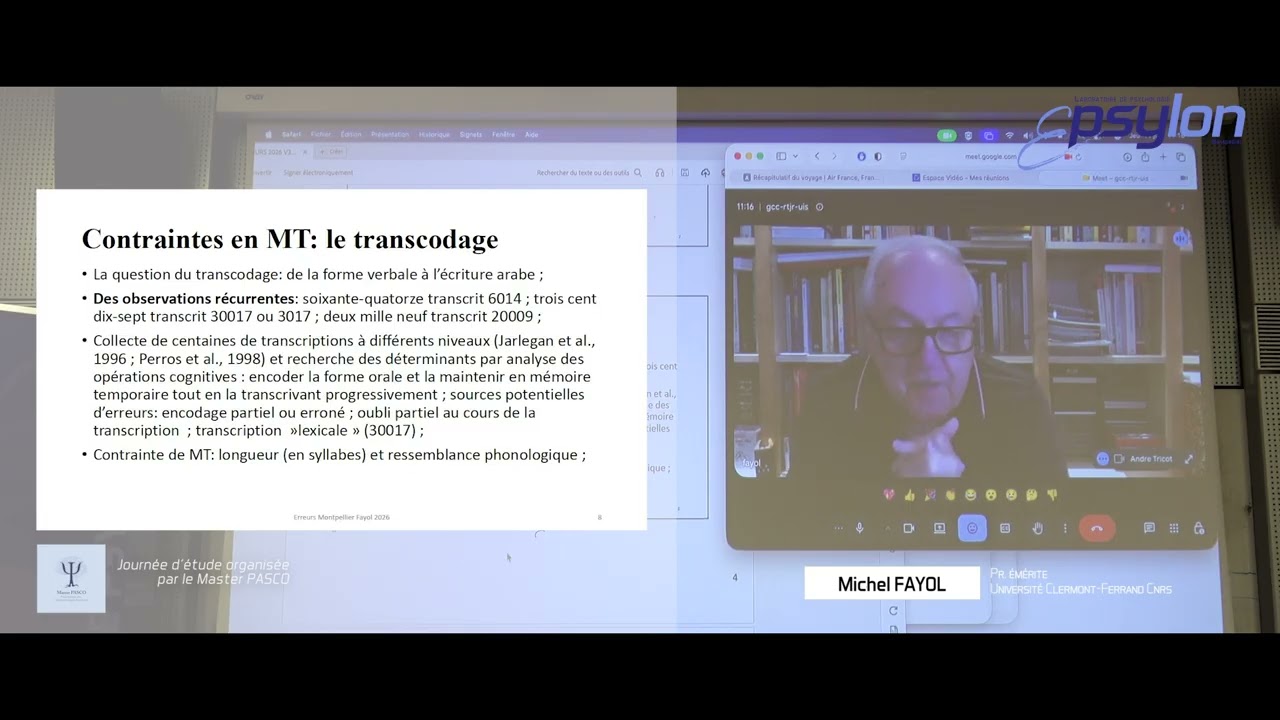
Michel Fayol Journée d'étude Pasco sur thème de : "Des erreurs : qu'en faire?"
Keywords
Summary
127 words
Critical Evaluation
Value of the Information & Strength of the Argument
The talk provides valuable insights into the cognitive mechanisms underlying errors in learning, supported by empirical research. Fayol argues convincingly for a preventive approach, citing studies that demonstrate the influence of memory and implicit learning. His argumentation is solid, though some points are presented briefly due to time constraints.
Scientific Rigor, Source Quality, Title Accuracy
Fayol references several studies, including his own and those of colleagues, but does not provide specific citations during the talk. The title accurately reflects the content. The presentation is scientifically rigorous, but the lack of explicit references limits verifiability.
103 words
Title / Content Match
The title accurately reflects the content, which is a presentation on the role of errors in learning, particularly in spelling and mathematics.
Quality & Reliability
8/10
The speaker is a professor emeritus with extensive research experience, and the talk is based on published studies and personal research. However, it is a conference presentation without formal peer review or detailed citations.
Key Moments
Markers derived by PSI from the transcript: the creator did not define chapters.
- Introduction and personal background
- Definition of errors and two categories
- Three sources of errors: system, learner, instruction
- Transcoding errors and short-term memory
- Training to prevent transcoding errors
- Orthographic errors and implicit learning
- Effects of working memory on spelling errors
- Misconceptions about the equals sign
- Recommendations and conclusion
Cited Sources
- Encyclopædia Universalis — Definition of error
- Dictionnaire de l'Académie française — Definition of error
Concurring Sources
- Fayol, M., & Seret, X. (2015). Transcoding numbers: A cognitive analysis. — Research on transcoding errors
- Bonin, P., & Méot, A. (2019). Written naming and spelling. — Effects of retrieval on spelling
Contribution & Novelties
The talk offers a preventive perspective on errors, emphasizing the role of memory and implicit learning. It provides practical recommendations for educators.
Pour aller plus loin :
- Working memory — Central to understanding error occurrence.
- Implicit learning — Key to understanding how errors arise from unconscious processes.
- Orthographic depth — Relevant to spelling errors in French.
56 words
Radar Profile
The profile shows high scores in information quantity, quality, technical level, and reliability, indicating a well-rounded and credible presentation.
💬 No comments were provided for analysis.