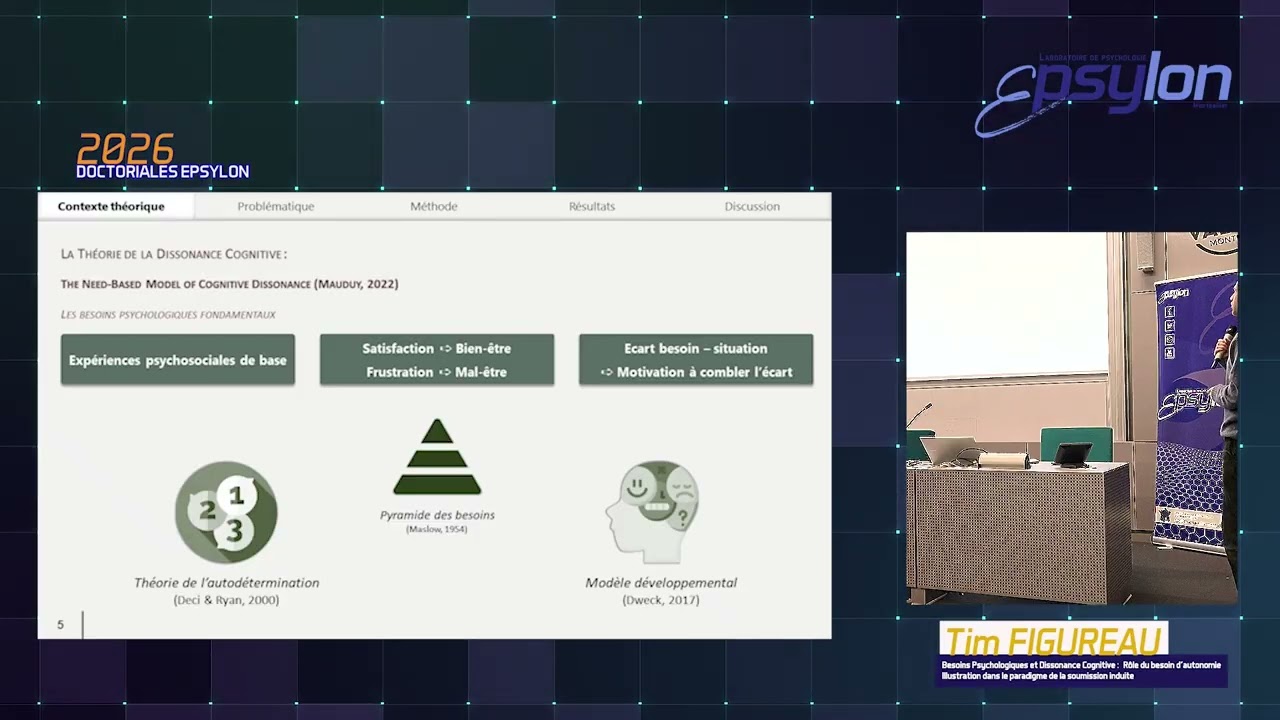
Doctoriales Epsylon 2026 Tim Figuereau
Keywords
Summary
155 words
Critical Evaluation
Value of the Information & Strength of the Argument
The presentation provides valuable insights into the psychological mechanisms underlying attitude change, particularly in the context of climate skepticism. The argumentation is structured and follows a logical progression from theory to hypothesis to results. The speaker acknowledges limitations and proposes future directions, demonstrating scientific rigor. However, the presentation is brief and lacks detailed statistical reporting, which limits the depth of evaluation.
70 words
Title / Content Match
Title accurately reflects the content: a presentation of doctoral research at the Epsylon doctoral days.
Quality & Reliability
7/10
Presentation of original research with clear methodology and results, but limited detail and no peer-reviewed publication cited.
Key Moments
Markers derived by PSI from the transcript: the creator did not define chapters.
- Introduction and presentation of the research topic: link between psychological needs and cognitive dissonance.
- Context: rising climate skepticism in France, with statistics.
- Explanation of cognitive dissonance theory and induced compliance paradigm.
- Theoretical background: from consistency to self-consistency to autonomy need.
- Study design: 301 participants, conditions, measures.
- Results: attitude change effect, interaction patterns, contrast analysis.
- Limitations and future directions: boosting autonomy to protect against attitude change.
Contribution & Novelties
The presentation offers a novel perspective by linking cognitive dissonance to fundamental psychological needs, specifically autonomy, within the induced compliance paradigm. It suggests that attitude change may serve to restore a sense of autonomy. This could have implications for designing interventions to reduce unwanted attitude shifts, such as climate skepticism.
Pour aller plus loin :
- Self-determination theory — Relevant for understanding the need for autonomy.
- Cognitive dissonance — Foundational theory.
- Induced compliance paradigm — The experimental paradigm used.
78 words
Radar Profile
The radar profile shows balanced scores across information quantity, quality, technical level, and reliability, indicating a well-rounded presentation with moderate depth and rigor.