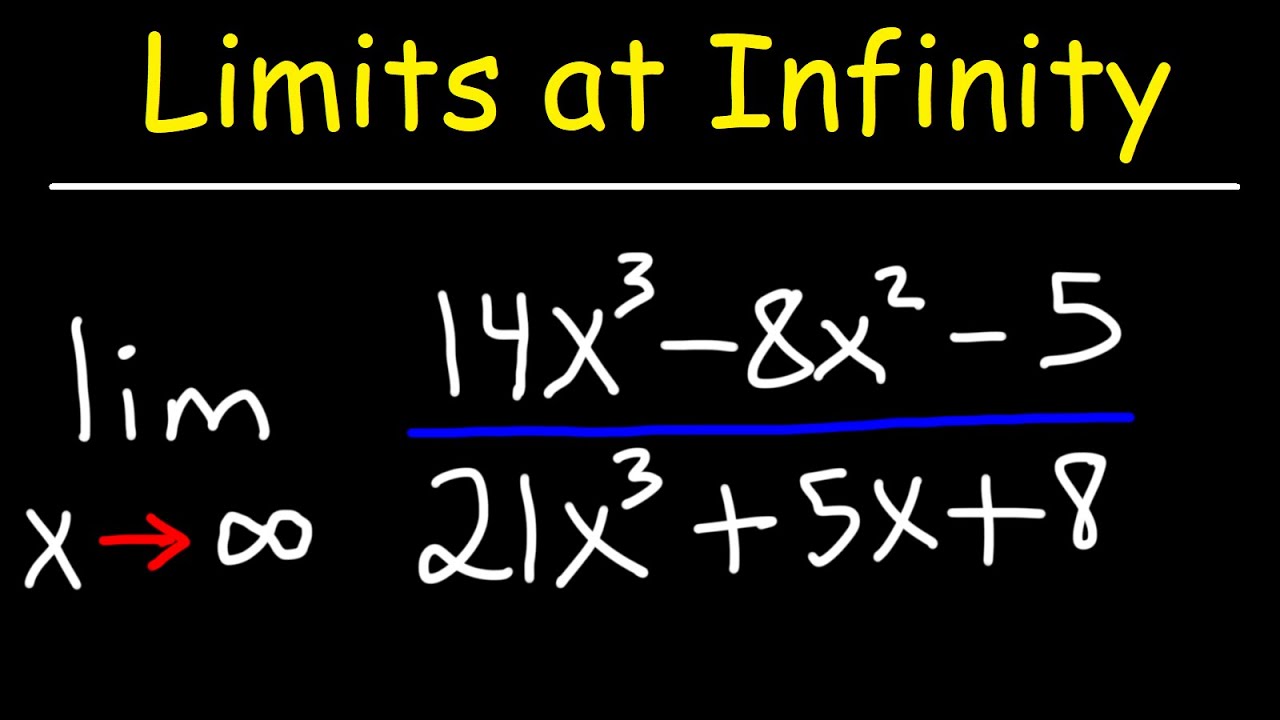
Limits at Infinity of Rational Functions
Keywords
Summary
174 words
Critical Evaluation
The video provides a clear and systematic approach to evaluating limits at infinity of rational functions, a fundamental topic in calculus. The instructor covers all three cases based on the relative degrees of the numerator and denominator, which is the standard method taught in calculus courses. The explanations are thorough, with both quick estimation techniques and formal algebraic steps, making it useful for students preparing for exams. The mathematical content is accurate: for bottom-heavy functions, the limit is 0; for equal degrees, the limit is the ratio of leading coefficients; for top-heavy functions, the limit is ±∞ depending on signs. The instructor correctly demonstrates the formal method of multiplying by the reciprocal of the highest power in the denominator, which is a standard technique. However, there are a few minor issues: the video is a bit repetitive, and the formal method for top-heavy functions could be confusing because it multiplies by 1/x^2 (the denominator’s degree) rather than the numerator’s degree, but this is explained adequately. The video does not cite external sources, but it is a tutorial based on standard mathematical principles, so this is not a major drawback. The title accurately reflects the content. Overall, the video is a reliable educational resource for students learning about limits at infinity.
210 words
Title / Content Match
The title accurately reflects the content, which focuses on evaluating limits at infinity of rational functions.
Quality & Reliability
8/10
Clear step-by-step explanations with multiple methods (quick and formal) for evaluating limits at infinity of rational functions. The mathematical rules are standard and correctly applied. The video is educational and reliable for its intended purpose.
Key Moments
Markers derived by PSI from the transcript: the creator did not define chapters.
- Introduction to the problem: evaluating limits at infinity of rational functions, Question 63.
- Statement 1: bottom-heavy function, limit goes to 0. Quick explanation and formal method.
- Statement 2: equal degrees, limit is ratio of leading coefficients (2/3). Formal method shown.
- Statement 3: top-heavy function, limit is positive infinity. Quick method using dominant terms.
- Formal method for statement 3: multiply by 1/x^2 and evaluate.
- Conclusion: all statements true, answer is D.
Cited Sources
- Limits Test Review - Playlist — Referenced in the video description as a playlist for further review of limits.
Concurring Sources
- Limits Test Review - Playlist — The video is part of a larger review playlist, which likely covers similar topics.
Contribution & Novelties
The video provides a clear, step-by-step tutorial on evaluating limits at infinity of rational functions, covering all three cases (bottom-heavy, equal degrees, top-heavy). It offers both quick estimation methods and formal algebraic techniques, which is helpful for students. The content is standard but well-presented.
Pour aller plus loin :
- Limits at infinity - Wikipedia — General concept of limits at infinity.
- Rational function - Wikipedia — Definition and properties of rational functions.
- Asymptote - Wikipedia — Horizontal asymptotes related to limits at infinity.
83 words
Radar Profile
The radar profile shows high scores in quality of information and technical level, with moderate quantity of information. The video is focused and reliable for its educational purpose.