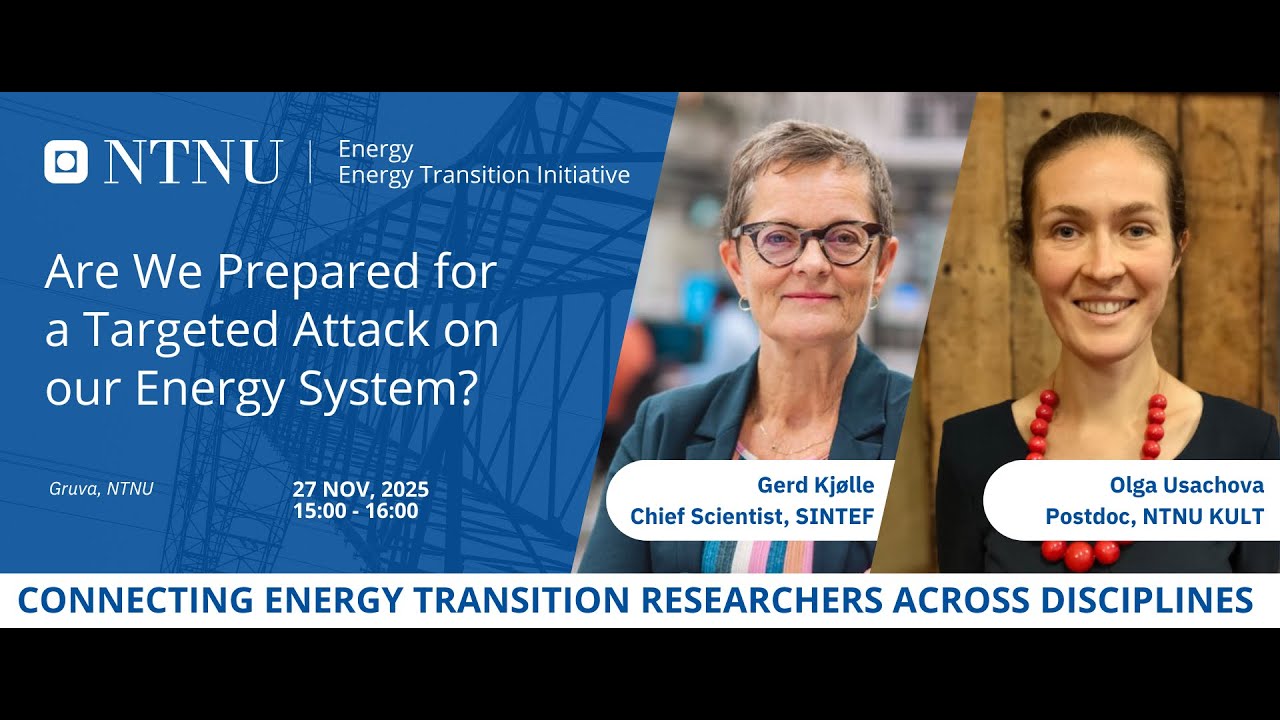
Is Norway Prepared for a Targeted Attack on its Energy System?
Keywords
Summary
218 words
Critical Evaluation
Value of the Information & Strength of the Argument
The seminar provides valuable insights into the multifaceted nature of energy security, combining technical and social perspectives. Kjølle’s presentation offers a comprehensive overview of the evolving risk landscape, including the impact of electrification, digitalisation, and climate change, and introduces the concept of the ’energy trilemma’ to illustrate conflicting goals. She supports her arguments with references to real-world events, such as the 2025 Iberian blackout and extreme weather incidents in Norway, and introduces a conceptual model (bow-tie) for understanding vulnerabilities and resilience. Usachova’s contribution is particularly valuable in highlighting the human and social dimensions often overlooked in technical discussions. She uses her Ukrainian background to ground the discussion in lived experience, illustrating the daily reality of attacks on energy infrastructure. Her emphasis on the human factor as a mediating link and the importance of communication, trust, and community resilience adds depth to the argument. The argumentation is coherent and well-structured, though it relies primarily on expert opinion and qualitative analysis rather than new empirical data. The speakers acknowledge knowledge gaps and the need for further research, which strengthens the credibility of their arguments.
Scientific Rigor, Source Quality, Title Accuracy
The seminar demonstrates a good level of scientific rigour, with both speakers drawing on their research and institutional reports. Kjølle references the FME SecurEL centre and a recent report on energy security and resilient society, while Usachova cites a literature review on cyber attacks and a report from the Centre for East European Studies. However, specific citations are not always provided in the transcript, and some claims are based on general knowledge. The title accurately reflects the content, which directly addresses the question of Norway’s preparedness. The seminar is well-structured, with clear presentations and a logical flow. The inclusion of both technical and social perspectives enhances the overall quality. The speakers are credible, with relevant expertise, and the content is presented in an accessible manner without oversimplifying the complexities.
326 words
Title / Content Match
The title accurately reflects the seminar's focus on assessing Norway's preparedness for targeted attacks on its energy system, which is directly addressed by both speakers.
Quality & Reliability
7/10
The seminar features two expert speakers from recognized institutions (SINTEF, NTNU) with relevant research backgrounds. They present a balanced view combining technical and social perspectives, referencing reports and real-world events. However, the content is largely qualitative and based on expert opinion rather than new empirical data, and some claims lack specific citations.
Key Moments
Markers derived by PSI from the transcript: the creator did not define chapters.
- Gerd Kjølle introduces the FME SecurEL centre and the vision for a resilient power grid.
- Kjølle explains the energy trilemma and the conflicting interests between climate, energy, nature, economy, and security of supply.
- Kjølle discusses the components of security of electricity supply and Norway's current high reliability (99.98%).
- Kjølle presents examples of unwanted events in 2025, including extreme weather and the Iberian blackout.
- Kjølle highlights the increasing cyber threats and the warning from the Norwegian National Security Authority about likely sabotage.
- Kjølle introduces the bow-tie model for understanding vulnerabilities and resilience, and discusses knowledge gaps.
- Olga Usachova begins her presentation, reflecting on the question 'who is we' and introducing her Ukrainian background.
- Usachova shows the reality of attacks on Ukraine's energy sector and the concept of a 'country of constant repair'.
- Usachova discusses Norway's vulnerabilities, including digitalisation, automation, and limited public awareness.
- Usachova emphasizes the human factor as a mediating link and the need for coordinated preparedness, concluding that preparedness is about communication, trust, and community resilience.
Cited Sources
- FME SecurEL centre — Gerd Kjølle introduces the centre and its vision for a resilient power grid.
- Report on energy security and resilient society — Kjølle refers to a report produced for Arendalsuka 2025.
- Centre for East European Studies report — Usachova cites a report from the Centre for East European Studies in Vilnius showing aggregated attacks on different sectors in Ukraine.
- Literature review on cyber attacks on energy infrastructure — Usachova mentions a literature review on the evolution of cyber attacks on energy infrastructure.
Concurring Sources
- Norwegian National Security Authority (NSM) warnings — Kjølle references NSM's warnings about the likelihood of sabotage against the energy sector.
- ENTSO-E (European Network of Transmission System Operators) — Kjølle mentions ENTSO-E's analysis of the Iberian blackout.
Contribution & Novelties
The seminar provides a timely and comprehensive overview of the challenges facing Norway’s energy system, combining technical and social perspectives. It highlights the increasing complexity and interconnectedness of the power grid, the rise of cyber threats, and the importance of human and social factors in preparedness. The speakers identify knowledge gaps and call for a holistic approach to resilience. The inclusion of a Ukrainian perspective adds a unique and valuable dimension, grounding the discussion in real-world experience.
Pour aller plus loin :
- Energy security — Provides a broad overview of the concept and its dimensions.
- Cyberattack — Explains different types of cyber attacks and their implications.
- Resilience (engineering) — Discusses resilience in engineering systems, relevant to the discussion on building resilient energy infrastructure.
- Critical infrastructure protection — Offers insights into protecting essential systems like energy grids.
136 words
Radar Profile
The radar profile shows a balanced performance across all dimensions, with slightly higher scores in information quality and reliability, reflecting the expert-driven content. The lower score in technical level suggests the content is accessible to a general audience while still providing depth.