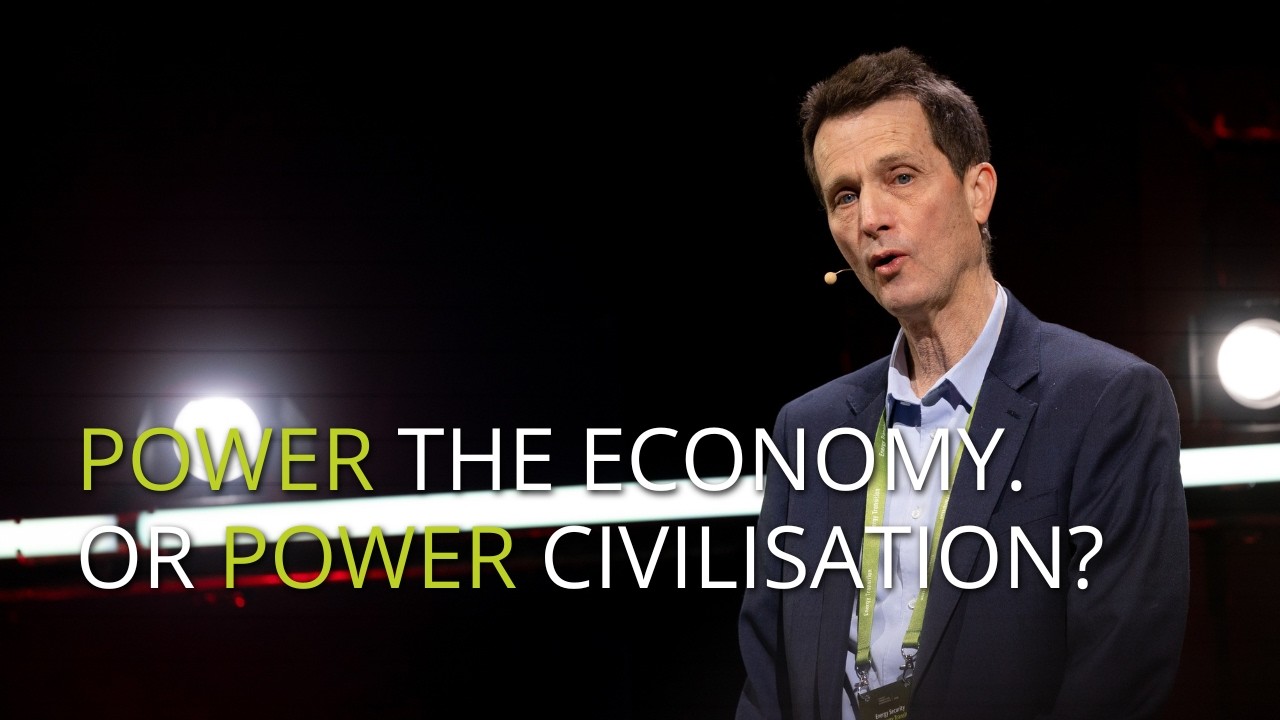
The Energy Transition Is Now a Civilisational Choice
Keywords
Summary
181 words
Critical Evaluation
Value of the Information & Strength of the Argument
The presentation offers valuable insights by framing the energy transition within the context of geopolitical instability and strategic competition. It argues convincingly that energy security, industrial policy, and environmental governance are now intertwined, and that the transition must be managed holistically. The argumentation is coherent and well-structured, moving from current vulnerabilities to the need for a comprehensive strategy. However, it relies heavily on the speaker’s authority and general observations rather than presenting new data or detailed analysis. The call for equity and efficiency is compelling, but the argument would be strengthened by concrete examples or case studies.
Scientific Rigor, Source Quality, Title Accuracy
The speaker’s credibility is high, given his role as senior advisor to the UNSPBF and his extensive experience in multilateral environmental negotiations. However, the presentation lacks explicit citations or references to specific studies or reports, except for a mention of the IEA’s projection on recycling reducing mining investment by 30% by 2040. The title accurately reflects the content, which centers on the strategic and civilisational dimensions of the energy transition. The presentation is an opinion piece rather than a rigorous scientific analysis, but it is grounded in current events and expert knowledge.
204 words
Title / Content Match
The title accurately reflects the central thesis that the energy transition is a fundamental choice for civilization, encompassing economic, security, and equity dimensions.
Quality & Reliability
7/10
The speaker is a senior advisor to the UN Science-Policy-Business Forum, with three decades of experience in multilateral environmental policy. The content is an expert opinion, well-structured and grounded in current geopolitical events, but lacks detailed citations or data sources.
Key Moments
Markers derived by PSI from the transcript: the creator did not define chapters.
- Introduction by moderator, highlighting Charles Arden-Clark's role and the context of the conference.
- Arden-Clark begins his speech, emphasizing the geopolitical turbulence and the impact of the Kharg Island strike and Strait of Hormuz closure.
- Discussion on the need for energy efficiency as a forgotten element in the transition.
- Highlighting structural inequalities and the deepening disparities for the global south.
- Exploration of the strategic dependency on critical minerals and rare earths, and the dual-use nature of these materials.
- Call for a balanced approach addressing strategic resilience, ecological stewardship, and equitable development.
- Conclusion: the energy transition is a civilisational choice, with responsibility to shape it wisely.
Cited Sources
- IEA report on critical minerals and recycling — Mentioned in the speech: 'Expanded recycling and material efficiency could reduce the need for new mining investment by roughly 30% by 2040, according to the IEA.'
Concurring Sources
- IEA: The Role of Critical Minerals in Clean Energy Transitions — Supports the claim about the importance of critical minerals and the potential for recycling to reduce mining needs.
- IEA: Energy Efficiency — Supports the emphasis on energy efficiency as a key element of the transition.
Dissenting Sources
- No discordant sources identified — The presentation is an opinion piece and does not directly contradict established scientific consensus.
Contribution & Novelties
The presentation provides a strategic perspective on the energy transition, linking it to geopolitical security and civilisational choices. It emphasizes the need for a holistic governance approach that balances resilience, ecology, and equity. The original contribution lies in framing the transition as a matter of international stability and justice, rather than purely technical or environmental.
Pour aller plus loin :
- Critical minerals and the energy transition — IEA report on the role of critical minerals.
- Energy efficiency — IEA overview of energy efficiency.
- Geopolitics of energy transition — IEA report on geopolitical implications.
93 words
Radar Profile
The radar profile shows high scores in information quality and reliability, reflecting the speaker's expertise and coherent argumentation. The lower score in technical level indicates that the content is accessible to a general audience, focusing on strategic and policy aspects rather than technical details.
💬 No comments were provided for analysis.