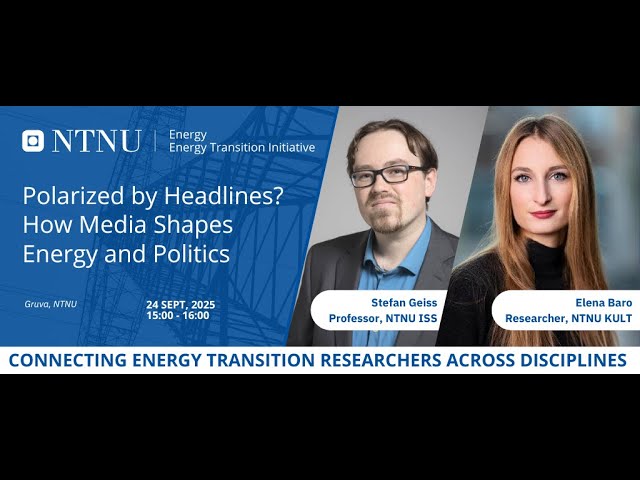
Polarized by Headlines? How Media Shapes Energy and Politics
Keywords
Summary
160 words
Critical Evaluation
Value of the Information & Strength of the Argument
The seminar provides valuable insights into the psychological and sociological mechanisms behind public opinion on energy issues. Stefan Geiss’s presentation effectively uses the spiral of silence theory and empirical data to argue that minority opposition can dominate public discourse, a claim supported by survey results. Elena Baro’s argument that out-group cues, particularly party dislike, are powerful determinants of policy support is well-illustrated with examples. The argumentation is coherent and grounded in established research, though some points could benefit from more detailed methodological explanations. The Q&A session adds practical perspectives on mitigating polarization.
101 words
Title / Content Match
The title accurately reflects the content, which focuses on how media framing and political identity shape public opinion on energy and climate policies.
Quality & Reliability
8/10
The seminar features two academic researchers from NTNU presenting peer-reviewed findings and established theories (spiral of silence, out-group cues). The content is well-structured, references scientific studies, and includes a moderated Q&A. However, as a seminar, it lacks formal peer review and some claims are presented without full methodological detail.
Chapters
Cited Sources
- Spiral of Silence Theory — Referenced by Stefan Geiss as a framework for understanding public opinion formation.
- NTNU Energy Transition Initiative — Organizer of the seminar, providing context for the discussion.
Concurring Sources
- Spiral of Silence Theory — Supports the claim that perceived public opinion influences willingness to speak out.
- Political Polarization — Aligns with the discussion on harmful polarization and its drivers.
Contribution & Novelties
The seminar offers a nuanced perspective on how media and political identity interact to shape energy policy debates, particularly in the Norwegian context. It combines theoretical frameworks with empirical data, highlighting the often-overlooked role of out-group cues and the spiral of silence. The discussion on strategies to reduce polarization is practical and timely.
Pour aller plus loin :
- Spiral of Silence — Foundational theory for understanding public opinion dynamics.
- Out-group cues in political communication — Relevant to understanding how group identities influence policy support.
- Polarization in climate politics — Provides broader context on the phenomenon discussed.
96 words
Radar Profile
The radar profile shows high scores in information quantity, quality, and reliability, with a slightly lower technical level. This indicates a well-balanced seminar that is accessible yet scientifically grounded, suitable for an academic audience.