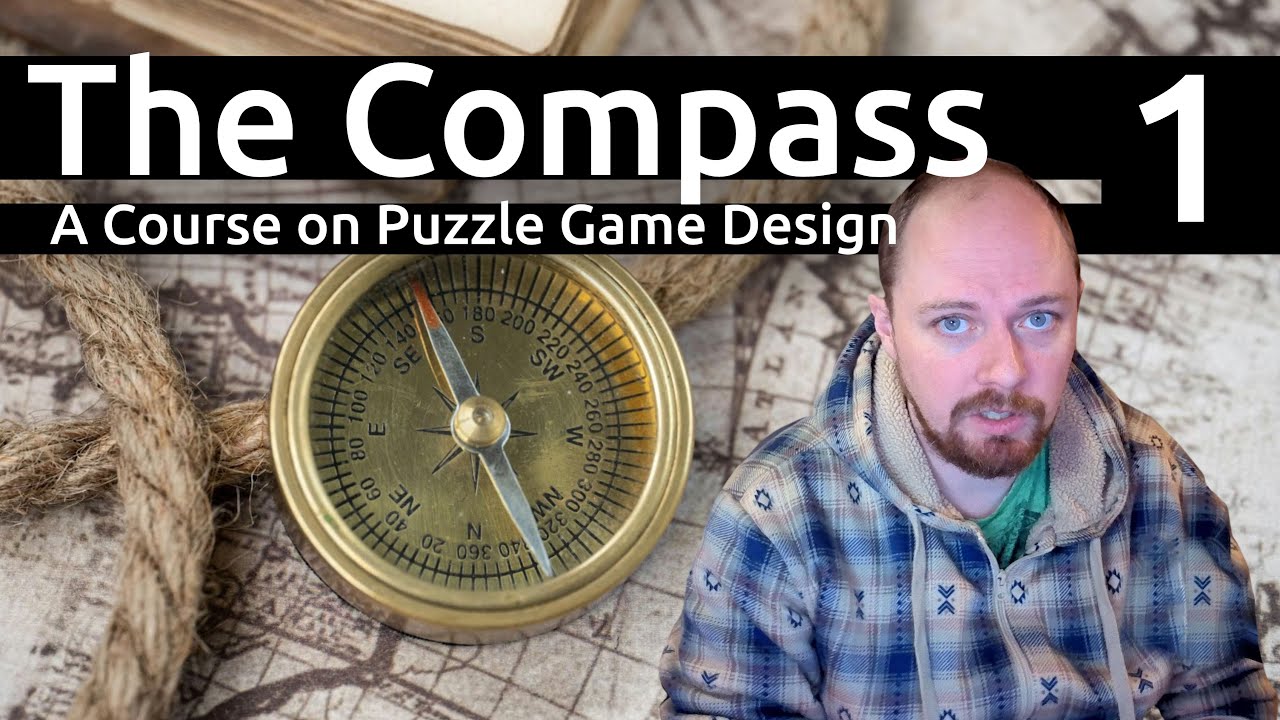
1. Overall Game Design - The Compass - A Course on Puzzle Game Design
Keywords
Summary
181 words
Critical Evaluation
Value of the Information & Strength of the Argument
The video provides valuable insights into puzzle game design, drawing on the author’s extensive experience. The argumentation is well-structured and logical, with clear definitions and examples. VanDevander effectively explains abstract concepts like orthogonality and contrivance using concrete game examples, making the content accessible and practical. He also presents a balanced view, acknowledging counterexamples like The Witness and Storyteller, which adds credibility. The advice on prototyping and evaluating ideas is actionable and grounded in real-world experience. The lecture is persuasive and well-reasoned, though it is based on personal philosophy rather than empirical research.
Scientific Rigor, Source Quality, Title Accuracy
The video demonstrates scientific rigor in its approach, referencing established design principles and providing examples from well-known games. The sources cited include the talk by Jonathan Blow and Marc ten Bosch, and the book ‘Game Feel’ by Steve Swink, which are relevant and credible. The title accurately reflects the content, as it is the first part of a course on puzzle game design. The lecture is well-organized and the arguments are coherent. However, the content is primarily based on the author’s personal experience and opinions, and lacks formal citations or peer-reviewed sources. The video does not include any public comments, so no analysis of audience reception is possible.
215 words
Title / Content Match
The title accurately reflects the content: it is the first part of a course on puzzle game design, focusing on overall game design principles.
Quality & Reliability
8/10
The video is a well-structured lecture by an experienced game designer (Matthew VanDevander, creator of Taiji). It references established design principles (Jonathan Blow and Marc ten Bosch's talk) and provides concrete examples from known games. The content is based on the author's professional experience and is presented with clear reasoning. However, it is primarily opinion-based and lacks formal citations or peer-reviewed sources, which slightly reduces the score.
Chapters
- Introduction
- How do you get ideas?
- Sub-Rules and Variants
- Orthogonal Mechanics
- Push, Pivot, or Punt
- Taiji Interface Evolution (Pushing Example)
- DO explore ideas that nobody has succeeded at before
- DON'T make weird stuff that feels bad
- DO watch people play the game
- DON'T over cater to too few or the wrong testers
- DO Nested Gameplay Loops
- DO Holistic Game Design
- Holistic Design (Story, Art, Sound Examples)
- DON'T take too long to get to the good part
- Outro and Homework Assignment
Cited Sources
- Game Feel — Referenced as a resource for understanding game feel, mentioned in the description.
- Slides for this lecture — Slides used in the lecture, provided in the description.
- The Compass - Course Playlist — Link to the full course playlist, mentioned in the description.
- My lecture from 10 years ago — Referenced as a previous talk by the author, linked in the description.
- Homework Assignment — Homework video for the course, linked in the description.
- Q&A — Q&A video for the course, linked in the description.
Concurring Sources
- Designing to Reveal the Nature of the Universe — The talk by Jonathan Blow and Marc ten Bosch, which the author explicitly builds upon.
Contribution & Novelties
The video offers a comprehensive framework for puzzle game design, synthesizing the author’s decade of experience into actionable principles. It introduces the concept of ‘depth’ as a balance of richness and surprise against contrivance, and provides a taxonomy of mechanics (sub-rules, variants, meta-mechanics) that is both clear and practical. The emphasis on orthogonality as a key criterion for mechanic selection is particularly valuable. The lecture also provides a decision-making framework (push, pivot, punt) that is useful for any designer. Overall, it is a valuable resource for both novice and experienced game designers.
Pour aller plus loin :
- Designing to Reveal the Nature of the Universe — The talk by Jonathan Blow and Marc ten Bosch that heavily influences this course.
- Game Feel — Steve Swink’s book on game feel, referenced in the video.
- Orthogonality (mathematics) — Mathematical concept of orthogonality, which the author applies to game design.
147 words
Radar Profile
The radar profile shows high scores in quantity and quality of information, indicating a content-rich and well-argued lecture. The technical level is moderately high, suitable for an audience with some game design background. The overall reliability is solid, though based on personal experience rather than empirical data.