Tobias Sutter: Towards Optimal Offline Reinforcement Learning
Keywords
Summary
163 words
Critical Evaluation
Value of the Information & Strength of the Argument
The talk provides a novel and theoretically grounded approach to offline reinforcement learning, addressing the challenge of statistical guarantees without i.i.d. assumptions. The argumentation is solid, with clear problem formulation, theoretical results (theorems on underestimation and efficiency), and a practical algorithm. The use of large deviations theory to derive the uncertainty set is elegant and well-motivated. The numerical experiments, while limited to one problem, support the claims of effectiveness. The speaker also acknowledges computational limitations and suggests future work, which adds credibility.
Scientific Rigor, Source Quality, Title Accuracy
The talk is scientifically rigorous, with clear definitions, theorems, and proofs sketched. The speaker references related work in economics, statistics, control, and RL, but does not provide specific citations in the talk. The title accurately reflects the content. The description includes the abstract and speaker affiliation, but no external links to papers. The talk appears to be based on original research, likely a paper, but no direct source is given. The adequacy between title and content is high.
175 words
Title / Content Match
The title accurately reflects the content, focusing on achieving optimality in offline reinforcement learning through a distributionally robust approach.
Quality & Reliability
8/10
The talk presents a rigorous theoretical framework with proofs for statistical guarantees, and includes numerical experiments. The methodology is well-motivated and builds on established concepts in robust optimization and large deviations. However, the presentation is concise and some technical details are omitted, and the numerical evaluation is limited to a single synthetic problem.
Key Moments
Markers derived by PSI from the transcript: the creator did not define chapters.
- Introduction and problem setup: Markov decision process, average reward, offline RL.
- Motivation: machine replacement problem and need for conservative estimators.
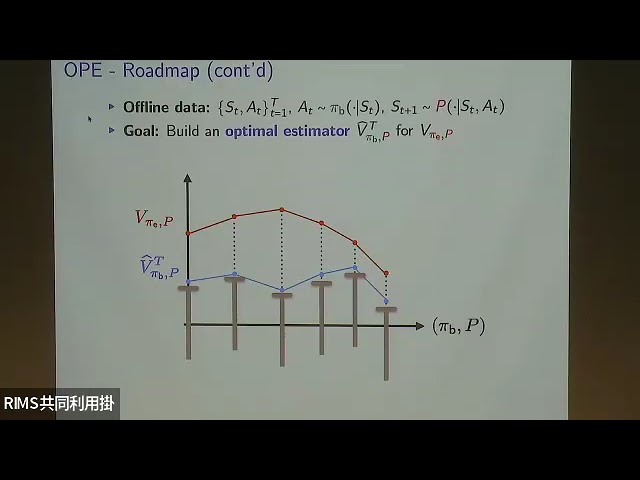
- Formalization: reparameterization using stationary state-action-next-state distribution, distribution shift function.
- Construction of the distributionally robust estimator and its theoretical guarantees.
- Reformulation as a robust MDP with non-rectangular uncertainty set.
- Algorithm: projected Langevin dynamics for solving the robust optimization.
- Extension to optimal policy learning via actor-critic method.
- Numerical experiments on machine replacement problem and comparison with baselines.
- Conclusion and discussion of limitations and future work.
Contribution & Novelties
The talk presents a novel distributionally robust approach to offline reinforcement learning that provides statistical guarantees (high-probability underestimation and efficiency) without requiring i.i.d. data. The use of large deviations principle to construct the uncertainty set is original and leads to a least conservative estimator. The method handles a single trajectory of serially correlated data, which is a significant contribution. The reformulation as a robust MDP with non-rectangular uncertainty set and the proposed algorithm are also novel.
Pour aller plus loin :
- Large deviations theory — Provides the theoretical foundation for the rate function used in the uncertainty set.
- Distributionally robust optimization — The general framework for handling uncertainty in optimization problems.
- Robust Markov decision process — The model used for the reformulated problem.
- Offline reinforcement learning — The broader field of learning policies from fixed datasets.
136 words
Radar Profile
The radar profile shows high scores in technical level and information quality, with slightly lower scores in quantity and reliability. This indicates a technically dense and rigorous presentation, but with limited breadth of content and reliance on the speaker's own claims without external verification.