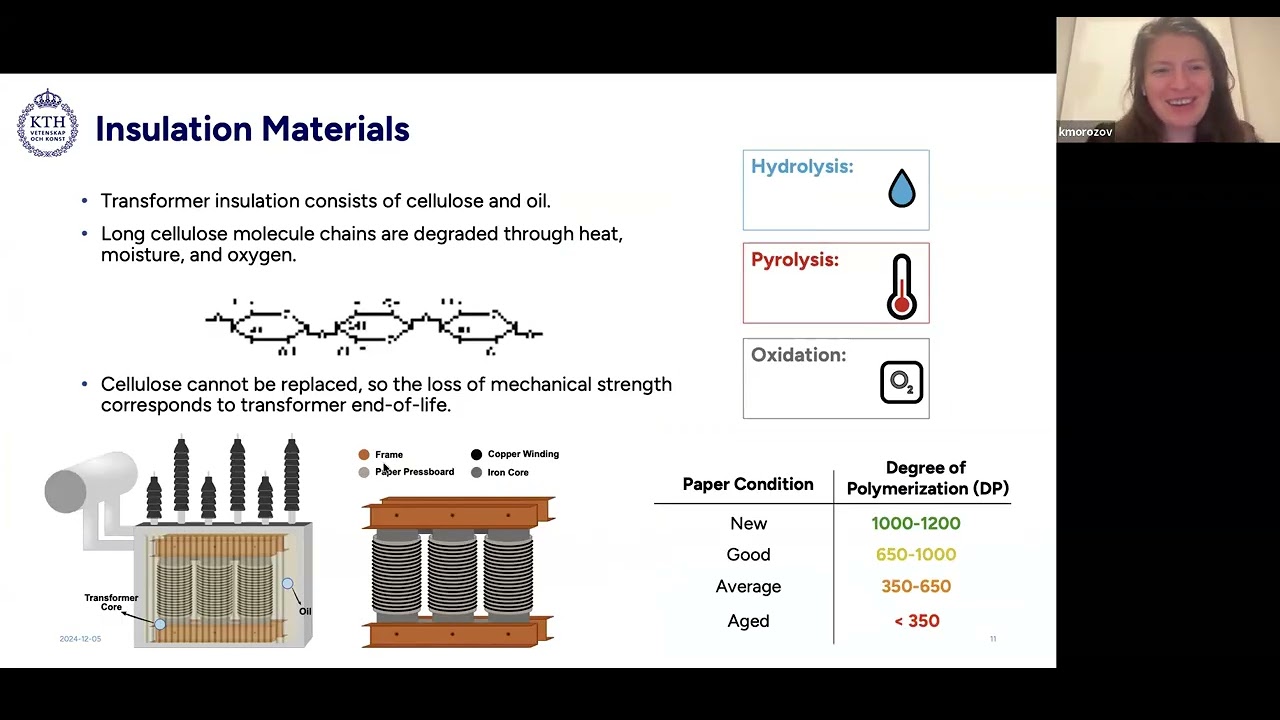
Kateryna Morozovska : Discovering Partially Known ODEs for Chemical Kinetics
Keywords
Summary
132 words
Critical Evaluation
Value of the Information & Strength of the Argument
The talk provides valuable insights into applying PINNs to real-world chemical kinetics problems, demonstrating the method’s capability to handle scarce and noisy data. The argumentation is solid, supported by simulation and experimental results, and the speaker clearly explains the methodology and challenges. The use of symbolic regression to discover unknown functions is a notable contribution, though the talk acknowledges limitations in the current implementation.
Scientific Rigor, Source Quality, Title Accuracy
The talk references several peer-reviewed papers and provides a clear description of the methods. The sources are credible and relevant to the topic. The title accurately reflects the content, and the presentation is well-structured. The speaker also mentions the summer school website for further resources. The talk does not include a formal discussion of limitations or potential biases, but overall, the scientific rigor is adequate for a seminar presentation.
148 words
Title / Content Match
The title accurately reflects the content, which focuses on discovering partially known ODEs for chemical kinetics using PINNs.
Quality & Reliability
7/10
The talk presents original research with clear methodology, references to peer-reviewed papers, and practical applications. However, it is a seminar presentation without full peer review, and some claims lack detailed validation.
Key Moments
Markers derived by PSI from the transcript: the creator did not define chapters.
- Introduction and overview of the talk
- Background on PINNs and inverse problems
- Case study 1: Cellulose degradation - problem setup
- Parameter estimation results for cellulose degradation
- Discovery of unknown function using symbolic regression
- Case study 2: Epoxy curing - problem description
- Results for epoxy curing and future work
- Conclusion and acknowledgments
- Q&A session and discussion
Cited Sources
- Physics-informed neural networks: A deep learning framework for solving forward and inverse problems involving nonlinear partial differential equations — Reference [1] in the description, foundational paper on PINNs.
- A reassessment of the low temperature thermal degradation of cellulose — Reference [2], discusses cellulose degradation mechanisms.
- Ageing of cellulose in mineral-oil insulated transformers — Reference [3], CIGRE report on transformer insulation aging.
- On the kinetics of degradation of cellulose — Reference [4], introduces Emsley's system of ODEs.
- Symbolic regression analysis — Reference [5], foundational work on symbolic regression.
- Discovering a reaction–diffusion model for Alzheimer’s disease by combining PINNs with symbolic regression — Reference [6], recent work combining PINNs and symbolic regression.
- Discovering Partially Known Ordinary Differential Equations: a Case Study on the Chemical Kinetics of Cellulose Degradation — Reference [7], the speaker's own paper on the cellulose degradation case.
- Summer school on PINNs — Website for the summer school on PINNs, mentioned in the talk.
Concurring Sources
- Physics-informed neural networks: A deep learning framework for solving forward and inverse problems involving nonlinear partial differential equations — The foundational PINN paper supports the methodology used in the talk.
- Discovering a reaction–diffusion model for Alzheimer’s disease by combining PINNs with symbolic regression — Recent work combining PINNs and symbolic regression, supporting the approach.
Contribution & Novelties
The talk presents a novel application of PINNs combined with symbolic regression to discover unknown functions and parameters in chemical kinetics ODEs, specifically for cellulose degradation and epoxy curing. The approach demonstrates the ability to handle scarce and noisy data, which is common in industrial applications. The work extends existing PINN methodologies to more complex systems and shows potential for generalization across different materials.
Pour aller plus loin :
- Physics-informed neural networks — Overview of PINNs and their applications.
- Symbolic regression — Explanation of symbolic regression and its uses.
- Arrhenius equation — Background on the Arrhenius equation used in chemical kinetics.
- Kamal’s model — Description of the Kamal equation for curing processes.
112 words
Radar Profile
The radar profile shows high scores in technical level and fiability, with moderate scores in information quantity and quality. This indicates a technically sound presentation with reliable methods, but with limited breadth of information and some potential for improvement in depth.