Christian Uhl: Extracting Dynamical Systems-Based Signals from Noisy and Incomplete Datasets
Keywords
Summary
198 words
Critical Evaluation
Value of the Information & Strength of the Argument
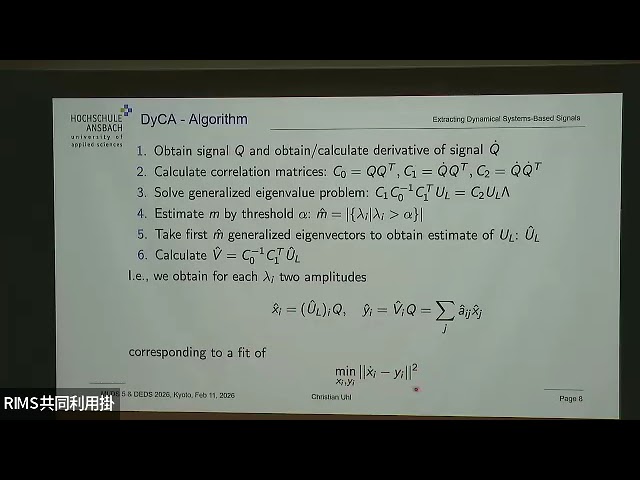
The talk provides a detailed derivation of the DyCA algorithm, including the optimization problem, the generalized eigenvalue formulation, and the mode selection procedure. The value lies in offering a new tool for signal decomposition that is theoretically grounded in dynamical systems theory. The argumentation is solid: the method is validated on synthetic examples with known ground truth, and comparisons with established methods (PCA, ICA, DMD) are presented. The speaker also honestly discusses limitations, such as the requirement for more linear than nonlinear equations and sensitivity to additive noise, which is addressed by the robust version. The real-world application to EEG data adds practical relevance. However, the presentation is dense and assumes familiarity with linear algebra and dynamical systems, which may limit accessibility.
Scientific Rigor, Source Quality, Title Accuracy
The scientific rigor is high: the algorithm is derived from first principles, and the experimental setup is clearly described. The speaker references key publications and provides a GitHub link for implementation, but these are not explicitly listed in the talk. The title accurately reflects the content. The talk is a seminar presentation, so it does not include formal citations, but the methodology appears sound. The lack of peer-reviewed references in the talk itself is a minor weakness, but the technical depth and honest discussion of limitations compensate.
224 words
Title / Content Match
The title accurately reflects the content: the speaker presents a method to extract dynamical systems-based signals from noisy and incomplete data.
Quality & Reliability
8/10
The talk presents a novel algorithm (DyCA) with mathematical derivations, simulated examples, and applications to real EEG data. The methodology is clearly explained, and the results are compared with established methods (PCA, ICA, DMD). Limitations are acknowledged. The presentation is technical and appears rigorous, though the lack of peer-reviewed references in the talk itself limits verification.
Key Moments
Markers derived by PSI from the transcript: the creator did not define chapters.
- Introduction and overview of DyCA algorithm
- Derivation of the optimization problem and generalized eigenvalue formulation
- Toy example with damped oscillator: demonstration of mode extraction and comparison with PCA/ICA/DMD
- Application to Rössler attractor: performance comparison and robustness analysis
- Real-world application to EEG data from epileptic seizures
- Limitations of DyCA and introduction of robust DyCA for additive noise and incomplete data
- Results of robust DyCA on Rössler attractor with missing data
- Conclusions and Q&A on potential control applications
Cited Sources
- GitHub repository for DyCA implementation — Speaker mentions that implementation is available on GitHub, but the exact URL is not provided in the talk.
Concurring Sources
- Koopman operator theory — The DyCA method is based on Koopman operator theory, which provides a linear representation of nonlinear dynamics.
- Dynamic Mode Decomposition (DMD) — DyCA is compared with DMD, a widely used method for extracting spatiotemporal patterns from dynamical systems.
Dissenting Sources
- Independent Component Analysis (ICA) — ICA is a common signal separation technique that fails in the presence of high noise, as shown in the talk.
Contribution & Novelties
The talk introduces Dynamical Component Analysis (DyCA), a novel algorithm that bridges signal processing and dynamical systems theory. Its key novelty is the formulation of signal decomposition as a generalized eigenvalue problem derived from a Koopman-based linear differential equation model, allowing extraction of deterministic components from noisy data. The robust version extends this to handle additive noise and incomplete data via L2 regularization and variational denoising. This is a significant contribution to the field of data-driven discovery of dynamical systems.
Pour aller plus loin :
- Koopman operator theory — Foundational concept for the approach.
- Dynamic Mode Decomposition (DMD) — A related method for decomposing dynamical systems.
- Shilnikov chaos — Relevant to the EEG analysis and the observed phase-space structure.
119 words
Radar Profile
The radar profile shows high scores in technical level and information quality, indicating a dense, mathematically rigorous presentation. The lower score in quantity of information relative to technical depth suggests the talk is focused but may not cover a broad range of examples. Overall, the profile reflects a specialized seminar talk suitable for experts.
💬 No comments were provided for analysis.