Yuanchao Xu: Generative Modeling through Koopman Spectral Analysis
Keywords
Summary
150 words
Critical Evaluation
Value of the Information & Strength of the Argument
The talk provides a valuable contribution by introducing a new method that leverages Koopman operator theory to accelerate Wasserstein gradient descent. The argumentation is solid, with a clear theoretical framework and rigorous convergence analysis. The speaker connects the method to Feynman-Kac theory, providing a probabilistic foundation. The experimental results across diverse settings support the claims of faster convergence and high sample quality. However, the talk does not deeply discuss limitations or potential failure cases, such as mode collapse, which is only briefly mentioned. The argumentation could be strengthened by addressing these issues more thoroughly.
Scientific Rigor, Source Quality, Title Accuracy
The talk demonstrates scientific rigor through a well-structured presentation and references to established methods like EDMD and SVGD. The speaker cites relevant literature, including the original SVGD paper and works on Koopman operator approximation. The title accurately reflects the content, focusing on generative modeling through Koopman spectral analysis. The talk does not explicitly cite external sources, but the description mentions the method’s name and the speaker’s affiliation, which adds credibility. The presentation is technically detailed, suitable for an expert audience.
189 words
Title / Content Match
The title accurately reflects the content, focusing on generative modeling via Koopman spectral analysis.
Quality & Reliability
8/10
The talk presents a novel method (KSWGD) with rigorous convergence analysis and experimental validation across multiple domains. The speaker is a postdoc at Kyoto University, and the method is grounded in established operator theory and optimal transport. The presentation is clear and the claims are supported by theoretical and empirical evidence.
Key Moments
Markers derived by PSI from the transcript: the creator did not define chapters.
- Introduction and overview of the talk
- Introduction to Koopman operator theory and its applications
- Discussion of data-driven methods for Koopman operator approximation
- Introduction to particle-based generative modeling and SVGD
- Presentation of KSWGD method and its theoretical foundations
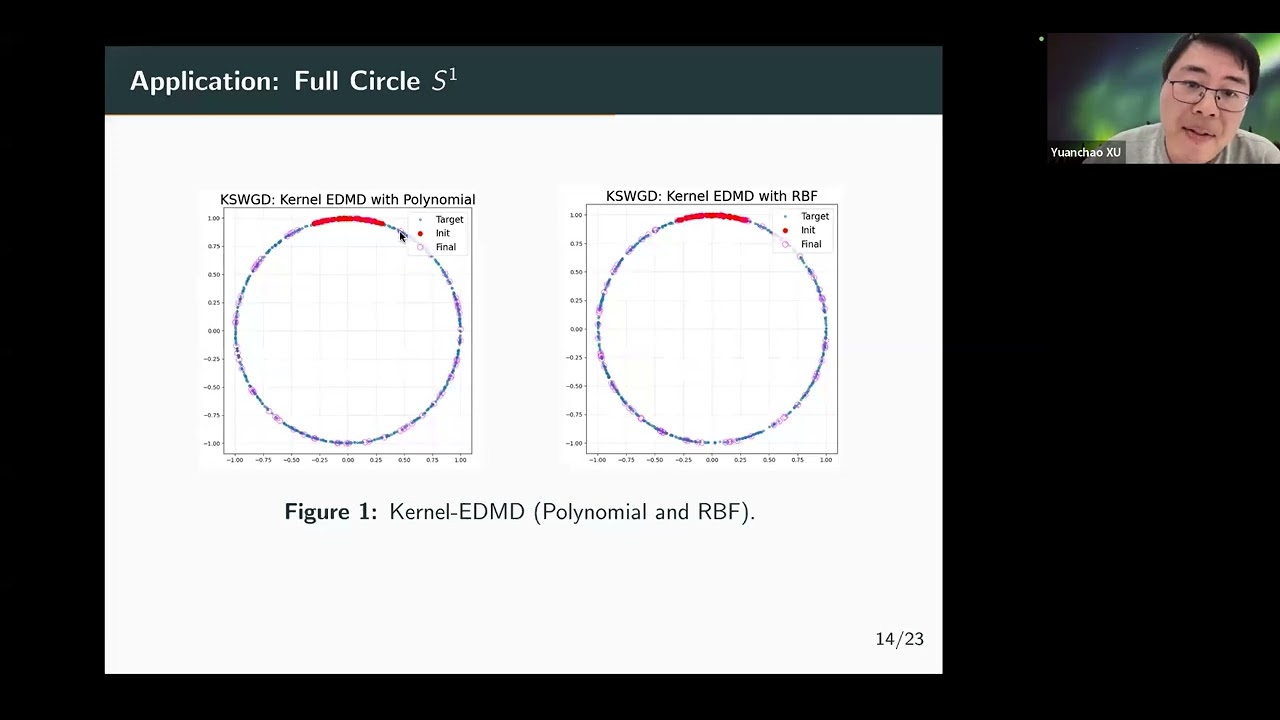
- Experimental results on various examples
- Conclusion and Q&A
Cited Sources
- Koopman Spectral Wasserstein Gradient Descent (KSWGD) — The method proposed in the talk, not yet published as a paper.
Concurring Sources
- Koopman operator theory — Provides background on the operator-theoretic framework used in the talk.
- Wasserstein gradient flows — Related to the optimization method used in KSWGD.
Contribution & Novelties
The talk introduces a novel method (KSWGD) that integrates Koopman operator theory with Wasserstein gradient descent for generative modeling. This approach eliminates the need for explicit target potential or neural network training, offering a data-driven alternative. The theoretical analysis provides convergence guarantees and connects to Feynman-Kac theory. The method demonstrates faster convergence and high sample quality across diverse experiments.
Pour aller plus loin :
- Koopman operator — Foundational concept for the method.
- Wasserstein gradient flow — Related to the optimization framework.
- Stein variational gradient descent — Baseline method discussed in the talk.
92 words
Radar Profile
The radar profile shows high scores in technical level and information quality, with slightly lower scores in information quantity and reliability. This indicates a technically dense presentation with strong theoretical and empirical support, but with limited breadth of sources and potential gaps in addressing limitations.
💬 No comments were provided for analysis.