Mercer's Theorem. An Operator Theorist's Perspective.
Keywords
Summary
195 words
Critical Evaluation
Value of the Information & Strength of the Argument
The talk provides a rigorous and self-contained proof of Mercer’s theorem, building on previous material. The argumentation is clear and logically structured, with each step motivated and justified. The speaker carefully handles technical details, such as the support of the measure and the density of the RKHS in the range of the operator. The use of Dini’s theorem to obtain uniform convergence is elegant and well-explained. The value of the presentation lies in its operator-theoretic perspective, which unifies various aspects of the theory and provides a solid foundation for applications in machine learning.
Scientific Rigor, Source Quality, Title Accuracy
The talk is mathematically rigorous, with careful definitions and proofs. The speaker references previous work and a preprint on arXiv, but no specific sources are cited in the description. The title accurately reflects the content, focusing on Mercer’s theorem from an operator theory viewpoint. The presentation is self-contained, though it assumes familiarity with functional analysis and RKHS theory. The technical assumptions are clearly stated, and the proofs are detailed. The talk does not include any external references beyond the mentioned preprint, but the mathematical content is consistent with standard literature.
198 words
Title / Content Match
The title accurately reflects the content: the talk presents Mercer's theorem from an operator theorist's viewpoint, focusing on integral operators and reproducing kernel Hilbert spaces.
Quality & Reliability
8/10
The talk is a rigorous mathematical presentation of Mercer's theorem from an operator theory perspective, building on previous work and providing detailed proofs. The speaker is an expert in the field, and the content is consistent with standard mathematical literature. However, the presentation is a seminar talk and not peer-reviewed, and the specific technical assumptions are not fully detailed in the abstract.
Key Moments
Markers derived by PSI from the transcript: the creator did not define chapters.
- Introduction and setup: compact metric space X, finite Borel measure μ, and the space of continuous functions.
- Discussion of the factorization of L2 and the embedding of continuous functions.
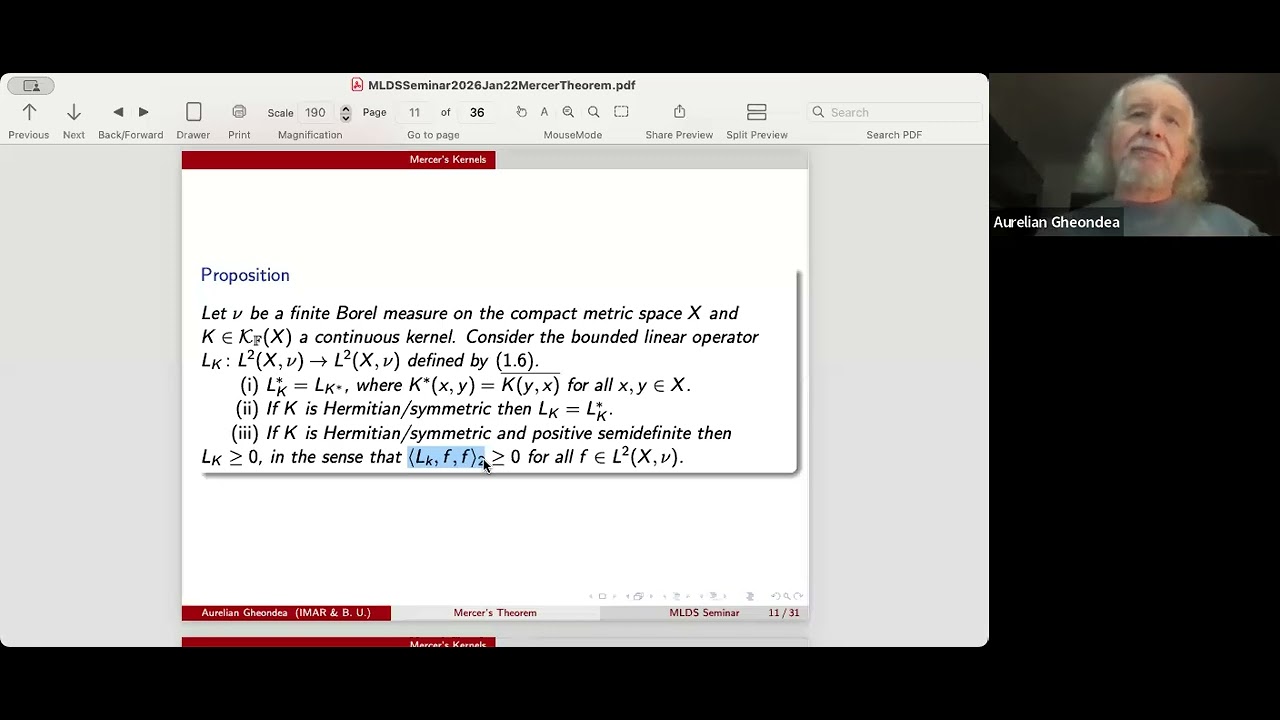
- Definition of the integral operator L_K and its properties: boundedness, compactness, Hilbert-Schmidt.
- Introduction of Mercer kernels and the associated reproducing kernel Hilbert space H_K.
- Proof that H_K is separable and that convergence in H_K implies uniform convergence.
- Construction of the kernel K^2 and its role in representing H_K as the range of L_K.
- Factorization of L_K as J_K J_K^* and identification of H_K with the range of the square root of L_K.
- Application of Dini's theorem to prove uniform convergence of the kernel expansion.
- Statement and proof of Mercer's theorem in the general setting.
- Conclusion and remarks on the significance of the result.
Cited Sources
- Preprint on arXiv (mentioned in talk) — The speaker refers to a preprint on arXiv containing careful proofs of the presented results.
Concurring Sources
- Mercer's theorem - Wikipedia — Standard reference for Mercer's theorem and its applications.
- Reproducing kernel Hilbert space - Wikipedia — Provides background on RKHS theory.
Contribution & Novelties
The talk provides a modern, operator-theoretic proof of Mercer’s theorem, emphasizing the role of reproducing kernel Hilbert spaces and integral operators. It offers a clear factorization of the integral operator and uses Dini’s theorem to establish uniform convergence. The presentation is self-contained and rigorous, making it a valuable resource for understanding the theoretical foundations of kernel methods.
Pour aller plus loin :
- Mercer’s theorem - Wikipedia — Overview and historical context.
- Reproducing kernel Hilbert space - Wikipedia — Background on RKHS.
- Dini’s theorem - Wikipedia — The theorem used for uniform convergence.
- Spectral theorem - Wikipedia — General spectral theory for compact operators.
103 words
Radar Profile
The radar profile shows high scores in quality of information, technical level, and global reliability, with a slightly lower score in quantity of information due to the focused scope of the talk. This indicates a highly technical and reliable presentation, though it may not cover a broad range of topics.