Prob-GParareal: A Probabilistic Numerical Parallel-in-Time Solver for Differential Equations
Keywords
Summary
126 words
Critical Evaluation
Value of the Information & Strength of the Argument
The talk provides a clear motivation for parallel-in-time methods, highlighting the computational cost of sequential solvers. The proposed method extends GParareal by incorporating uncertainty quantification through Gaussian processes. The argumentation is solid: the speaker explains the limitations of previous approaches (e.g., ignoring posterior covariance) and justifies the particle-based propagation. The theoretical analysis includes error bounds and complexity, and the numerical experiments cover diverse ODE systems, demonstrating the method’s versatility. The presentation is well-structured, with intuitive explanations and visual aids. The speaker also discusses potential improvements and ongoing work, showing scientific rigor.
Scientific Rigor, Source Quality, Title Accuracy
The talk is based on original research, presumably forthcoming or under review. The speaker mentions joint work with collaborators and a previous paper on random weight neural networks. No specific external sources are cited in the talk, but the description provides the abstract. The title accurately reflects the content. The methodology is sound, with theoretical and empirical components. However, the lack of peer-reviewed publication details and the informal seminar format slightly reduce the perceived rigor. The speaker acknowledges limitations, such as the computational cost of Gaussian processes and the need for further work on uncertainty quantification in the neural network variant.
207 words
Title / Content Match
The title accurately reflects the content, which introduces and analyzes Prob-GParareal, a probabilistic parallel-in-time solver.
Quality & Reliability
8/10
The talk presents original research with theoretical analysis and numerical experiments on benchmark systems. The methodology is clearly explained, and the speaker acknowledges limitations and ongoing work. However, the presentation is a seminar talk without peer-reviewed publication details, and the results are not independently verified.
Key Moments
Markers derived by PSI from the transcript: the creator did not define chapters.
- Introduction to parallel-in-time solvers and motivation
- Explanation of the Parareal algorithm
- Introduction of GParareal and Gaussian process modeling
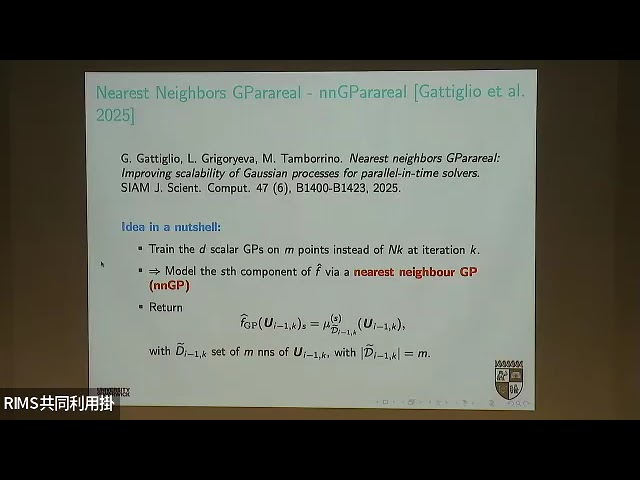
- Nearest-neighbor GPs for scalability
- Particle-based uncertainty propagation
- Theoretical error bounds and complexity analysis
- Numerical experiments on benchmark ODEs
- Behavior of uncertainty for chaotic systems
- Early stopping criterion based on particle variance
- Summary and conclusions
Cited Sources
- Prob-GParareal: A Probabilistic Numerical Parallel-in-Time Solver for Differential Equations — The talk itself, which presents the method and results.
Concurring Sources
- Probabilistic Numerics and Uncertainty in Computations — General framework for probabilistic numerical methods, supporting the approach.
- GParareal: A time-parallel ODE solver using Gaussian process emulation — The original GParareal method, which is extended in this work.
Dissenting Sources
- A critique of probabilistic numerics — Raises questions about the interpretation and utility of probabilistic numerical methods, which could be seen as a counterpoint to the approach.
Contribution & Novelties
The main contribution is the extension of GParareal to provide uncertainty quantification, which is novel in the context of parallel-in-time methods. The particle-based propagation allows for probabilistic forecasts and a natural early stopping criterion. The method is compatible with existing solvers and handles probabilistic initial conditions. The theoretical bounds and numerical experiments on diverse systems demonstrate its robustness.
Pour aller plus loin :
- Probabilistic Numerics — Foundational concepts for uncertainty in numerical methods.
- Gaussian Process — Core modeling tool used in the method.
- Parareal — The parallel-in-time algorithm that is extended.
- Nearest Neighbor Gaussian Processes — Scalable GP approximation used in the variant.
103 words
Radar Profile
The radar profile shows high scores across all dimensions, indicating a well-rounded presentation with substantial information, technical depth, and reliability. The method is novel and well-supported, though the lack of peer-reviewed publication slightly lowers the reliability score.
💬 No comments were provided for analysis.